Review
. 2023 Aug 14;378(1883):20220299.
doi: 10.1098/rstb.2022.0299. Epub 2023 Jun 26.

Gender disparities in material and educational resources differ by kinship system

Affiliations
Review

Gender disparities in material and educational resources differ by kinship system

Siobhán M Mattison et al. Philos Trans R Soc Lond B Biol Sci. .

Abstract

Contemporary inequality exists at an unprecedented scale. Social scientists have emphasized the role played by material wealth in driving its escalation. Evolutionary anthropologists understand the drive to accumulate material wealth as one that is coupled ultimately to increasing reproductive success. Owing to biological caps on reproduction for women, the efficiency of this conversion can differ by gender, with implications for understanding the evolution of gender disparities in resource accumulation. Efficiency also differs according to the type of resources used to support reproductive success. In this paper, we review evolutionary explanations of gender disparities in resources and investigate empirical evidence to support or refute those explanations among matrilineal and patrilineal subpopulations of ethnic Chinese Mosuo, who share an ethnolinguistic identity, but differ strikingly in terms of institutions and norms surrounding kinship and gender. We find that gender differentially predicts income and educational attainment. Men were more likely to report income than women; amounts earned were higher for men overall, but the difference between men and women was minimal under matriliny. Men reported higher levels of educational attainment than women, unexpectedly more so in matrilineal contexts. The results reveal nuances in how biology and cultural institutions affect gender disparities in wealth. This article is part of the theme issue 'Evolutionary ecology of inequality'.

Keywords: China; Mosuo; evolution; gender inequality; matriliny; patriliny.


Conflict of interest statement

We declare we have no competing interests.

Figures
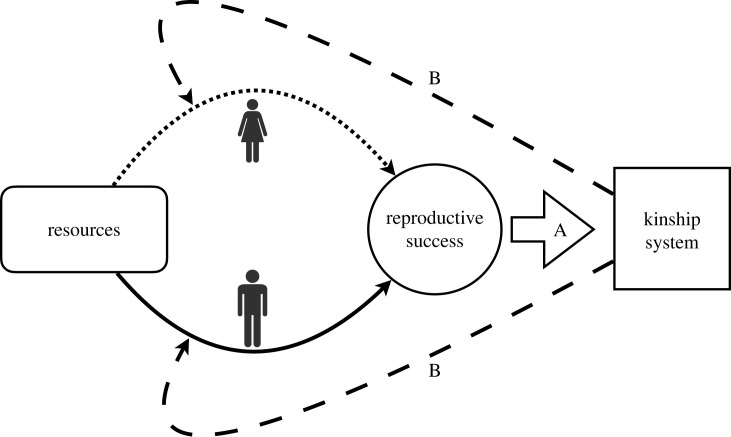
Figure 1.
Figure 1.
Conceptual model. Resources are used to support reproductive success. The ways that men and women do this can be highly divergent or more similar, according to the type of resource and surrounding socio-ecological constraints on reproduction. The relationship between resources and reproductive success (as well as other variables, such as paternity certainty) are thought to underlie differences in kinship systems (path A). Resultant norms and institutions can, in turn, influence the relationships between resources and reproductive success and feed potential divergence between men and women (path B).
Figure 2.
Figure 2.
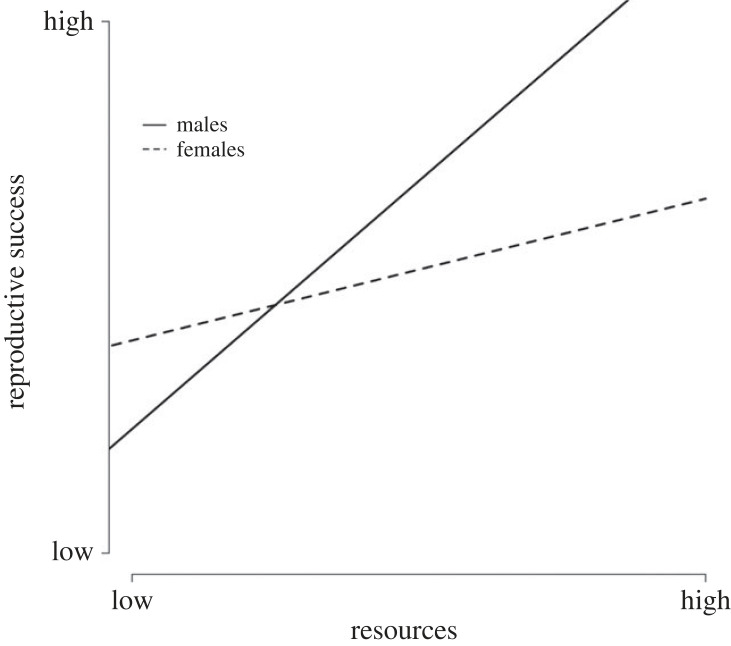
The relationship between resources and reproductive success often differs for men and women, with the rate of conversion being higher for men. It is a truism that, on average, men and women achieve the same reproductive success (every child has one mother and one father), but variation around that leads to individual differences that support different gender-biases in parental investment and social structure [23]. The left of the figure exemplifies conditions under which women may be expected to achieve higher reproductive success than men with available resources, which is thought to explain female-biased inheritance as daughters are a more secure investment under such circumstances.
Figure 3.
Figure 3.
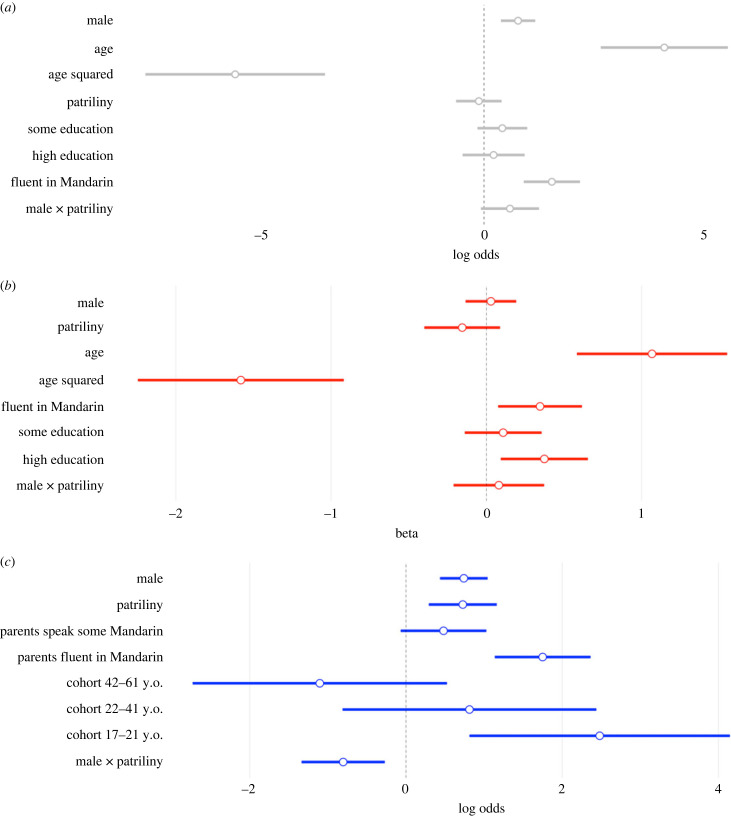
Model effects plot for the log odds of reporting an income (a), parameter estimates of income (amount) (b) and the log odds of educational attainment (c). The error bars represent robust 95% confidence intervals (y.o., year old). (Online version in colour.)
Figure 4.
Figure 4.
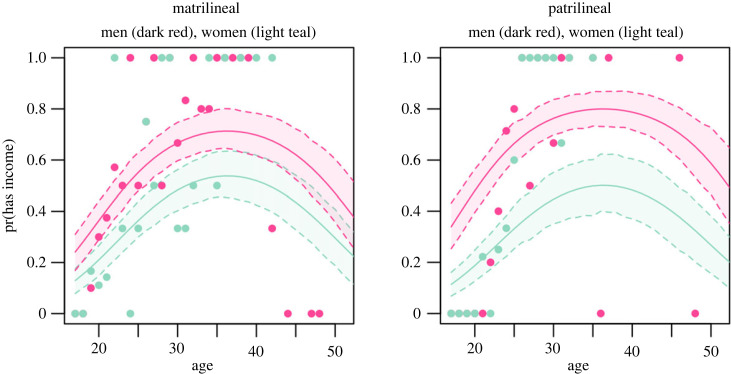
Empirical frequencies of non-zero income for specific ages, stratified by sex and education level with corresponding model predictions of means (lines) and 89% highest posterior density interval (coloured regions) from the hurdle component (i.e. probability of reporting any income) among Mosuo overall. (Online version in colour.)
Figure 5.
Figure 5.
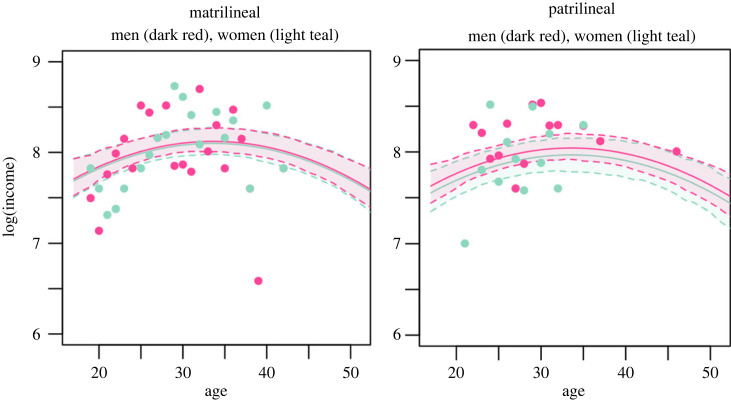
Observed mean log-income for specific ages, stratified by sex and kinship systems with corresponding model predictions of means (lines) and 89% highest posterior density interval (coloured regions) from the log-linear model component among Mosuo overall. Model estimates apply for individuals with high levels of education and fluency in Mandarin. (Online version in colour.)

References

    1. Flannery K. 2012. The creation of inequality: how our prehistoric ancestors set the stage for monarchy, slavery, and empire. Cambridge, MA: Harvard University Press.
    1. Cashdan EA. 1980. Egalitarianism among hunters and gatherers. Am. Anthropol. 82, 116-120. ( 10.1525/aa.1980.82.1.02a00100) - DOI
    1. Mattison SM, Smith EA, Shenk MK, Cochrane EE. 2016. The evolution of inequality. Evol. Anthropol. 25, 184-199. ( 10.1002/evan.21491) - DOI - PubMed
    1. Shultziner D, Stevens T, Stevens M, Stewart BA, Hannagan RJ, Saltini-Semerari G. 2010. The causes and scope of political egalitarianism during the Last Glacial: a multi-disciplinary perspective. Biol. Philos. 25, 319-346.
    1. Rogers DS, Deshpande O, Feldman MW. 2011. The spread of inequality. PLoS ONE 6, e24683. - PMC - PubMed

Publication types

LinkOut - more resources