. 2023 Sep;40(9):3639-3680.
doi: 10.1007/s12325-023-02549-3. Epub 2023 Jun 29.

Burden and Treatment of Achondroplasia: A Systematic Literature Review

Affiliations

Burden and Treatment of Achondroplasia: A Systematic Literature Review

Molly C Murton et al. Adv Ther. 2023 Sep.

Abstract

Background: Achondroplasia is the most common form of skeletal dysplasia. Recent advances in therapeutic options have highlighted the need for understanding the burden and treatment landscape of the condition. This systematic literature review (SLR) aimed to identify health-related quality of life (HRQoL)/utilities, healthcare resource use (HCRU), costs, efficacy, safety and economic evaluation data in achondroplasia and to identify gaps in the research.

Methods: Searches of MEDLINE, Embase, the University of York Centre for Reviews and Dissemination (CRD), the Cochrane Library and grey literature were performed. Articles were screened against pre-specified eligibility criteria by two individuals and study quality was assessed using published checklists. Additional targeted searches were conducted to identify management guidelines.

Results: Fifty-nine unique studies were included. Results demonstrated a substantial HRQoL and HCRU/cost-related burden of achondroplasia on affected individuals and their families throughout their lifetimes, particularly in emotional wellbeing and hospitalisation costs and resource use. Vosoritide, growth hormone (GH) and limb lengthening all conferred benefits for height or growth velocity; however, the long-term effects of GH therapy were unclear, data for vosoritide were from a limited number of studies, and limb lengthening was associated with complications. Included management guidelines varied widely in their scope, with the first global effort to standardise achondroplasia management represented by the International Achondroplasia Consensus Statement published at the end of 2021. Current evidence gaps include a lack of utility and cost-effectiveness data for achondroplasia and its treatments.

Conclusions: This SLR provides a comprehensive overview of the current burden and treatment landscape for achondroplasia, along with areas where evidence is lacking. This review should be updated as new evidence becomes available on emerging therapies.

Keywords: Achondroplasia; Disease overview; Dwarfism; Growth hormone; Limb lengthening; Short stature; Vosoritide.


Conflict of interest statement

Melita Irving has received honoraria for consultancy services from BioMarin, QED Therapeutics, Sanofi, Ascendis, Alexion, Kyowa Kirin, Innoskel, Novo Nordisk; Thomas Butt and Renée Shediac are employees and shareholders of BioMarin; Molly Murton, Emma Drane and Danielle Goff-Leggett are employees of Costello Medical. Jamie O’Hara has no conflicts of interest to declare.

Figures
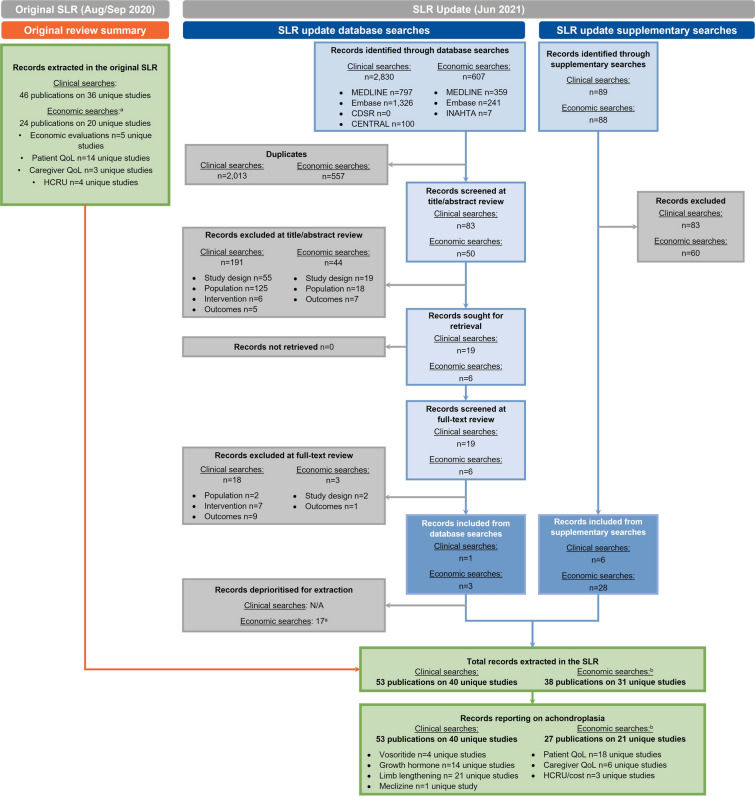
Fig. 1
Fig. 1
PRISMA flow diagram of studies included in the SLR. PRISMA diagram reporting flow of studies included in the SLR. In total, 59 unique studies were included across both streams (two studies were included in both the clinical and economic searches [36, 38]). aSome records identified in the economic searches were included in multiple evidence streams (i.e., both patient QoL and costs). bStudies reporting outcomes for forms of short stature other than achondroplasia are not included in this article. CDSR Cochrane Database of Systematic Reviews, CENTRAL Cochrane Central Register of Controlled Trials, HCRU healthcare resource use, INAHTA International Network of Agencies for Health Technology Assessment, PRISMA Preferred Reporting Items for Systematic Reviews and Meta-Analyses, QoL quality of life, SLR systematic literature review
Fig. 2
Fig. 2
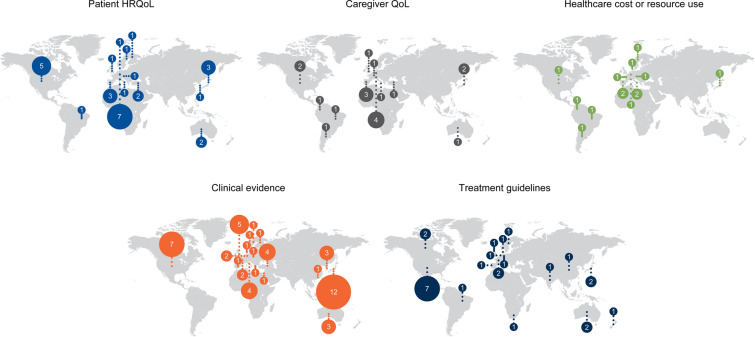
Geographical spread of studies included in the review. Geographic spread of studies reporting different outcomes in the literature review. Bubble size scaled to represent number of studies. International studies are recorded in multiple countries, aligned with their participating centres. Patient HRQoL: Germany, n = 7; US, n = 5; Japan and Spain, n = 3; Australia and Turkey, n = 2; Austria, Brazil, Denmark, Finland, Italy, South Korea, Sweden and UK, n = 1. Caregiver QoL: Germany, n = 4; Spain, n = 3; Japan and US, n = 2; Argentina, Australia, Brazil, Colombia, France, Italy, Turkey and UK, n = 1. Healthcare cost and resource use: Italy and Spain, n = 2; Argentina, Austria, Brazil, Colombia, Denmark, France, Germany, Japan, Sweden and US, n = 1. Clinical evidence: Japan, n = 12; US, n = 7; UK, n = 5; Italy and Turkey, n = 4; Australia and South Korea, n = 3; France and Germany, n = 2; Denmark, Finland, Greece, Hong Kong, Israel, Norway, Poland, Spain and Sweden, n = 1. Treatment guidelines: US, n = 7; Australia, Canada, France and Japan, n = 2; Brazil, China, Denmark, Germany, India, New Zealand, Portugal, South Africa, Sweden, The Netherlands and UK, n = 1
Fig. 3
Fig. 3
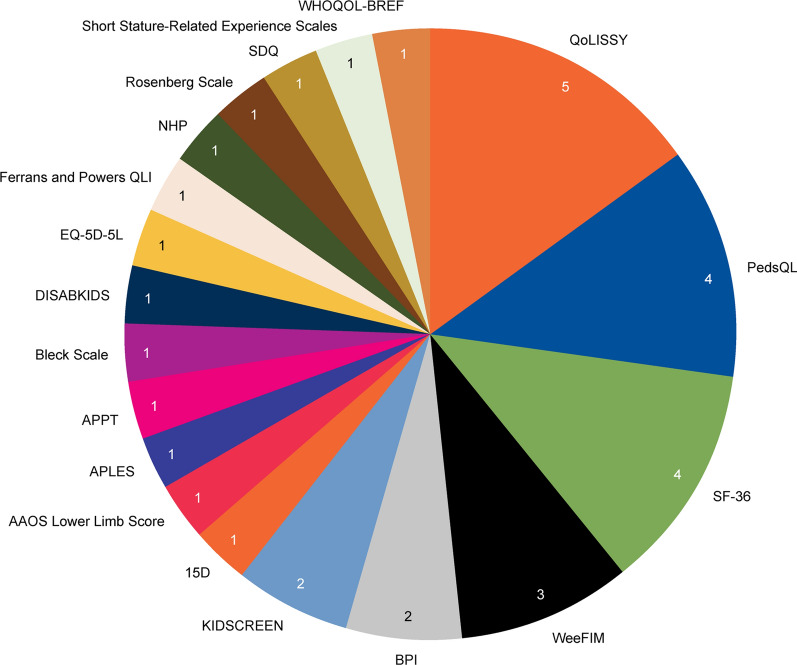
HRQoL scales used in the included studies. HRQoL scales used to measure HRQoL in achondroplasia. Nineteen different instruments were used to elicit HRQoL data. The most commonly used scale was the QoLISSY questionnaire (n = 5 studies), followed by PedsQL and the SF-36 (n = 4 studies), WeeFIM (n = 3 studies), BPI and KIDSCREEN (n = 2 studies). Other scales were used in one study each, including two studies that assessed utilities (via EQ-5D and 15D scales). The figure does not tally with the number of included studies (N = 18) because of some studies using multiple QoL scales. 15D 15-dimensional measure of health-related quality of life, AAOS American Academy of Orthopaedic Surgeons, APLES Achondroplasia Personal Life Experience Scale, APPT Adolescent Pediatric Pain Tool, BPI Brief Pain Inventory, EQ-5D-5L EuroQol 5-Dimension 5-Level, NHP Nottingham Health Profile, PedsQL Pediatric Quality of Life Inventory, QLI Quality of Life Index, QoLISSY Quality of Life in Short Stature Youth, SDQ Strengths and Difficulties Questionnaire, SF-36 Short Form 36, WeeFIM Functional Independence Measure for Children, WHOQOL-BREF World Health Organization Quality of Life: Brief Version
Fig. 4
Fig. 4
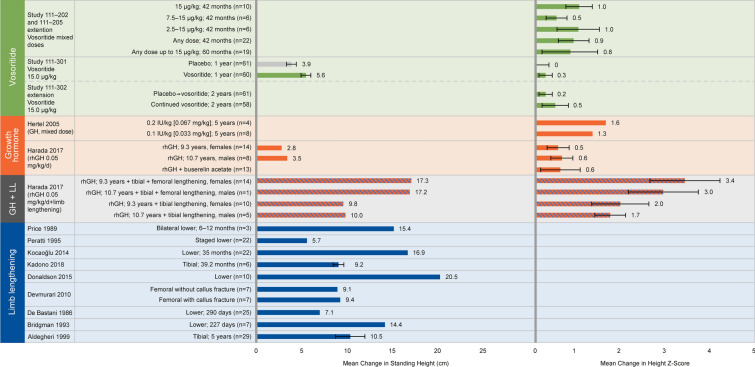
Mean change in height reported across studies. Legend: Mean change in A standing height, B height Z-score from baseline following intervention. A favourable effect on change in height was reported for all ifentified inteventions. However, outcomes were reported over different time periods for the therapies. For vosoritide, outcomes were measured at 2–5 years; for GH, outcomes were measured at 5–10.7 years; for limb lengthening, outcomes were measured from 6 months to 5 years. Included studies: Study 111-202 [58] and extension Study 111-205 [59]; Study 111-301 [36] and extension Study 111-302 [60]; Hertel [65]; Harada [68]; Price [73]; Peretti [69]; Kocaoğlu [76]; Kadono [77]; Donaldson [70]; Devmurari [75]; De Bastini [71]; Bridgman [80]; Aldegheri [74]. GH growth hormone, LL limb lengthening, rhGH recombinant human growth hormone
Fig. 5
Fig. 5
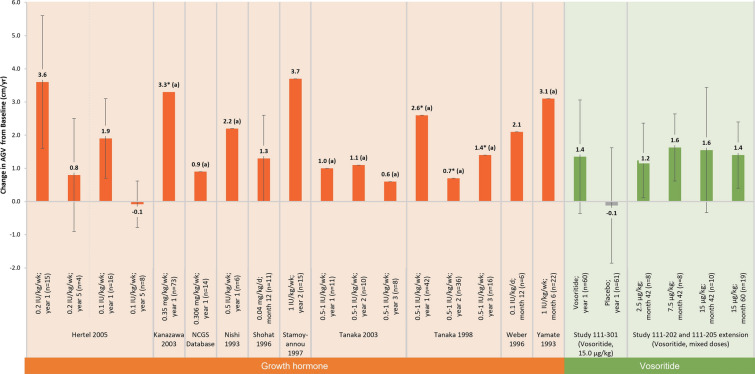
Mean change in AGV reported across studies. Mean change in AGV from baseline following intervention for GH and vosoritide studies, reported at different follow-up time points. Two GH studies reported a significant increase in AGV. A further two GH studies, Seino 2000 [61] and Ramaswami 1999 [63], did not explicitly report change in AGV from baseline, only that it was significantly higher following one year of GH therapy and therefore are not included in the figure. In three GH studies that measured AGV at different time points, a trend towards tachyphylaxis was observed. In vosoritide studies, a positive increase in AGV was observed, though statistical significance was not reported. Included studies: Hertel [65]; Kanazawa [62]; NCGS Database [67]; Nishi [126]; Shohat [90]; Stamoyannou [66]; Tanaka [64]; Tanaka [88]; Weber [91]; Yamate [89]; Study 111-301 [36]; Study 111-202 [58] and extension Study 111-205 [59]. *Statistically significant change from baseline; achange in AGV derived from calculation based on information reported in the study. AGV annualised growth velocity, GH growth hormone, rhGH recombinant human growth hormone
Fig. 6
Fig. 6
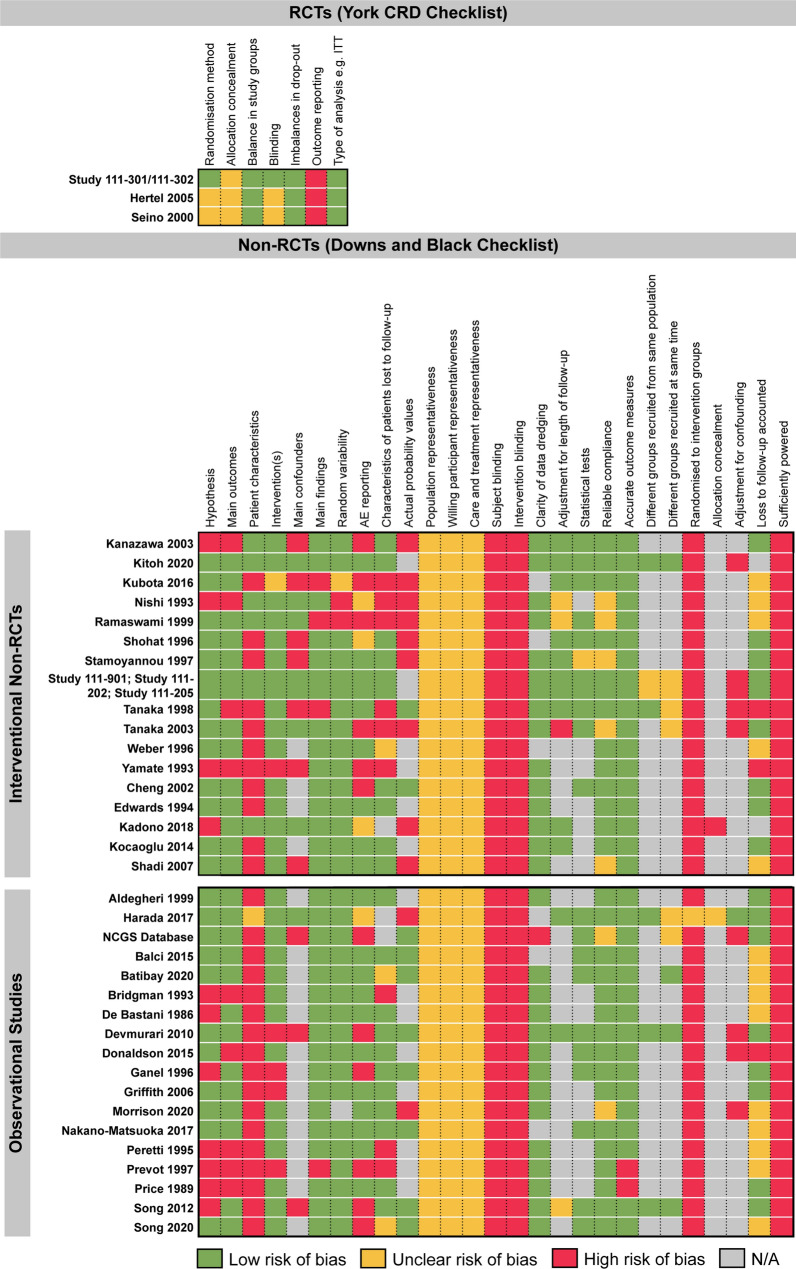
Summary of quality assessments. Summary of quality assessment scoring for different study designs reporting clinical evidence. RCTs were assessed using the York CRD tool [32]; non-randomised interventional studies and observational studies were assessed using the Downs and Black checklist [33]. Separate quality assessments were not performed for the extension studies of Study 111-301 and 111–202. All three RCTs used ITT analysis and reported similar baseline characteristics between arms; however, none provided details on allocation concealment. Of the 17 interventional non-RCTs, the majority clearly described the measured outcomes, stated the objectives and provided estimates of the random variability in outcome data. However, the representativeness of patients to the entire population of children with achondroplasia from which they were recruited was unclear. Of the 18 observational studies, 11 stated the objectives clearly, 13 described the main outcomes to be measured, and 14 clearly described the intervention of interest. However, the characteristics of patients were not described clearly by any study. AE adverse event, CRD Centre fpr Reviews and Dissemination, ITT intention to treat, NA not applicable, RCT randomised controlled trial
Fig. 7
Fig. 7
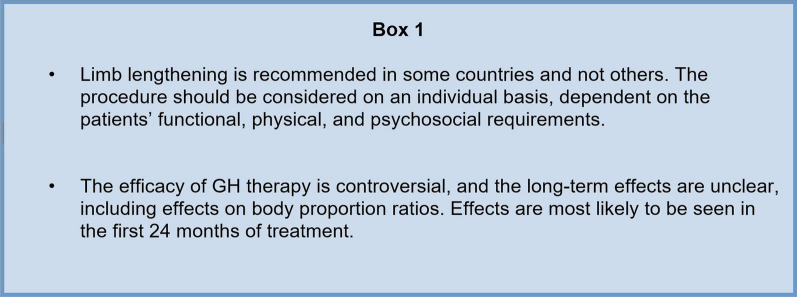
Key consensus statement from International Management Guidelines on Achondroplasia. GH growth hormone

References

    1. Wright MJ, Irving MD. Clinical management of achondroplasia. Arch Dis Child. 2012;97(2):129. doi: 10.1136/adc.2010.189092. - DOI - PubMed
    1. Horton WA, Hall JG, Hecht JT. Achondroplasia. The Lancet. 2007;370(9582):162–172. doi: 10.1016/S0140-6736(07)61090-3. - DOI - PubMed
    1. Foreman PK, van Kessel F, van Hoorn R, van den Bosch J, Shediac R, Landis S. Birth prevalence of achondroplasia: A systematic literature review and meta-analysis. Am J Med Genet A. 2020;182(10):2297–2316. doi: 10.1002/ajmg.a.61787. - DOI - PMC - PubMed
    1. Baujat G, Legeai-Mallet L, Finidori G, Cormier-Daire V, Le Merrer M. Achondroplasia. Best Pract Res Clin Rheumatol. 2008;22(1):3–18. doi: 10.1016/j.berh.2007.12.008. - DOI - PubMed
    1. Ireland PJ, Pacey V, Zankl A, Edwards P, Johnston LM, Savarirayan R. Optimal management of complications associated with achondroplasia. Appl Clin Genet. 2014;7:117–125. doi: 10.2147/TACG.S51485. - DOI - PMC - PubMed

Publication types

Substances

LinkOut - more resources