. 2023 Jun 13;8(3):396-415.
doi: 10.1016/j.synbio.2023.06.001. eCollection 2023 Sep.

Methanol-based biomanufacturing of fuels and chemicals using native and synthetic methylotrophs

Affiliations

Methanol-based biomanufacturing of fuels and chemicals using native and synthetic methylotrophs

Arslan Sarwar et al. Synth Syst Biotechnol. .

Abstract

Methanol has recently gained significant attention as a potential carbon substrate for the production of fuels and chemicals, owing to its high degree of reduction, abundance, and low price. Native methylotrophic yeasts and bacteria have been investigated for the production of fuels and chemicals. Alternatively, synthetic methylotrophic strains are also being developed by reconstructing methanol utilization pathways in model microorganisms, such as Escherichia coli. Owing to the complex metabolic pathways, limited availability of genetic tools, and methanol/formaldehyde toxicity, the high-level production of target products for industrial applications are still under development to satisfy commercial feasibility. This article reviews the production of biofuels and chemicals by native and synthetic methylotrophic microorganisms. It also highlights the advantages and limitations of both types of methylotrophs and provides an overview of ways to improve their efficiency for the production of fuels and chemicals from methanol.

Keywords: Bacillus methanolicus; Escherichia coli; Methylobacterium extorquens; Native methylotrophs; Pichia pastoris; Synthetic methylotrophs.


Conflict of interest statement

The authors declare that they have no known competing financial interests or personal relationships that could have appeared to influence the work reported in this paper.

Figures
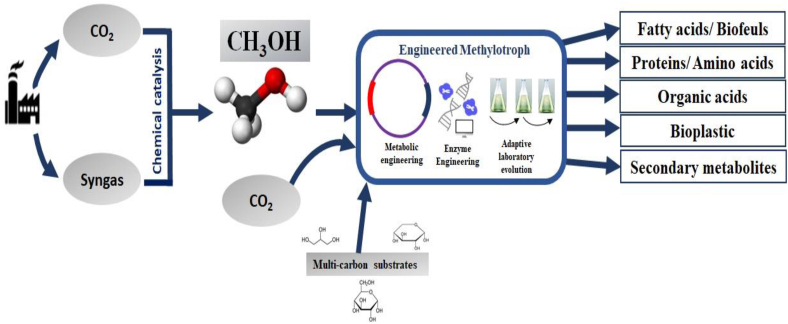
Fig. 1
Fig. 1
Overview of integrated bio-refinery for the production of fuels and chemicals from methanol. CO2 or syngas produced from fossil fuels can be converted to methanol by chemical conversion which can be subsequently utilized by engineered methylotrophs for the production of desired chemicals. In addition, the methylotrophs can be converted to auto-methylotroph or hetero-methylotroph by metabolic engineering strategies to enhance the biomass or productivity of the microorganism.
Fig. 2
Fig. 2
Production of fuels and chemicals from methylotrophic yeasts. The native key enzymes of methanol assimilation in methylotrophic yeasts are shown in purple. The overexpressed endogenous and heterologously expressed key enzymes for the target product are shown in red and blue, respectively. The solid arrow shows a single reaction while the dashed arrow shows multiple reactions. Enzyme abbreviations:AOX, alcohol oxidase; FDH, Formate dehydrogenase; DAS, Dihydroxyacetone synthase; DAK, dihydroxyacetone kinase; FBA, Fructose-1,6-bisphosphate aldolase; FBPase, Fructose 1,6-bisphosphatase; CrtB, phytoene synthase; CrtI, phytoene desaturase; ValS, valencene synthase; ADH, alcohol dehydrogenase; ERG9, squalene synthase; ERG1, squalene epoxidase; PgDDS, dammarenediol synthase gene; FAS, Fatty acid synthase; TesB, thioesteras; ScADH5, alcohol dehydrogenase; CpFAH, Fatty acid hydroxylase; DGAT, acyl-CoA: diacylglycerol acyltransferase; npgA, phosphopantetheinyl transferase; 6-MSAS, 6-methylsalicylic acid synthase, citABCDE, gene cluster for citrinin synthesis; undB, desaturase-like decarboxylase; D-LDH, d-lactate dehydrogenase; ASPDH, Aspartate dehydrogenase; ADC, l-Aspartate-α-decarboxylases. Metabolite abbreviations: CO2, Carbon dioxide; DHA, Dihydroxyacetone; GAP, glyceraldehyde 3-phosphate; DHAP, Dihydroxyacetone phosphate, F1,6BP, Fructose 1,6 bisphosphate; Xu5P, Xylulose 5-phosphate; GAP, Glyceraldehyde 3-phosphate.
Fig. 3
Fig. 3
Production of fuels and chemicals from native methylotrophic bacteria. Methylotrophic bacteria can either use the RuMP pathway or the serine cycle for methanol assimilation. Methylotrophic bacteria utilizing the serine cycle contain the EMC pathway and TCA cycle for biomass generation while methylotrophic bacteria utilizing the RuMP pathway mainly use the TCA cycle for biomass generation. The RuMP pathway is shown in blue while the serine cycle is shown in purple. The native key enzymes of methanol assimilation in methylotrophic bacteria are shown in purple. The overexpressed endogenous and heterologously expressed key enzymes for the target product are shown in red and blue, respectively. The solid arrow shows a single reaction while the dashed arrow shows multiple reactions. Enzyme abbreviations:PQQ-MDH, PQQ-dependent methanol dehydrogenase; NAD-MDH, NAD-dependent methanol dehydrogenase; HPS, 3-hexulose-6-phosphate synthase; PHI, 6-phospho-3-hexuloisomerase; PFK, 6-phosphofructokinase; FBA, fructose-bisphosphate aldolase; FDH, Formate dehydrogenase; RPE, Ribulose-5-phosphate 3-epimerase; RPI, Ribose-5-phosphate isomerase; SHMT, Serine hydroxymethyltransferase; Mtd, Methylene-tetrahydromethanopterin; lysA, mesodiaminopimelate decarboxylase; cadA, lysine decarboxylase; patA, putrescine aminase; patD, 5-aminopentanal dehydrogenase; DavB, lysine 2-monooxygenase; DavA, 5-aminovaleramidase; HDI, homoserine dehydrogenase; HDII, homoserine dehydrogenase; thrC, threonine synthase; cad, cis-aconitic acid decarboxylase; gabA, glutamate decarboxylase; phaCAC, PHA synthase from A. caviae; phaC, PHA synthase; alsSD, acetolactate synthase; budAB, acetolactate decarboxylase; mcr, malonyl-CoA reductase; Ter, trans-2-enoyl-CoA reductase; Adh2, bifunctional aldehyde/alcohol dehydrogenase; RCM, (R)-3-hydroxybutyryl coenzyme A (CoA)-specific coenzyme B12-dependent mutases; ccr, crotonyl-CoA carboxylase; zssl, α-humulene synthase; vioABCD, gene cluster for violacein synthesis. Metabolite abbreviations: Ru5P, Ribulose 5-Phosphate; CH2formula imageH4F, N5,N10-methylenetetrahydromethanopterin; H4MPT, Tetrahydromethanopterin; H4F, tetrahydrofolate; PEP, Phosphoenolpyruvate; H6P, Hexulose-6-phosphate; F6P, Fructose-6-phosphate; FBP, Fructose 1,6-bisphophate; DHAP, Dihydroxyacetone phosphate; GAP, Glyceraldehyde 3-phosphate; Xu5P, Xylulose 5-phosphate; E4P, Erythrose 4-phosphate; S7P, sedoheptulose-7-phosphate; R5P, ribose-5-phosphate; Ru5P, Ribulose-5-phosphate; CO2, Carbon dioxide; 3-HP, 3- Hydroxy propionic acid; PHB, Poly (3-Hydroxybutyrate); 2-HIBA, 2-Hydroxyisobutyric acid; FPP, Farnesyl diphosphate; P (3HB-co-3HV-co-3HHX), Poly (3-hydroxybutyrate-co-3-hydroxyvalerate-co-3-hydroxyhexanoate); GABA, γ-aminobutyric acid.
Fig. 4
Fig. 4
Strategies to enhance the methanol assimilation or biomass in native methylotrophic microorganisms. (A) Construction of RuMP pathway in serine cycle utilizing bacteria. The enzymes shown in red were heterologously expressed or overexpressed to make the functional RuMP pathway in M. extorquens AM1. The Solid arrow shows a single reaction while the dashed arrow shows multiple reactions. (B) Strategies for Co-utilization of sugar substrates such as glucose (gold color), glycerol (green color), or xylose (blue color) to convert RuMP utilizing methylotroph to hetero-methylotroph. The solid arrow shows a single reaction while the dashed arrow shows multiple reactions. (C) Strategy to convert methylotroph into autotroph by constructing CBB cycle in native methylotrophs. The methanol conversion to biomass can be blocked at formaldehyde or formate level in RuMP/XuMP or serine cycle utilizing microbe, respectively. In this way, methanol will be used to generate the energy while CO2 produced by the dissimilation pathway will be used to produce biomass. (D) Strategy to convert methylotroph into auto-methylotroph by constructing CBB cycle in native methylotrophs either using RuMP, XuMP, or serine cycle. The CO2 produced by the dissimilation pathway can be converted to biomass. The methanol will be converted to biomass and also will be used to generate energy. (E) Enzyme engineering of MDH to increase the formaldehyde formation from methanol. (F) Adaptive laboratory evolution of native methylotrophic microorganisms to increase methanol/formaldehyde tolerance and enhanced methanol assimilation. Enzymes abbreviations:Mdh, Methanol dehydrogenase; Hps, 3-hexulose-6-phosphate synthase; Phi, 6-phospho-3-hexuloisomerase; Pfk, 6-phosphofructokinase; G6dph, Glucose-6-phosphate dehydrogenase; GlpF, glycerol transporter; GlpK, glycerol kinase; GlpD, glycerol 3-phosphate dehydrogenase; GspA, glycerol 3-phosphate dehydrogenase; XylA, xylose isomerase; XylB, xylulose kinase; HK, hexokinase. Metabolite abbreviations: CH2formula imageH4F, N5,N10-methylenetetrahydromethanopterin; CO2, Carbon dioxide; H6P, Hexulose-6-phosphate; F6P, Fructose-6-phosphate; FBP, Fructose 1,6-bisphosphate; DHAP, Dihydroxyacetone phosphate; GAP, Glyceraldehyde 3-phosphate; Ru5P, Ribulose 5-Phosphate; G6P, glucose-6-phosphate; 6-PG, 6-phosphogluconate; G3P, glyceraldehyde-3-phosphate; 2-PG, 2-phosphoglycerate; H4MPT, Tetrahydromethanopterin; H4F, tetrahydrofolate; Xu5P, Xylulose 5-phosphate; Gly3P, glycerol 3-phosphate; ADP, Adenosine diphosphate; ATP, Adenosine triphosphate, NAD(P)+, Nicotinamide adenine dinucleotide phosphate; NAD(P)H, reduced form of NAD(P)+; NAD+, Nicotinamide adenine dinucleotide; NADH, Reduced form of NAD+; 3PGA, 3-phosphoglycerate; RuBP, Ribulose 1,5-bisphosphate.

References

    1. Ali A., Shen P.K. Recent advances in graphene-based platinum and palladium electrocatalysts for the methanol oxidation reaction. J Mater Chem. 2019;7(39):22189–22217. doi: 10.1039/c9ta06088j. - DOI
    1. Stacheter A., Noll M., Lee C.K., Selzer M., Glowik B., Ebertsch L., et al. Methanol oxidation by temperate soils and environmental determinants of associated methylotrophs. ISME J. 2013;7(5):1051–1064. doi: 10.1038/ismej.2012.167. - DOI - PMC - PubMed
    1. Fabarius J.T., Wegat V., Roth A., Sieber V. Synthetic methylotrophy in yeasts: towards a circular bioeconomy. Trends Biotechnol. 2021;39(4):348–358. doi: 10.1016/j.tibtech.2020.08.008. - DOI - PubMed
    1. Khirsariya P., Mewada R.K. Single step oxidation of methane to methanol–towards better understanding. Procedia Eng. 2013;51:409–415. doi: 10.1016/j.proeng.2013.01.057. - DOI
    1. Antoniewicz M.R. Synthetic methylotrophy: strategies to assimilate methanol for growth and chemicals production. Curr Opin Biotechnol. 2019;59:165–174. doi: 10.1016/j.copbio.2019.07.001. - DOI - PubMed

LinkOut - more resources
