Design and Evaluation of Haptic Guidance in Ultrasound-Based Needle-Insertion Procedures
- PMID: 37384470
- PMCID: PMC11803533
- DOI: 10.1109/TBME.2023.3290919
Design and Evaluation of Haptic Guidance in Ultrasound-Based Needle-Insertion Procedures
Abstract
Objective: This article presents two haptic guidance systems designed to help a clinician keep an ultrasound probe steady when completing ultrasound-assisted needle insertion tasks. These procedures demand spatial reasoning and hand-eye coordination because the clinician must align a needle with the ultrasound probe and extrapolate the needle trajectory using only a 2D ultrasound image. Past research has shown that visual guidance helps the clinician align the needle, but does not help the clinician keep the ultrasound probe steady, sometimes resulting in a failed procedure.
Methods: We created two separate haptic guidance systems to provide feedback if the user tilts the ultrasound probe away from the desired setpoint using (1) vibrotactile stimulation provided by a voice coil motor or (2) distributed tactile pressure provided by a pneumatic mechanism.
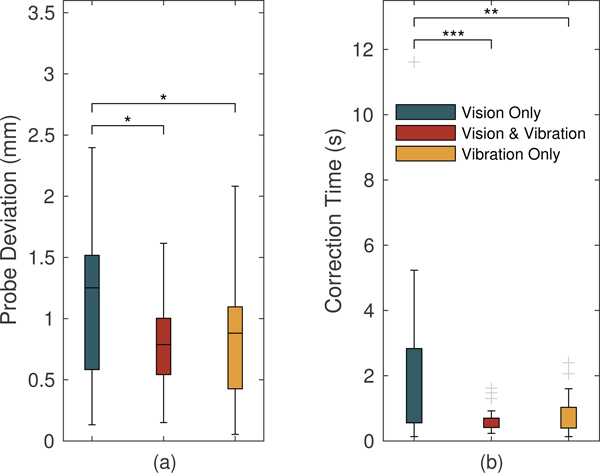
Results: Both systems significantly reduced probe deviation and correction time to errors during a needle insertion task. We also tested the two feedback systems in a more clinically relevant setup and showed that the perceptibility of the feedback was not affected by the addition of a sterile bag placed over the actuators and gloves worn by the user.
Conclusion: These studies show that both types of haptic feedback are promising for helping the user keep the ultrasound probe steady during ultrasound-assisted needle insertion tasks. Survey results indicated that users preferred the pneumatic system over the vibrotactile system.
Significance: Haptic feedback may improve user performance in ultrasound-based needle-insertion procedures and shows promise in training for needle-insertion tasks and other medical procedures where guidance is required.
Figures




References
-
- Mitragotri S, “Healing sound: the use of ultrasound in drug delivery and other therapeutic applications,” Nature Reviews Drug Discovery, vol. 4, no. 3, pp. 255–260, 2005. - PubMed
-
- Hong Y et al., “Real-time ultrasound elastography in the differential diagnosis of benign and malignant thyroid nodules,” Journal of Ultrasound in Medicine, vol. 28, no. 7, pp. 861–867, 2009. - PubMed
-
- Antonakakis JG, Ting PH, and Sites B, “Ultrasound-guided regional anesthesia for peripheral nerve blocks: an evidence-based outcome review,” Anesthesiology Clinics, vol. 29, no. 2, pp. 179–191, 2011. - PubMed
-
- American College of Emergency Physicians, “Emergency ultrasound guidelines.” Annals of Emergency Medicine, vol. 53, no. 4, pp. 550–570, 2009. - PubMed
Publication types
MeSH terms
Grants and funding
LinkOut - more resources
Full Text Sources
Miscellaneous