. 2023 Jun 29;19(6):e1011469.
doi: 10.1371/journal.ppat.1011469. eCollection 2023 Jun.

Neutralization profiles of HIV-1 viruses from the VRC01 Antibody Mediated Prevention (AMP) trials

Affiliations

Neutralization profiles of HIV-1 viruses from the VRC01 Antibody Mediated Prevention (AMP) trials

Nonhlanhla N Mkhize et al. PLoS Pathog. .

Abstract

The VRC01 Antibody Mediated Prevention (AMP) efficacy trials conducted between 2016 and 2020 showed for the first time that passively administered broadly neutralizing antibodies (bnAbs) could prevent HIV-1 acquisition against bnAb-sensitive viruses. HIV-1 viruses isolated from AMP participants who acquired infection during the study in the sub-Saharan African (HVTN 703/HPTN 081) and the Americas/European (HVTN 704/HPTN 085) trials represent a panel of currently circulating strains of HIV-1 and offer a unique opportunity to investigate the sensitivity of the virus to broadly neutralizing antibodies (bnAbs) being considered for clinical development. Pseudoviruses were constructed using envelope sequences from 218 individuals. The majority of viruses identified were clade B and C; with clades A, D, F and G and recombinants AC and BF detected at lower frequencies. We tested eight bnAbs in clinical development (VRC01, VRC07-523LS, 3BNC117, CAP256.25, PGDM1400, PGT121, 10-1074 and 10E8v4) for neutralization against all AMP placebo viruses (n = 76). Compared to older clade C viruses (1998-2010), the HVTN703/HPTN081 clade C viruses showed increased resistance to VRC07-523LS and CAP256.25. At a concentration of 1μg/ml (IC80), predictive modeling identified the triple combination of V3/V2-glycan/CD4bs-targeting bnAbs (10-1074/PGDM1400/VRC07-523LS) as the best against clade C viruses and a combination of MPER/V3/CD4bs-targeting bnAbs (10E8v4/10-1074/VRC07-523LS) as the best against clade B viruses, due to low coverage of V2-glycan directed bnAbs against clade B viruses. Overall, the AMP placebo viruses represent a valuable resource for defining the sensitivity of contemporaneous circulating viral strains to bnAbs and highlight the need to update reference panels regularly. Our data also suggests that combining bnAbs in passive immunization trials would improve coverage of global viruses.


Conflict of interest statement

The authors have no competing interests to declare.

Figures
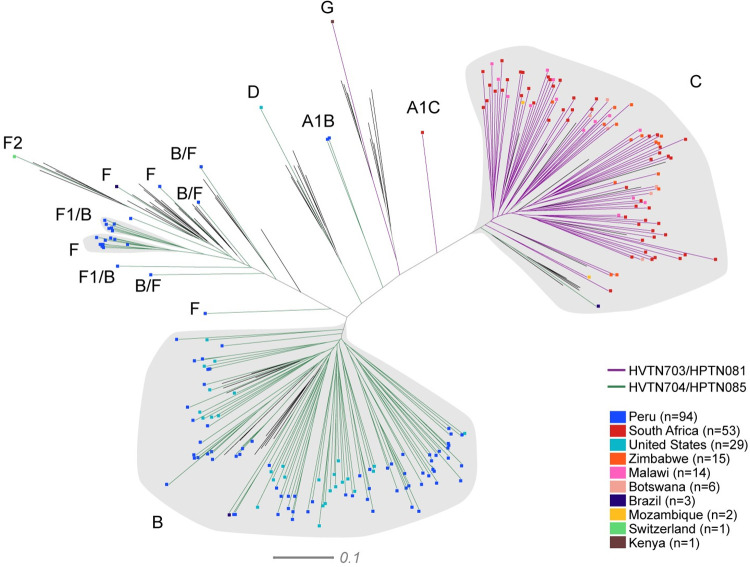
Fig 1
Fig 1. Phylogenetic analysis of envelope nucleotide sequences from the AMP trials.
Sequences from all arms of HVTN703/HPTN081 (purple branches) and HVTN704/HPTN085 (green branches) are shown in the tree. Each participant is represented by a single Env gene sequence. The ends of the branches are coloured according to the country of origin: Peru (bright blue), South Africa (red), United States (teal), Zimbabwe (orange), Malawi (pink), Botswana (dark teal), Brazil (dark blue), Mozambique (yellow), Switzerland (blue), and Kenya (brown). Branches in black (with no coloured ends) represent reference strains from different clades. The scale is shown at the bottom.
Fig 2
Fig 2. Neutralization profiles of pseudoviruses from the different study arms of the AMP trials.
Box plots illustrate neutralization data (IC80 titers, median and range) of all viruses against 8 bnAbs in clinical development and separated according to study arms in (A) HVTN703/HPTN081 (placebo n = 33, low dose n = 35, high dose n = 21) and (B) HVTN704/HPTN085 (placebo n = 47, low dose n = 42, high dose n = 38). Solid bars represent median titers.
Fig 3
Fig 3. Neutralization profiles of pseudoviruses from the placebo arms of the AMP trials.
Hierarchical clustering was utilized to analyze virus/bnAb combinations for HVTN703/HPTN081 (A) and HVTN704/HPTN085 (B) viruses were clustered according to their neutralization profiles along the vertical axes and bnAbs by sensitivity along the horizontal axes. A tally of the number of viruses by neutralization sensitivity (IC80 titer) and colour key is shown on the upper right corners of the plots. All sequences for HVTN703/HPTN081 are clade C and all sequences for HVTN704/HPTN085 are clade B unless otherwise denoted (●G, ▲F, ○F2, □ A/B recombinant, ■B/F recombinant).
Fig 4
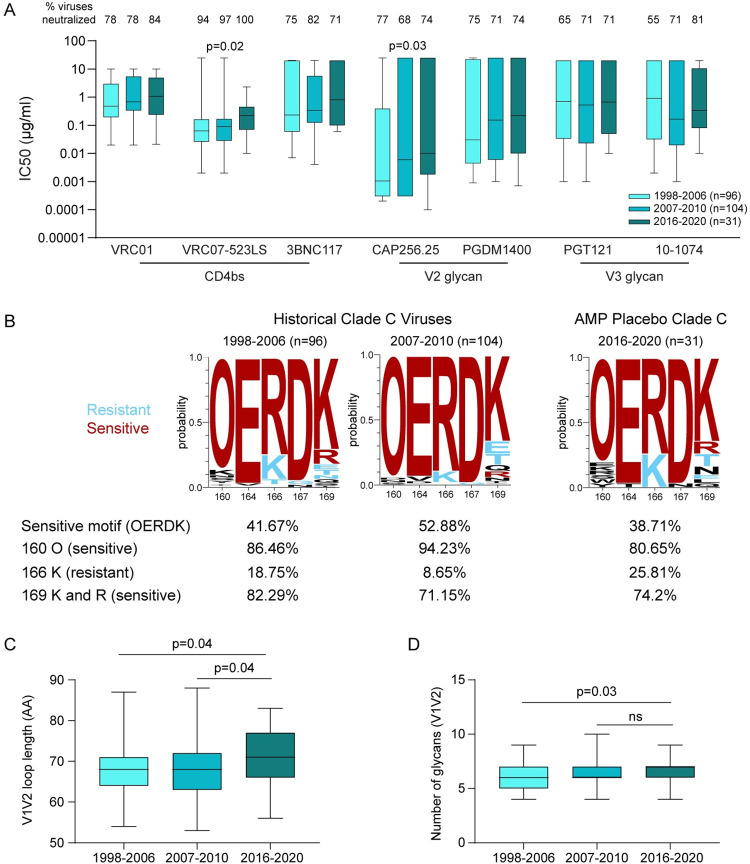
Fig 4. Neutralization sensitivity and genetic characteristics of historical clade C viruses compared to AMP placebo viruses.
(A) Previously characterized clade C panel viruses were analyzed according to time of collection (1998–2006, 2007–2010) and their sensitivity to bnAbs was compared to placebo viruses from AMP (2016–2020). The cut-off IC50 for VRC01 is 10μg/ml; 20μg/ml for 3BNC117, PGT121 and 10–1074; 25μg/ml for VRC07-523LS, CAP256.25 and PGDM1400. The Jonckheere-Terpstra trend test was used to determine changes in neutralization sensitivity over time and p<0.05 was considered significant. (B) logogram of clade C viruses for sites linked to CAP256.25 resistance/sensitivity for the three time periods. The amino acid frequency (y-axis) is shown for each residue at positions 160,164,166,167 and 169. The size of each AA in the logogram is proportional to its frequency and the “O” represents N-linked glycans. Residues associated with a sensitive neutralization phenotype are in red while residues in blue represent resistant residues. Residues that are not associated with either resistant or sensitive are in black. (C) V1V2 loop length and (D) the number of potential N-linked glycosylation sites were compared across the three time periods. The Mann-Whitney test was used to compare differences between the groups and p<0.05 was considered significant.
Fig 5
Fig 5. Predicted coverage of bnAb combinations against circulating viruses.
(A) Diagram illustrating neutralization coverage (created with BioRender.com). “1 Active” is the percent of viruses neutralized by at least one bnAb, “2 Active” is the percent of viruses that can be neutralized by at least two bnAbs, “3 Active” is the percent of viruses that can be neutralized by all three bnAbs. Neutralization coverage by single antibodies (black) was calculated at IC80 <1μg/ml.Using the Bliss Hill Independence model, the active coverage of the antibodies in triple combinations (purple shades for HVTN703/HPTN081 and green shades for HVTN704/HPTN085) was calculated based on the single antibody neutralization data with (B) HVTN703/HPTN081 (clade C) viruses and (C) HVTN704/HPTN085 (clade B) viruses. Coverage at 50% and 90% is indicated by the dotted lines.

References

    1. Moldt B, Rakasz EG, Schultz N, Chan-Hui PY, Swiderek K, Weisgrau KL, et al. Highly potent HIV-specific antibody neutralization in vitro translates into effective protection against mucosal SHIV challenge in vivo. Proc National Acad Sci. 2012;109(46):18921–5. doi: 10.1073/pnas.1214785109 - DOI - PMC - PubMed
    1. Pegu A, Yang Z yong, Boyington JC, Wu L, Ko SY, Schmidt SD, et al. Neutralizing antibodies to HIV-1 envelope protect more effectively in vivo than those to the CD4 receptor. Sci Transl Med. 2014;6(243):243ra88. doi: 10.1126/scitranslmed.3008992 - DOI - PMC - PubMed
    1. Gautam R, Nishimura Y, Pegu A, Nason MC, Klein F, Gazumyan A, et al. A single injection of anti-HIV-1 antibodies protects against repeated SHIV challenges. Nature. 2016;533(7601):105–9. doi: 10.1038/nature17677 - DOI - PMC - PubMed
    1. Saunders KO, Wang L, Joyce MG, Yang ZY, Balazs AB, Cheng C, et al. Broadly Neutralizing Human Immunodeficiency Virus Type 1 Antibody Gene Transfer Protects Nonhuman Primates from Mucosal Simian-Human Immunodeficiency Virus Infection. J Virol. 2015;89(16):8334–45. doi: 10.1128/JVI.00908-15 - DOI - PMC - PubMed
    1. Corey L, Gilbert PB, Juraska M, Montefiori DC, Morris L, Karuna ST, et al. Two Randomized Trials of Neutralizing Antibodies to Prevent HIV-1 Acquisition. New Engl J Med. 2021;384(11):1003–14. doi: 10.1056/NEJMoa2031738 - DOI - PMC - PubMed

Publication types