. 2023 Jun 29;14(1):3841.
doi: 10.1038/s41467-023-39473-7.

Magmatic surge requires two-stage model for the Laramide orogeny

Affiliations

Magmatic surge requires two-stage model for the Laramide orogeny

Joshua J Schwartz et al. Nat Commun. .

Abstract

The Laramide orogeny is a pivotal time in the geological development of western North America, but its driving mechanism is controversial. Most prominent models suggest this event was caused by the collision of an oceanic plateau with the Southern California Batholith (SCB) which caused the angle of subduction beneath the continent to shallow and led to shut-down of the arc. Here, we use over 280 zircon and titanite Pb/U ages from the SCB to establish the timing and duration of magmatism, metamorphism and deformation. We show that magmatism was surging in the SCB from 90 to 70 Ma, the lower crust was hot, and cooling occurred after 75 Ma. These data contradict plateau underthrusting and flat-slab subduction as the driving mechanism for early Laramide deformation. We propose that the Laramide orogeny is a two-stage event consisting of: 1) an arc 'flare-up' phase in the SCB from 90-75 Ma; and 2) a widespread mountain building phase in the Laramide foreland belt from 75-50 Ma that is linked to subduction of an oceanic plateau.


Conflict of interest statement

The authors declare no competing interests.

Figures
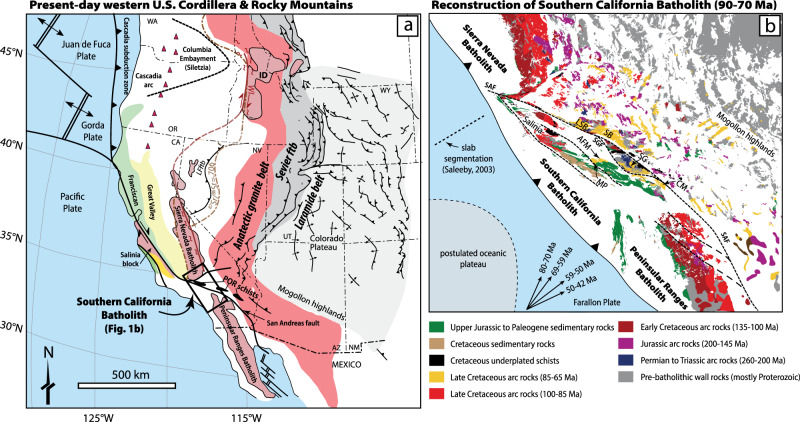
Fig. 1
Fig. 1. Generalized maps of the US sector of the western North American Cordillera and palinspastic reconstruction of the Southern California Batholith.
a Map of western North American Cordillera showing the current distribution of the Mesozoic and present-day magmatic arc, Sevier fold-thrust belt, Laramide foreland belt, and hinterland (after). The distribution of the anatectic granite belt is after Chapman et al.. b Late Cretaceous (ca. 90–70 Ma) tectonic reconstruction of the Cordilleran arc in Southern California (after). The Southern California Batholith (SCB) lies between the northern Peninsular Ranges Batholith and southern Sierra Nevada Batholith. This study focuses on the Late Cretaceous (90–70 Ma) plutonic flare-up in the SCB (yellow rocks), particularly those in the coastal arc in the Transverse Ranges and their relationship to flat-slab subduction models. Our data come from all major structural blocks in the Transverse Ranges (see abbreviations on map). SAF San Andreas fault, SGF San Gabriel fault, LSB Little San Bernardino Mountains, SB San Bernardino Mountains, MP Pine Mountain block, SG San Gabriel Mountains, CM Cucamonga block, AFM Alamo-Frasier Mountain block.
Fig. 2
Fig. 2. Timing of Mesozoic events in the Southern California Batholith (SCB).
a Histogram and kernel density estimates for plutons in the SCB. b Calculated areal addition rates (km2/Ma) versus time for the Mesozoic SCB in 5 m.y. bins. Areal addition rates for the Sierra Nevada Batholith are shown for comparison (not to scale). c Temporal evolution of magmatism deformation, metamorphism, deposition, and flat-slab subduction in the SCB. Our new model is compatible with underthrusting of the conjugate Hess oceanic plateau after 75-70 Ma, but is inconsistent with earlier amagmatic models and collision of the putative conjugate Shatsky Rise at ca. 88 Ma. The two stages of the Laramide orogeny are illustrated at the bottom of C. Stage I involved a magmatic flare-up event associated with granulite-facies metamorphism in the SCB, and basement-involved thrusting and basin formation in SW Montana. Stage II involves rapid cooling of the SCB, widespread basement-involved thrusting, and basin formation in Utah, Colorado and Wyoming. We attribute this latter part of the Laramide orogeny to underthrusting of the conjugate Hess oceanic plateau beneath the SCB. SCB Southern California Batholith, SNB Sierra Nevada Batholith.
Fig. 3
Fig. 3. Major-element geochemistry plots for Late Cretaceous arc rocks in the coastal batholiths of the SCB and SNB (blue and black dots) versus peraluminous leucogranites of the Cordilleran anatectic belt (red dots).
a AFM diagram. b Fe* vs. SiO2. c Modified alkali lime index vs. SiO2. d Major element compositional variation plot. In general, plots show that granitoids from the SCB overlap those of the SNB and arc melt inclusions (gray dots). Peraluminous leucogranites of the Cordilleran Anatectic Belt are geochemically distinct and unrelated to rocks in the coastal batholiths. Melt inclusion data are from the GEOROC database and SNB data are compiled from the NAVDAT database. Fields for Cordilleran granitoids after ref. . FeO* = FeO + (Fe2O3*0.8998). a alkali, ac alkali calcic, ca calc-alkalic, c calcic.
Fig. 4
Fig. 4. Time-temperature cooling curves for the major structural blocks of the Southern California Batholith.
Data show that the arc flare-up was followed by widespread, post-75 Ma cooling below 350 °C in all structural blocks. These data support models for regional cooling of the SCB after 75-70 Ma due to underthrusting of the conjugate Hess oceanic plateau. Data compiled from this study and others,,,,.
Fig. 5
Fig. 5. Schematic models for the two-stage evolution of the Southern California Batholith.
a Late Cretaceous arc flare-up in the SCB occurred from 90–70 Ma. Extension in the backarc occurred in the eastern Mojave region and may be related to lithospheric delamination, while shortening occurred in the Laramide thrust belt. This phase coincides with possible collision and dextral (northward) translation of the Insular superterrane (IST) that may have occurred north of the SCB and the future Garlock Fault (fGF). b Cessation of magmatism, rapid cooling after 75-70 Ma in the SCB, and underthrusting of the Pelona schist is linked to flat-slab subduction and underthrusting of the Hess conjugate (H). Eastward (continentward) migration of the arc is associated with basement-involved thrusting and basin formation in the Laramide fold and thrust-belt. Existing mainstream models focus on this stage of the Laramide orogeny and our data show that this event occurred no earlier than 75-70 Ma and involved the Hess conjugate (rather than the Shatsky conjugate). Global plate reconstructions are modified after.

References

    1. Snoke, A. W. & Chapman, J. B. NORTH AMERICA | Southern Cordillera. in Encyclopedia of Geology (eds. Richard C. Selley, L. Robin M. Cocks & Ian R. Plimer) 48–61 (Elsevier Ltd, 2021).
    1. Dickinson WR. Evolution of the North American cordillera. Annu Rev. Earth Planet Sci. 2004;32:13–45. doi: 10.1146/annurev.earth.32.101802.120257. - DOI
    1. Weil, A. B. & Yonkee, A. Laurentia: Turning Points in the Evolution of a Continent (eds. Whitmeyer, S. J., Williams, M. L., Kellett, D. A. & Tikoff, B.) Vol. 220. p. 707–771 (Geological Society of America, 2023).
    1. English JM, Johnston ST. The laramide orogeny: what were the driving forces? Int. Geol. Rev. 2004;46:833–838. doi: 10.2747/0020-6814.46.9.833. - DOI
    1. Wells, M. L., Hoisch, T. D., Cruz-Uribe, A. M. & Vervoort, J. D. Geodynamics of synconvergent extension and tectonic mode switching: constraints from the Sevier-Laramide orogen. Tectonics31, (2012).
