


Functional Materials and Innovative Strategies for Wearable Thermal Management Applications
- PMID: 37386321
- PMCID: PMC10310690
- DOI: 10.1007/s40820-023-01126-1
Functional Materials and Innovative Strategies for Wearable Thermal Management Applications
Abstract
Highlights:
This article systematically reviews the thermal management wearables with a specific emphasis on materials and strategies to regulate the human body temperature.
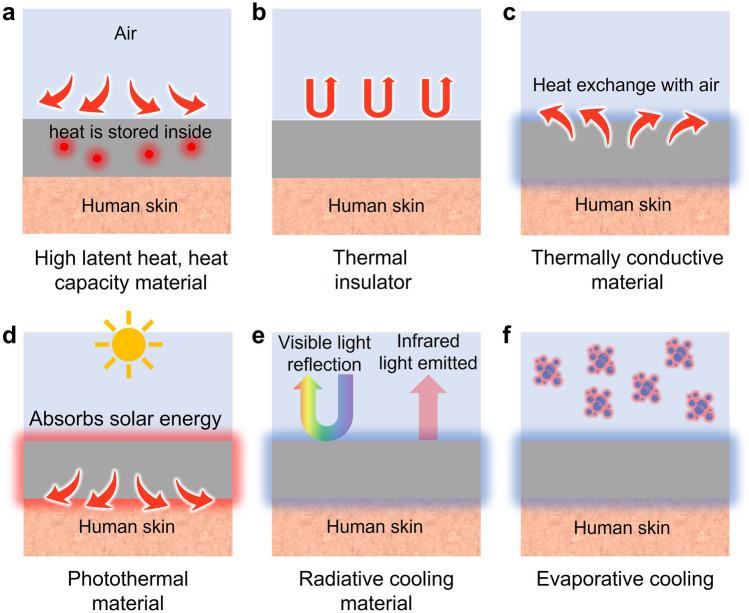
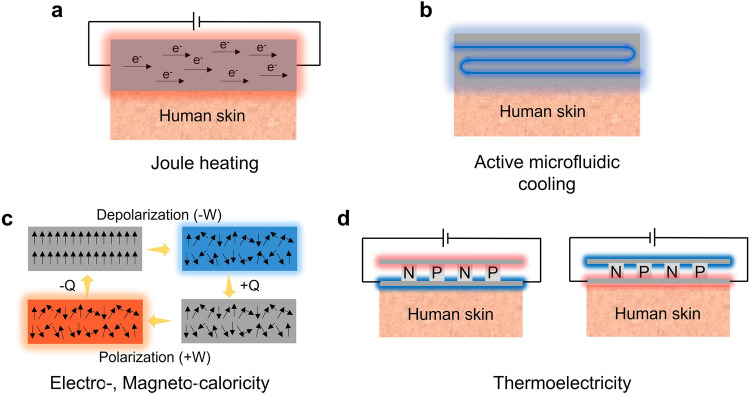
Thermal management wearables are subdivided into the active and passive thermal managing methods.
The strength and weakness of each thermal regulatory wearables are discussed in details from the view point of practical usage in real-life.
Abstract:
Thermal management is essential in our body as it affects various bodily functions, ranging from thermal discomfort to serious organ failures, as an example of the worst-case scenario. There have been extensive studies about wearable materials and devices that augment thermoregulatory functionalities in our body, employing diverse materials and systematic approaches to attaining thermal homeostasis. This paper reviews the recent progress of functional materials and devices that contribute to thermoregulatory wearables, particularly emphasizing the strategic methodology to regulate body temperature. There exist several methods to promote personal thermal management in a wearable form. For instance, we can impede heat transfer using a thermally insulating material with extremely low thermal conductivity or directly cool and heat the skin surface. Thus, we classify many studies into two branches, passive and active thermal management modes, which are further subdivided into specific strategies. Apart from discussing the strategies and their mechanisms, we also identify the weaknesses of each strategy and scrutinize its potential direction that studies should follow to make substantial contributions to future thermal regulatory wearable industries.
Keywords: Active heat transfer; Passive heat transfer; Thermal management; Wearable device; Wearable materials.
Conflict of interest statement
The authors declare that they have no known competing financial interests or personal relationships that could have appeared to influence the work reported in this paper.
Figures
References
-
- Kaiyala KJ. Energy Homeostasis: Thermoregulation. In: Squire LR, editor. Encyclopedia of Neuroscience. Oxford: Elsevier; 2009. pp. 1043–1052.
-
- E.V. Osilla, J.L. Marsidi, S. Sharma, Physiology, temperature regulation, in: StatPearls [Internet], StatPearls Publishing. - PubMed
-
- Sarbu I. A review on substitution strategy of non-ecological refrigerants from vapour compression-based refrigeration, air-conditioning and heat pump systems. Int. J. Refrig. 2014;46(1):123–141. doi: 10.1016/j.ijrefrig.2014.04.023. - DOI
-
- Brown DR, Stout T, Dirks JA, Fernandez N. The prospects of alternatives to vapor compression technology for space cooling and food refrigeration applications. Energy Eng. 2012;109(6):7–20. doi: 10.1080/01998595.2012.10554226. - DOI
-
- Zhang Q, Xue T, Tian J, Yang Y, Fan W, et al. Polyimide/boron nitride composite aerogel fiber-based phase-changeable textile for intelligent personal thermoregulation. Compos. Sci. Technol. 2022;226(28):109541. doi: 10.1016/j.compscitech.2022.109541. - DOI
Publication types
LinkOut - more resources
Full Text Sources