


Fluid balance in critically ill children with lower respiratory tract viral infection: a cohort study
- PMID: 37386553
- PMCID: PMC10141805
- DOI: 10.1186/s44158-023-00093-8
Fluid balance in critically ill children with lower respiratory tract viral infection: a cohort study
Abstract
Background: Increasing evidence has associated positive fluid balance of critically ill patients with poor outcomes. The aim of this study was to explore the pattern of daily fluid balances and their association with outcomes in critically ill children with lower respiratory tract viral infection.
Methods: A retrospective single-center study was conducted, in children supported with high-flow nasal cannula, non-invasive ventilation, or invasive ventilation. Median (interquartile range) daily fluid balances, cumulative fluid overload (FO) and peak FO variation, indexed as the % of admission body weight, over the first week of Pediatric Intensive Care Unit admission, and their association with the duration of respiratory support were assessed.
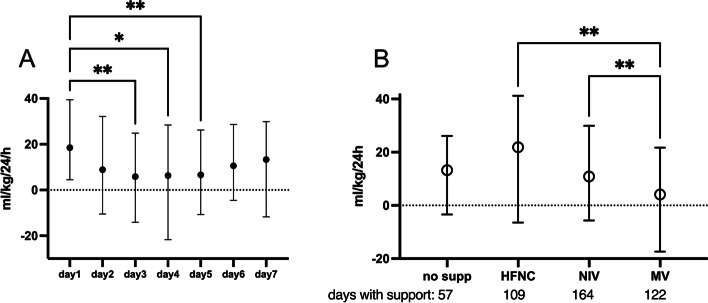
Results: Overall, 94 patients with a median age of 6.9 (1.9-18) months, and a respiratory support duration of 4 (2-7) days, showed a median (interquartile range) daily fluid balance of 18 (4.5-19.5) ml/kg at day 1, which decreased up to day 3 to 5.9 (- 14 to 24.9) ml/kg and increased to 13 (- 11 to 29.9) ml/kg at day 7 (p = 0.001). Median cumulative FO% was 4.6 (- 0.8 to 11) and peak FO% was 5.7 (1.9-12.4). Daily fluid balances, once patients were stratified according to the respiratory support, were significantly lower in those requiring mechanical ventilation (p = 0.003). No correlation was found between all examined fluid balances and respiratory support duration or oxygen saturation, even after subgroup analysis of patients with invasive mechanical ventilation, or respiratory comorbidities, or bacterial coinfection, or of patients under 1 year old.
Conclusions: In a cohort of children with bronchiolitis, fluid balance was not associated with duration of respiratory support or other parameters of pulmonary function.
Keywords: Bronchiolitis; Fluid balance; Fluid overload; Respiratory support.
© 2023. The Author(s).
Conflict of interest statement
The authors declare that they have no competing interests.
Figures
References
LinkOut - more resources
Full Text Sources