


Susceptibility profile and β-lactamase content of global Pseudomonas aeruginosa isolates resistant to ceftolozane/tazobactam and/or imipenem/relebactam-SMART 2016-21
- PMID: 37388237
- PMCID: PMC10306085
- DOI: 10.1093/jacamr/dlad080
Susceptibility profile and β-lactamase content of global Pseudomonas aeruginosa isolates resistant to ceftolozane/tazobactam and/or imipenem/relebactam-SMART 2016-21
Abstract
Objectives: To determine susceptibility profiles and β-lactamase content for ceftolozane/tazobactam-resistant and imipenem/relebactam-resistant Pseudomonas aeruginosa isolates collected in eight global regions during 2016-21.
Methods: Broth microdilution MICs were interpreted using CLSI breakpoints. PCR to identify β-lactamase genes or WGS was performed on selected isolate subsets.
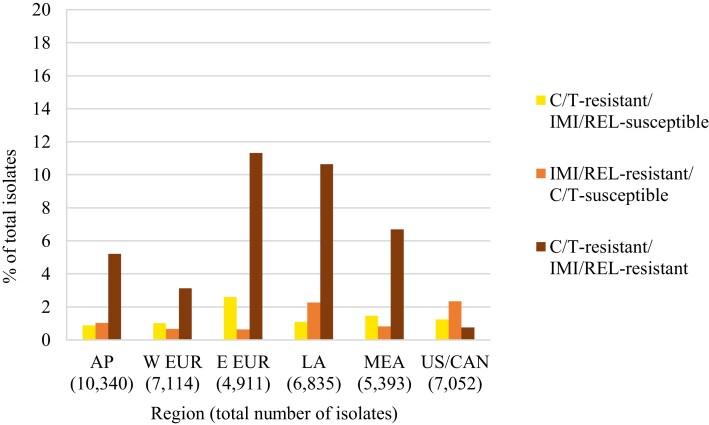
Results: Ceftolozane/tazobactam-resistant [from 0.6% (Australia/New Zealand) to 16.7% (Eastern Europe)] and imipenem/relebactam-resistant [from 1.3% (Australia/New Zealand) to 13.6% (Latin America)] P. aeruginosa varied by geographical region. Globally, 5.9% of isolates were both ceftolozane/tazobactam resistant and imipenem/relebactam resistant; 76% of these isolates carried MBLs. Most ceftolozane/tazobactam-resistant/imipenem/relebactam-susceptible isolates carried ESBLs (44%) or did not carry non-intrinsic (acquired) β-lactamases (49%); 95% of imipenem/relebactam-resistant/ceftolozane/tazobactam-susceptible isolates did not carry non-intrinsic β-lactamases. Isolates that carried indicators of strong PDC (Pseudomonas-derived cephalosporinase) up-regulation without a mutation known to expand the spectrum of PDC, or non-intrinsic β-lactamases, showed an 8-fold increase in ceftolozane/tazobactam modal MIC; however, this rarely (3%) resulted in ceftolozane/tazobactam resistance. Isolates with a PDC mutation and an indicator for PDC upregulation were ceftolozane/tazobactam non-susceptible (MIC, ≥ 8 mg/L). MICs ranged widely (1 to >32 mg/L) for isolates with a PDC mutation and no positively identified indicator for PDC up-regulation. Imipenem/relebactam-resistant/ceftolozane/tazobactam-susceptible isolates without non-intrinsic β-lactamases frequently (91%) harboured genetic lesions implying OprD loss of function; however, this finding alone did not account for this phenotype. Among imipenem-non-susceptible isolates without non-intrinsic β-lactamases, implied OprD loss only shifted the distribution of imipenem/relebactam MICs up by 1-2 doubling dilutions, resulting in ∼10% imipenem/relebactam-resistant isolates.
Conclusions: P. aeruginosa with ceftolozane/tazobactam-resistant/imipenem/relebactam-susceptible and imipenem/relebactam-resistant/ceftolozane/tazobactam-susceptible phenotypes were uncommon and harboured diverse resistance determinants.
© The Author(s) 2023. Published by Oxford University Press on behalf of British Society for Antimicrobial Chemotherapy.
Figures



References
-
- Karlowsky JA, Lob SH, Raddatz Jet al. In vitro activity of imipenem/relebactam and ceftolozane/tazobactam against clinical isolates of gram-negative bacilli with difficult-to-treat resistant phenotypes—study for monitoring antimicrobial resistance trends, United States 2015–2017. Clin Infect Dis 2021; 72: 2112–20. 10.1093/cid/ciaa381 - DOI - PubMed
-
- Karlowsky JA, Lob SH, DeRyke CAet al. In vitro activity of ceftolozane-tazobactam, imipenem-relebactam, ceftazidime-avibactam, and comparators against Pseudomonas aeruginosa isolates collected in United States hospitals according to results from the SMART surveillance program, 2018 to 2020. Antimicrob Agents Chemother 2022; 66: e00189-22. 10.1128/AAC.00189-22 - DOI - PMC - PubMed
-
- Tamma PD, Aitken SL, Bonomo RAet al. Infectious Diseases Society of America guidance on the treatment of extended-spectrum β-lactamase producing Enterobacterales (ESBL-E), carbapenem-resistant Enterobacterales (CRE), and Pseudomonas aeruginosa with difficult-to-treat resistance (DTR-P. aeruginosa). Clin Infect Dis 2021; 72: 1109–16. 10.1093/cid/ciab295 - DOI - PubMed
LinkOut - more resources
Full Text Sources