


Coagulation-flocculation treatment for batik effluent as a baseline study for the upcoming application of green coagulants/flocculants towards sustainable batik industry
- PMID: 37389087
- PMCID: PMC10300373
- DOI: 10.1016/j.heliyon.2023.e17284
Coagulation-flocculation treatment for batik effluent as a baseline study for the upcoming application of green coagulants/flocculants towards sustainable batik industry
Abstract
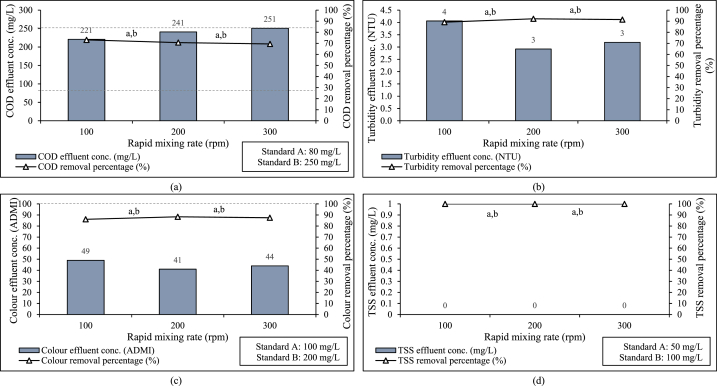
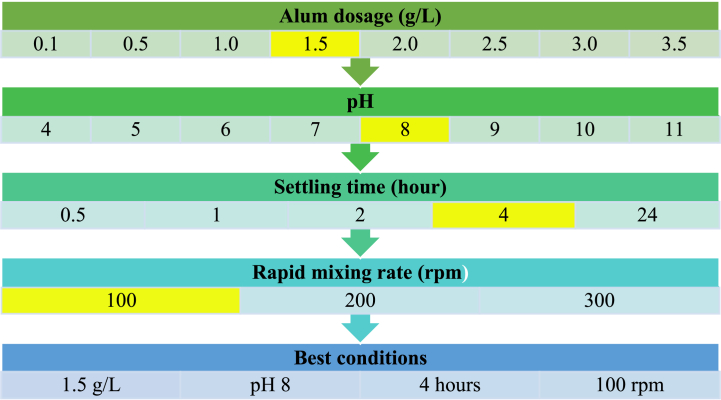
The batik industry has been one of the main family businesses in most of the east-coast region of the Malaysian peninsula for many years. However, appropriate water treatment is still a major challenge for this industry. Stringent laws introduced by the Malaysian authorities and the intention to protect the environment are factors that drive researchers to search for suitable, appropriate, affordable and efficient treatment of batik wastewater. Treatment research on batik wastewater is still lacking and coagulation-flocculation treatment using alum was introduced and chosen as a stepping stone toward the selection of green coagulants. This study aimed to determine the best conditions for alum flocculation-coagulation using a standard jar test method. Four main factors were investigated: alum dosage (0.1-3.5 g/L), pH (4-11), settling time (0.5-24 h) and rapid mixing rate (100-300 rpm). Results obtained were further analysed statistically using SPSS software prior to determining the significant effect of variable changes. From this study, the best conditions for batik wastewater treatment using the flocculation-coagulation process were found to be at alum dosage of 1.5 g/L, pH 8, 4 h settling time and a rapid mixing rate of 100 rpm. Chemical oxygen demand (COD), turbidity, colour and total suspended solids (TSS) were removed by 70.7, 92.2, 88.4 and 100%, respectively, under these conditions. This study showed that batik wastewater can be treated by the coagulation-flocculation process using chemical means of alum. This indicates the need for forthcoming developments in natural-based-coagulant-flocculants toward the sustainability of the batik industry.
Keywords: Batik; Dye; Statistical analysis; Sustainability development goals; Textile effluent.
© 2023 The Authors. Published by Elsevier Ltd.
Conflict of interest statement
The authors declare that they have no known competing financial interests or personal relationships that could have appeared to influence the work reported in this paper.
Figures
References
-
- Ahmad A.L., Harris W.A., Syafiee Seng O.B. Removal of dye from wastewater of textile industry using membrane technology. Jurnal Teknologi. 2002;36(F):31–44. doi: 10.11113/jt.v36.581. - DOI
-
- Sutisna, Wibowo E., Rokhmat M., Rahman D.Y., Murniati R., Khairurrijal Abdullah M. Batik wastewater treatment using TiO2 nanoparticles coated on the surface of plastic sheet. Procedia Eng. 2017;170:78–83. doi: 10.1016/j.proeng.2017.03.015. - DOI
-
- Garg A., Bhat K.L., Bock C.W. Mutagenicity of aminoazobenzene dyes and related structures: a QSAR/QPAR investigation. Dyes Pigments. 2002;55(1):35–52. doi: 10.1016/S0143-7208(02)00070-0. - DOI
-
- Suhardi B., Laksono P.W., Nur Fadhilah N. Analisis penerapan produksi bersih pada batik printing ikm batik puspa kencana laweyan surakarta. J. Teknologi Industri Pertanian. 2017;27(2):182–191.
LinkOut - more resources
Full Text Sources
