Review
. 2023 Feb 17;3(1):mtsi.v3i1.2023.308.
doi: 10.48327/mtsi.v3i1.2023.308. eCollection 2023 Mar 31.

[Overview of infectious and non-infectious diseases in French Guiana in 2022]

[Article in French]
Loïc Epelboin  1   2 Philippe Abboud  1 Karim Abdelmoumen  3 Frédégonde About  1 Antoine Adenis  2 Théo Blaise  2 Romain Blaizot  4 Timothée Bonifay  4 Morgane Bourne-Watrin  5 Mathilde Boutrou  1   2   3   4   5   6   7   8   9   10   11   12   13   14   15   16   17   18   19   20   21   22   23   24   25   26   27   28   29 Gabriel Carles  6 Pierre-Yves Carlier  8 Jean-François Carod  7 Luisiane Carvalho  9 Pierre Couppié  5 Bertrand De Toffol  2   10 François Delon  28 Magalie Demar  11   12 Justin Destoop  5 Maylis Douine  2 Jean-Pierre Droz  13 Narcisse Elenga  14 Antoine Enfissi  15 Yves-Kénol Franck  16 Alexis Fremery  17 Mélanie Gaillet  18 Hatem Kallel  19 Arsène Amadouhé Kpangon  20 Anne Lavergne  21 Paul Le Turnier  1 Lucas Maisonobe  1 Céline Michaud  18 Rémi Mutricy  17 Mathieu Nacher  2 Richard Naldjinan-Kodbaye  1 Margot Oberlis  22 Guillaume Odonne  23 Lindsay Osei  14 Jean Pujo  17 Sébastien Rabier  2   24 Brigitte Roman-Laverdure  1 Cyril Rousseau  9   18 Dominique Rousset  12 Nadia Sabbah  25 Vincent Sainte-Rose  12 Roxane Schaub  2 Karamba Sylla  26 Marc-Alexandre Tareau  2   23 Victor Tertre  27 Camille Thorey  26 Véronique Vialette  28 Gaëlle Walter  1 Magaly Zappa  29 Félix Djossou  1 Nicolas Vignier  2   24
Affiliations
Review

[Overview of infectious and non-infectious diseases in French Guiana in 2022]

[Article in French]
Loïc Epelboin et al. Med Trop Sante Int. .

Abstract

Source of many myths, French Guiana represents an exceptional territory due to the richness of its biodiversity and the variety of its communities. The only European territory in Amazonia, surrounded by the Brazilian giant and the little-known Suriname, Ariane 6 rockets are launched from Kourou while 50% of the population lives below the poverty line. This paradoxical situation is a source of health problems specific to this territory, whether they be infectious diseases with unknown germs, intoxications or chronic pathologies.Some infectious diseases such as Q fever, toxoplasmosis, cryptococcosis or HIV infection are in common with temperate countries, but present specificities leading to sometimes different management and medical reasoning. In addition to these pathologies, many tropical diseases are present in an endemic and / or epidemic mode such as malaria, leishmaniasis, Chagas disease, histoplasmosis or dengue. Besides, Amazonian dermatology is extremely varied, ranging from rare but serious pathologies (Buruli ulcer, leprosy) to others which are frequent and benign such as agouti lice (mites of the family Trombiculidae) or papillonitis. Envenomations by wild fauna are not rare, and deserve an appropriate management of the incriminated taxon. Obstetrical, cardiovascular and metabolic cosmopolitan pathologies sometimes take on a particular dimension in French Guiana that must be taken into account in the management of patients. Finally, different types of intoxication are to be known by practitioners, especially due to heavy metals.European-level resources offer diagnostic and therapeutic possibilities that do not exist in the surrounding countries and regions, thus allowing the management of diseases that are not well known elsewhere.Thanks to these same European-level resources, research in Guyana occupies a key place within the Amazon region, despite a smaller population than in the surrounding countries. Thus, certain pathologies such as histoplasmosis of the immunocompromised patient, Amazonian toxoplasmosis or Q fever are hardly described in neighboring countries, probably due to under-diagnosis linked to more limited resources. French Guiana plays a leading role in the study of these diseases.The objective of this overview is to guide health care providers coming to or practicing in French Guiana in their daily practice, but also practitioners taking care of people returning from French Guiana.

Source de nombreux mythes, la Guyane représente un territoire exceptionnel par la richesse de sa biodiversité et par la variété des communautés qui la composent. Seul territoire européen en Amazonie, entouré du géant brésilien et du méconnu Suriname, on y lance des fusées Ariane 6 depuis Kourou tandis que 50% de la population vit en dessous du seuil de pauvreté. Cette situation paradoxale est source de problématiques de santé spécifiques à ce territoire, qu'il s'agisse de maladies infectieuses à germes méconnus, d'intoxications, ou de pathologies chroniques.

Certaines maladies infectieuses telles que la fièvre Q, la toxoplasmose, la cryptococcose ou l'infection à VIH sont communes aux pays tempérés, mais présentent en Guyane des spécificités entraînant une prise en charge et un raisonnement médical parfois différents. Parallèlement à ces pathologies, de nombreuses maladies tropicales sont par ailleurs présentes sur un mode endémique et / ou épidémique telles que le paludisme, la leishmaniose, la maladie de Chagas, l'histoplasmose ou la dengue.

De plus, la dermatologie amazonienne est extrêmement variée, allant de pathologies rares, mais graves (ulcère de Buruli, lèpre), à d'autres fréquentes et bénignes telles que les poux d'agouti (acariens de la famille des Trombiculidae) ou la papillonite. Les envenimations par la faune sauvage ne sont pas rares, et méritent une prise en charge appropriée au taxon incriminé. Les pathologies obstétricale, cardiovasculaire et métabolique cosmopolites prennent parfois en Guyane une dimension particulière à prendre en compte dans la prise en charge des patients. Enfin, différents types d'intoxication sont à connaître par les praticiens, notamment aux métaux lourds.

Les ressources de niveau européen offrent des possibilités diagnostiques et thérapeutiques inexistantes dans les pays et régions des environs, permettant ainsi la prise en charge de maladies peu connues ailleurs.

Du fait de ces mêmes ressources de niveau européen, la recherche en Guyane occupe une place clé au sein de la région amazonienne, malgré une population moins nombreuse que dans les pays alentour. Ainsi, certaines pathologies telles que l'histoplasmose du patient immunodéprimé, la toxoplasmose amazonienne ou la fièvre Q ne sont pratiquement pas décrites dans les pays voisins, probablement du fait d'un sous-diagnostic lié à des ressources plus limitées. La Guyane joue ainsi un rôle moteur dans l’étude de ces pathologies.

L'objectif de ce panorama est d'orienter les soignants venant ou exerçant en Guyane dans leur pratique quotidienne, mais également les praticiens prenant en charge des personnes au retour de Guyane.

Keywords: Epidemiology; French Guiana; South America; Travel medicine; Tropical medicine.


Figures
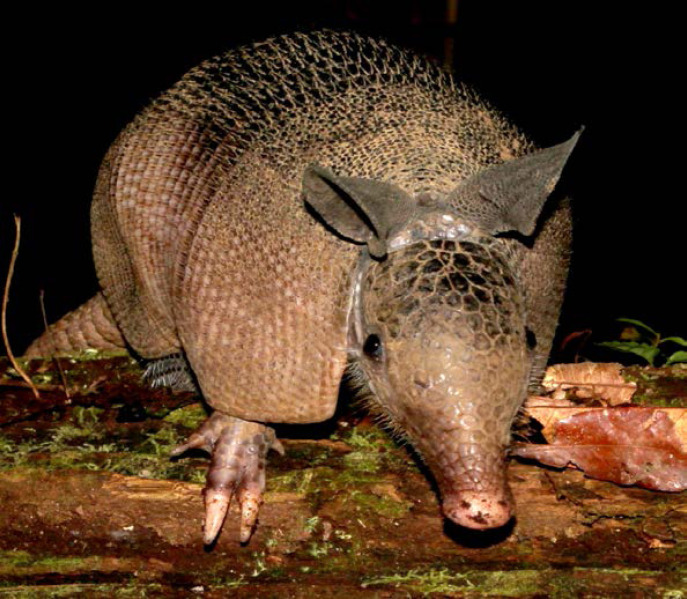
Figure 1
Figure 1
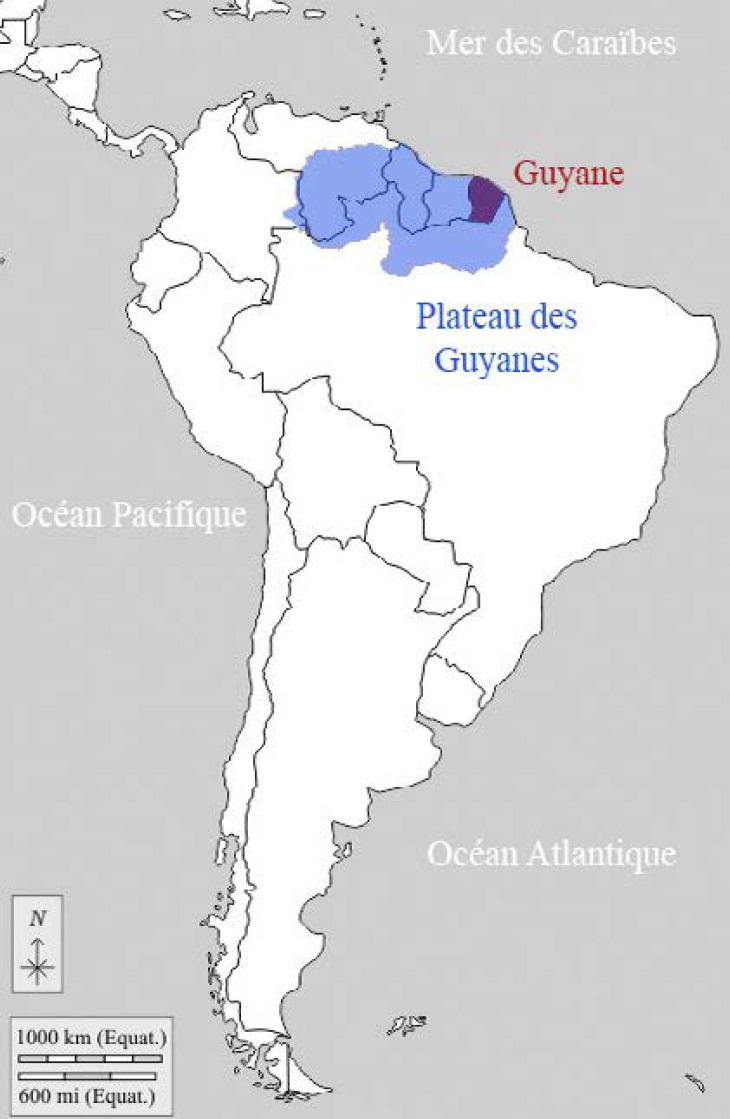
Situation géographique de la Guyane (source: d-maps.com/carte.php?num_car=5106) Geographical situation of French Guiana (source: d-maps.com/carte.php?num_car=5106)
Figure 2
Figure 2
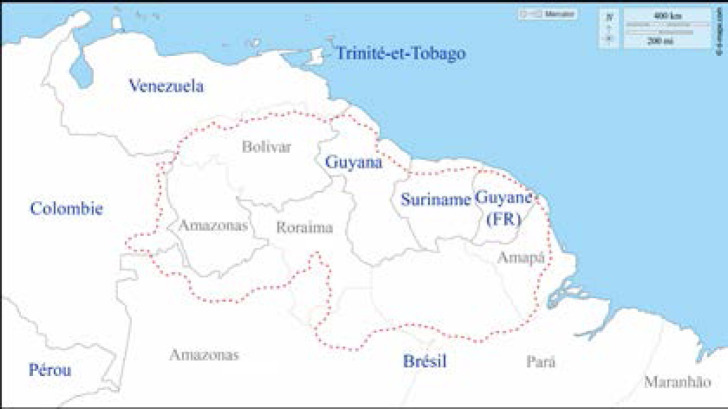
Carte du plateau des Guyanes (source: d-maps.com/carte.php?num_car=284548">https://d-maps.com/carte.php?num_car=284548">d-maps.com/carte.php?num_car=284548) Légende: Les pointillés rouges montrent la délimitation de l'aire géologique. Historiquement: États Amazonas et Bolivar du Venezuela et départements de Vichada et Guainía de Colombie (ex-Guyane espagnole), Guyana (ex-Guyane britannique), Suriname (ex-Guyane néerlandaise), Guyane française et au Brésil les États Amapá et Roraima, et partie des États Pará et Amazonas (ex-Guyane portugaise)) Map of the Guiana Shield (source: d-maps.com/carte.php?num_car=284548) Caption: The red dotted line shows delimitation of the geological area. Amazonas and Bolivar States in Venezuela and the Departments of Vichada and Guainía in Colombia (ex-Spanish Guiana), Guiana (ex-British Guiana), Suriname (ex-Dutch Guiana), French Guiana and in Brazil the States of Amapá and Roraima, and parts of the States of Pará and Amazonas (ex-Portuguese Guiana)
Figure 3
Figure 3
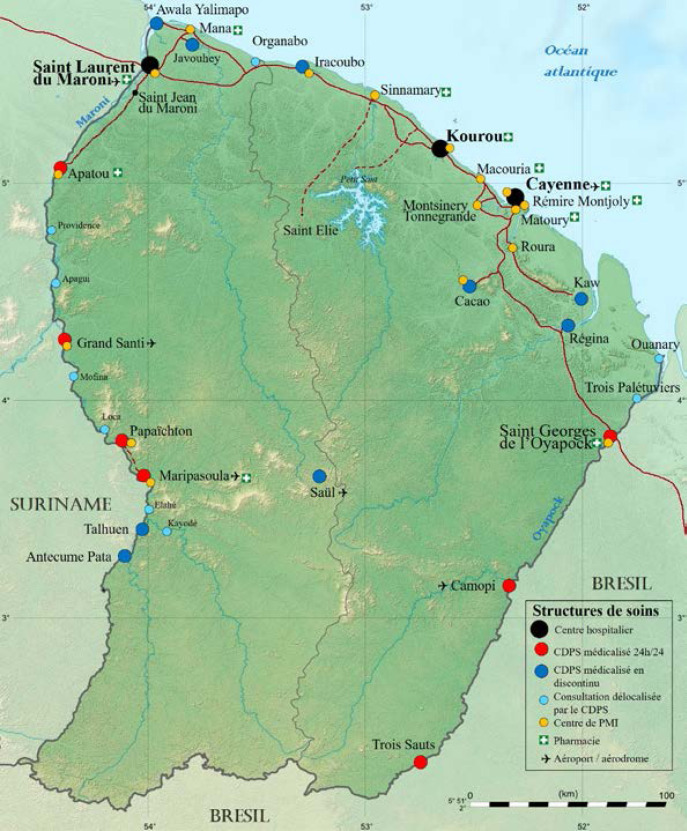
Carte géographique de répartition des structures de santé (Réalisation: É. Martin) Geographical distribution of healthcare structures (Creation: É. Martin)
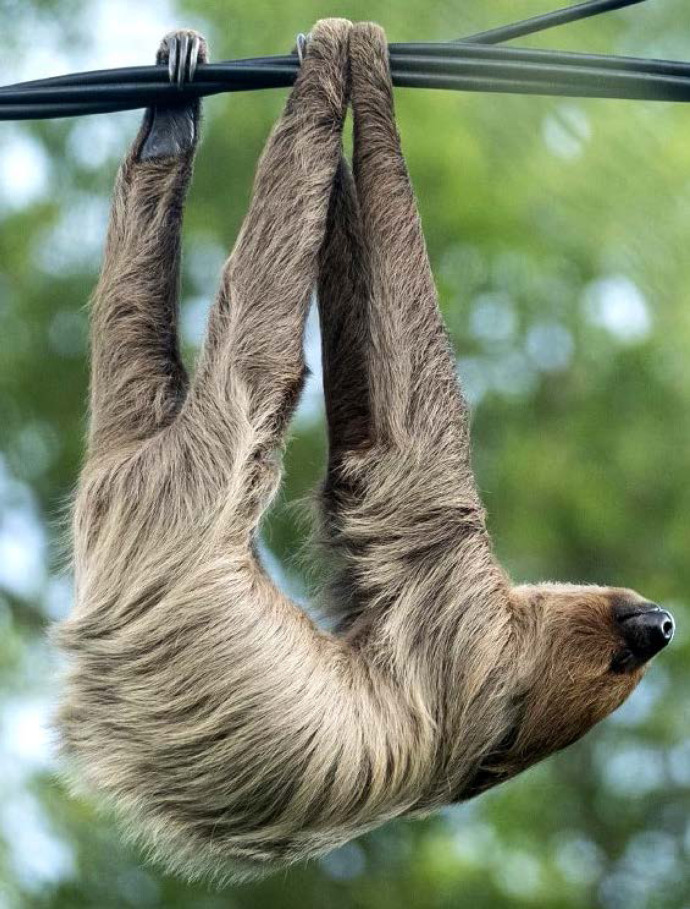
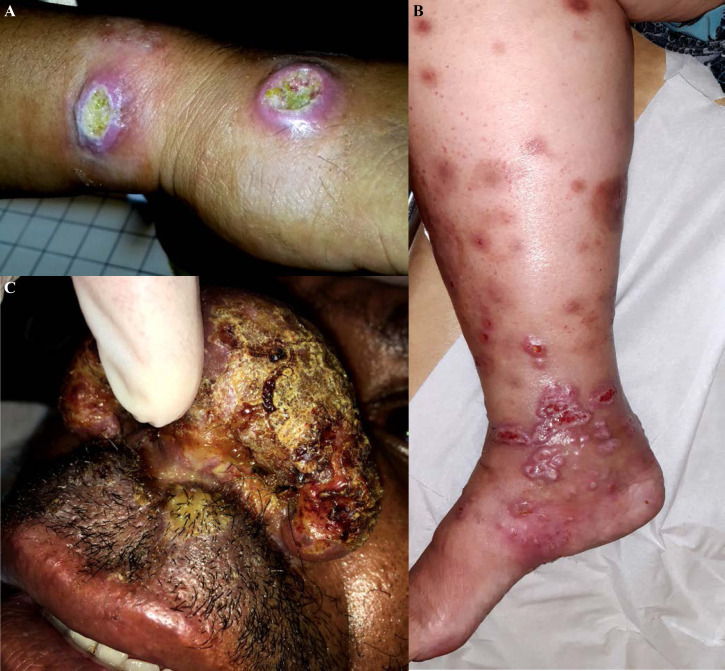
Figure 4
Figure 4
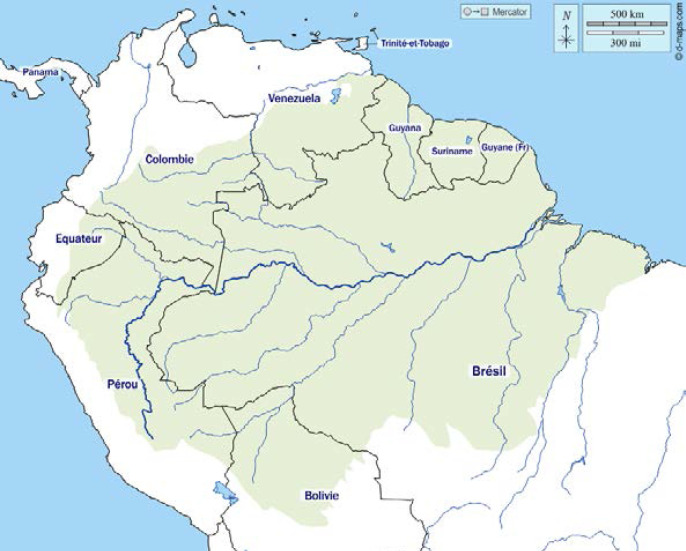
Carte politique de l'Amazonie (source: d-maps.com/carte.php?num_car=2316) Political map of Amazonia (source: d-maps.com/carte.php?num_car=2316)
Figure 5
Figure 5
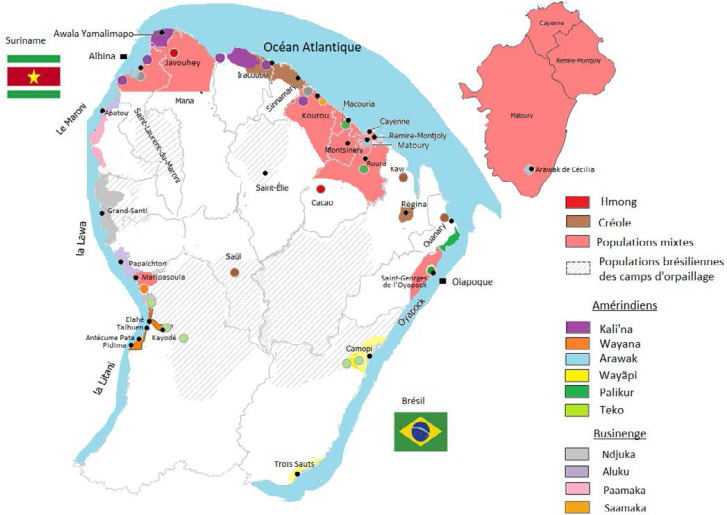
Carte de répartition des ethnies et langues de Guyane (réalisation: S. Rabier, L. Epelboin et M.-A. Tareau) Geographical distribution of ethnic groups and languages in French Guiana (creation: S. Rabier, L. Epelboin and M.-A. Tareau)
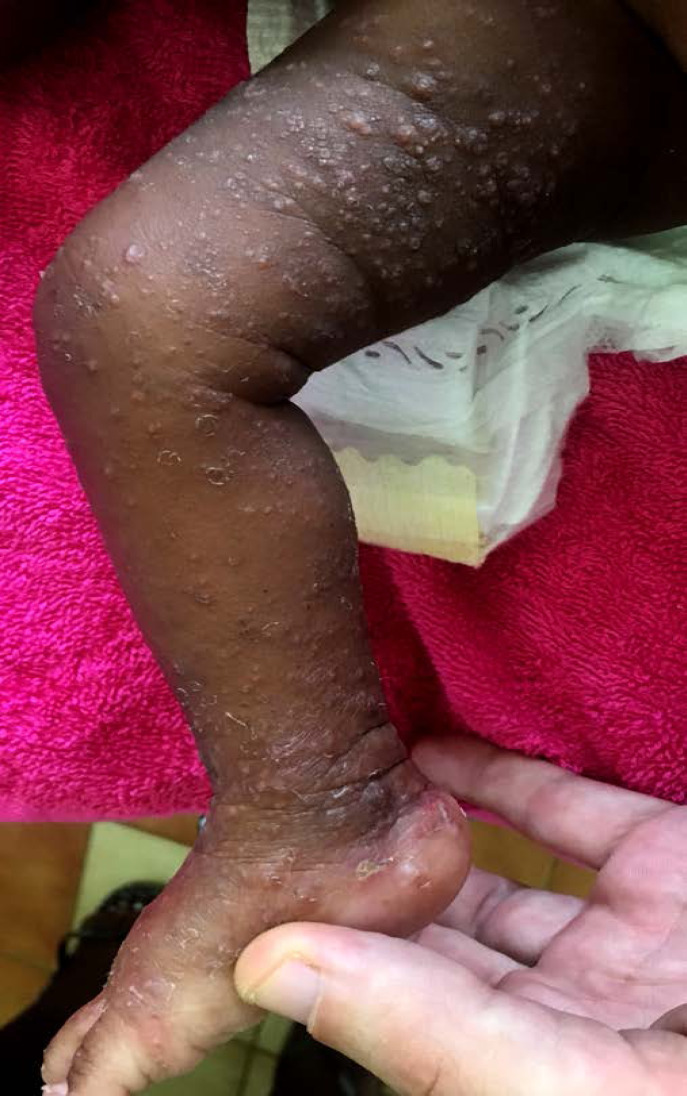
Figure 6
Figure 6
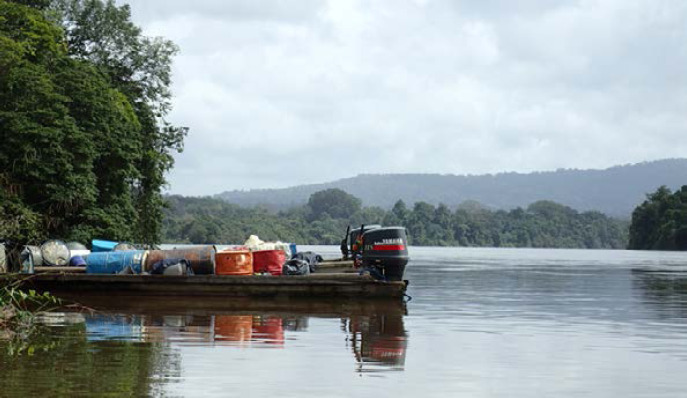
Pirogue surchargée de bidons d'essences remontant le Maroni vers Maripasoula (crédit photo: M. Douine) Pirogue overloaded with petrol cans going up the Maroni towards Maripasoula (photo credit: M. Douine)
Figure 7
Figure 7
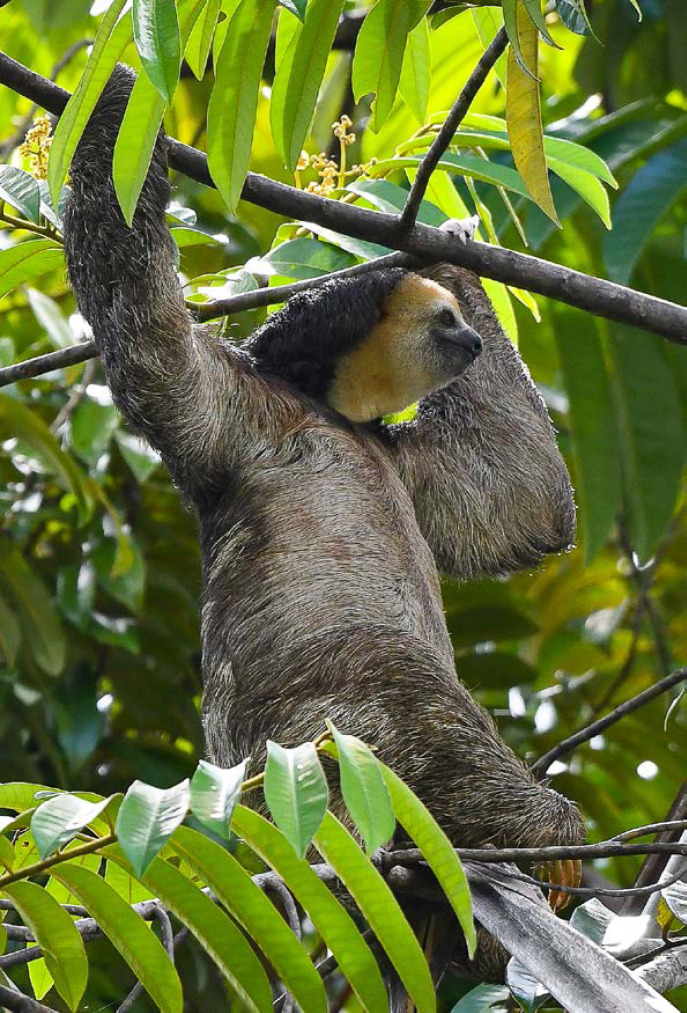
Paresseux à trois doigts (Bradypus tridactylus) (crédit photo: L. Epelboin) Pale-throated sloth (Bradypus tridactylus} (photo credit: L. Epelboin)
Figure 8
Figure 8
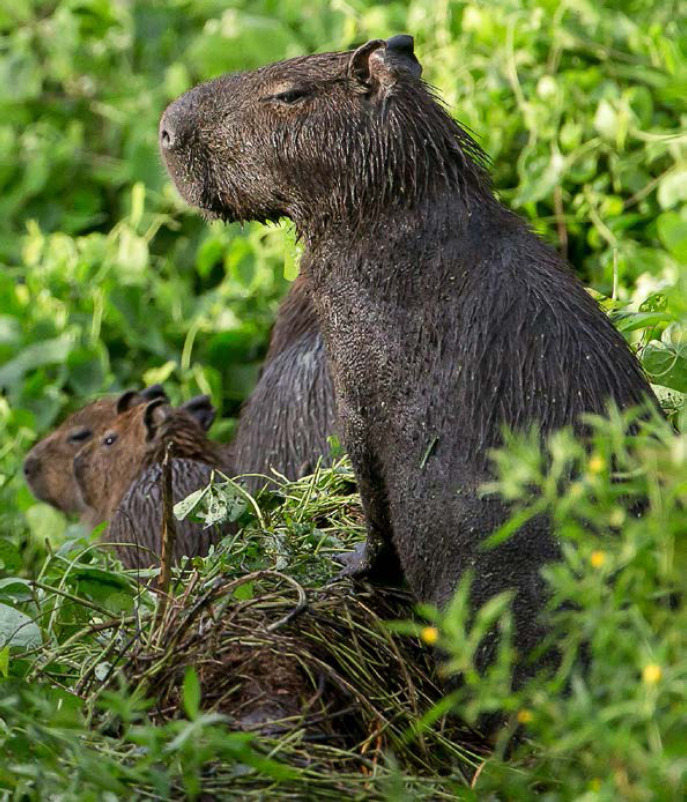
Cabiaï ou capybara (Hydrochoerus hydrochaeris) (crédit photo: N. Defaux) Greater capybara (Hydrochoerus hydrochaeris) (photo credit: N. Defaux)
Figure 9
Figure 9
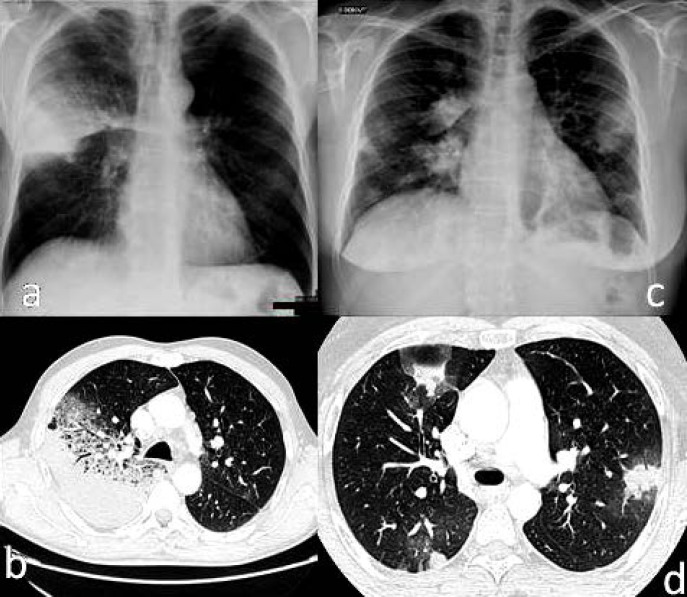
Radiographies et scanners thoraciques de 2 patients atteints de fièvre Q (crédit photo: M. Zappa) a. radiographie pulmonaire et b. scanner thoracique en fenêtre parenchymateuse: condensation alvéolaire unique systématisée du LSD; c. radiographie pulmonaire et d. scanner thoracique en fenêtre parenchymateuse: condensations alvéolaires de plus petite taille bilatérales touchant plusieurs lobes Chest radiographies and CT scans of 2 patients with Q fever (photo credit: M. Zappa) a. chest X-ray and b. chest CT in parenchymal window: single systematized alveolar condensation of LSD; c. chest X-ray and d. chest CT in parenchymal window: bilateral smaller alveolar condensations involving several lobes
Figure 10
Figure 10
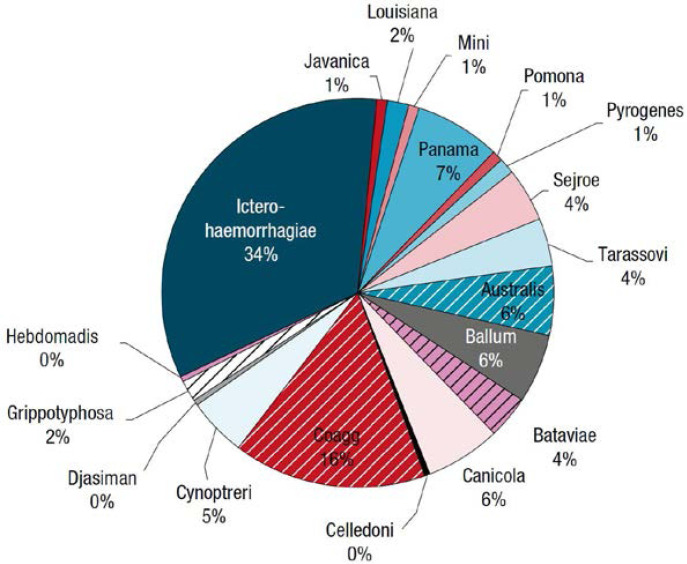
Répartition des sérogroupes et sérovars de Leptospira en Guyane, données du Centre national de référence de la leptospirose (Institut Pasteur, Paris), 1996-2015 Distribution of Leptospira serogroups and serovars in French Guiana, data from National Reference Center for Leptospirosis (Institut Pasteur, Paris), 1996-2015
Figure 11
Figure 11
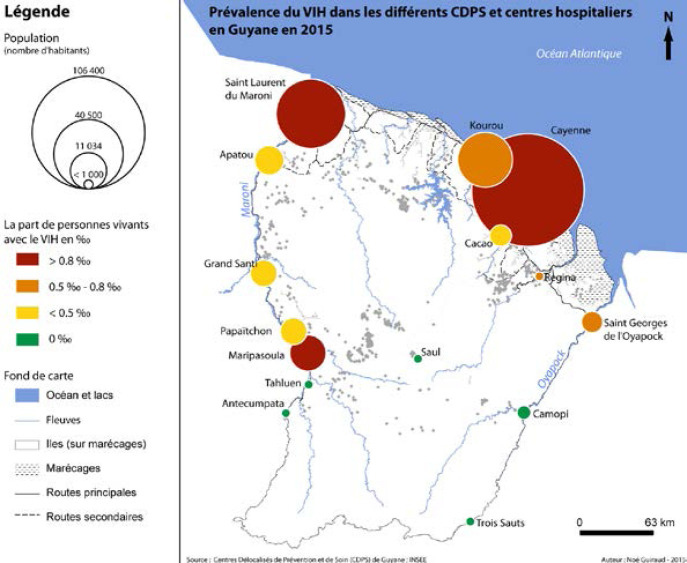
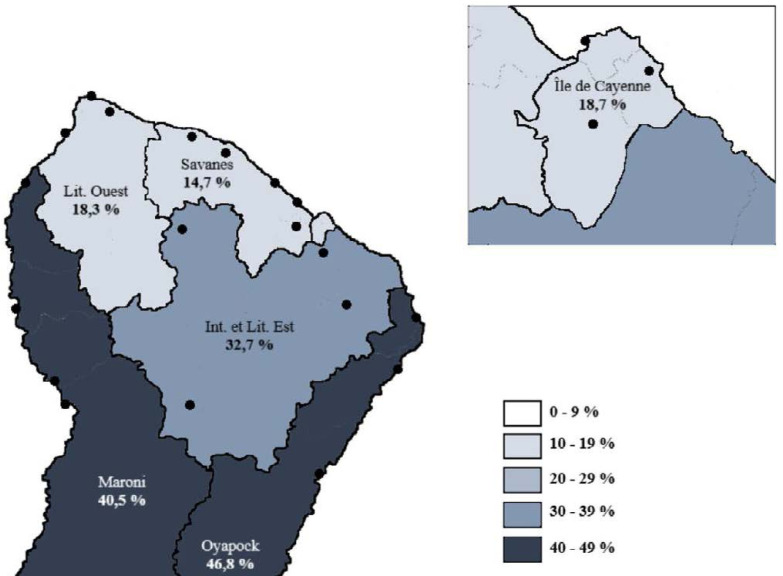
Prévalence du VIH dans les différents CDPS et CH en Guyane en 2015 [242] HIV prevalence in the various CDPS (Off-site prevention and healthcare centres) and CH (General hospitals) in French Guiana in 2015 [242]
Figure 12
Figure 12
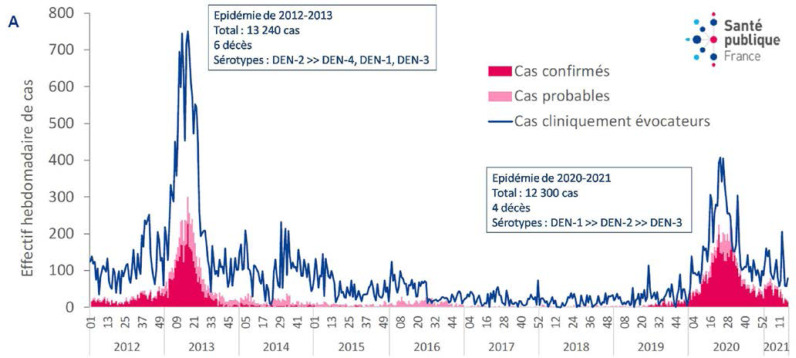
Nombre hebdomadaire estimé de cas cliniquement évocateurs de dengue chez des patients ayant consulté en médecine de ville ou dans un centre de santé et nombre de cas confirmés de dengue, Guyane, janvier 2012 à avril 2021 (source: Luisiane Carvalho, Santé publique France) Estimated weekly number of clinically suggestive cases of dengue in patients having consulted a practitioner in town or a health centre, and number of confirmed dengue cases, French Guiana, January 2012 to April 2022 (source: Luisiane Carvalho, Santé publique France)
Figure 13
Figure 13
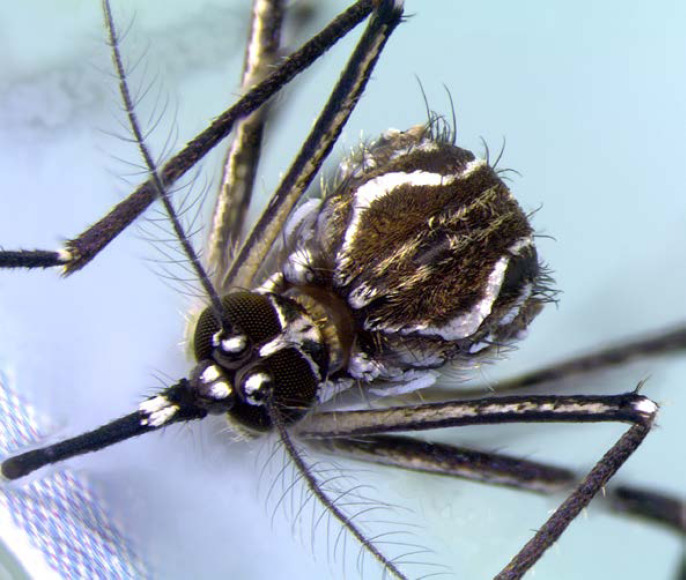
Aedes aegypti (crédit photo: Institut Pasteur de la Guyane; photo: P. Gaborit) Aedes aegypti (photo credit: Institut Pasteur de la Guyane; photo: P. Gaborit)
Figure 14
Figure 14
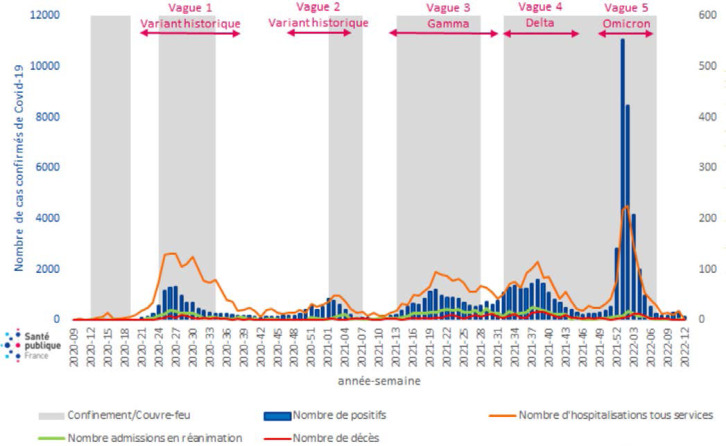
Évolution hebdomadaire du nombre de cas confirmés de Covid-19, du nombre d'hospitalisations tous services confondus et du nombre de décès à l'hôpital, Guyane, mars 2020 à mars 2022. Données SIDEP, SIVIC: Santé publique France en Guyane Weekly evolution of confirmed Covid-19 cases, hospital admissions including all wards, and in-hospital deaths, French Guiana, March 2020 to March 2022. SIDEP and SIVIC data, Santé publique France in French Guiana
Figure 15
Figure 15
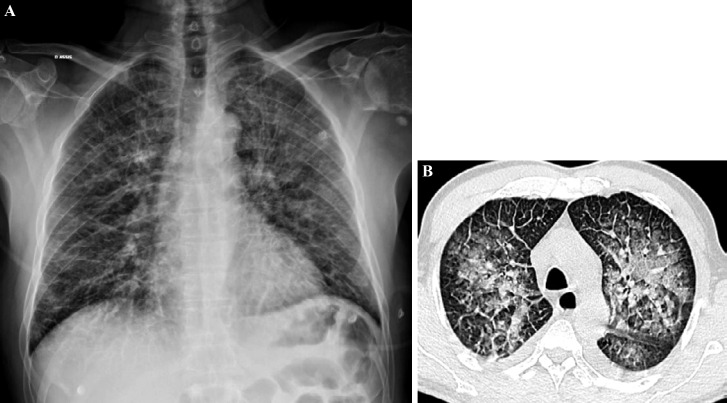
Patient âgé de 55 ans admis en réanimation pour prise en charge d'un syndrome pulmonaire à hantavirus compliqué d'une défaillance multiviscérale (respiratoire, rénale et hématologique) (crédit photo: M. Zappa) Légende: La radiographie pulmonaire (A) et le scanner thoracique (B) (fenêtre parenchymateuse passant par les lobes supérieurs) montrent des condensations alvéolaires et verre dépoli en plage prédominant dans les régions centrales associés à des lignes septales. Évolution favorable sous traitement symptomatique de réanimation et antibiothérapie. 55-year-old patient admitted in intensive care unit for management of a pulmonary hantaviral syndrome complicated by multivisceral failure (respiratory, renal and hematological) (photo credit: M. Zappa) Chest X-ray (A) and CT scan (B) (parenchymal window through the upper lobes) show alveolar condensations and ground glass predominantly in the central regions associated with septal lines. Favorable evolution under symptomatic resuscitation treatment and antibiotic therapy.
Figure 16
Figure 16
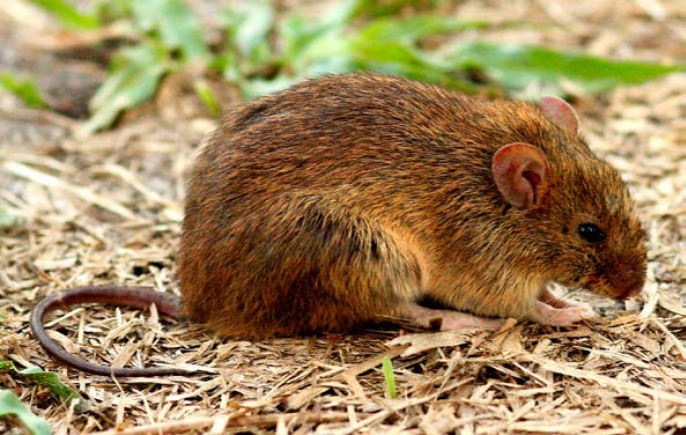
Rat des cannes à queue courte (Zygodontomys brevicauda), vecteur de l'hantavirus Maripa, pripris (marais) de Yiyi, Sinnamary (crédit photo: A. Baglan) Short-tailed cane mouse (Zygodontomys brevicauda), vector of Maripa hantavirus, Yiyi pripris (marshes), Sinnamary (photo credit: A. Baglan)
Figure 17
Figure 17
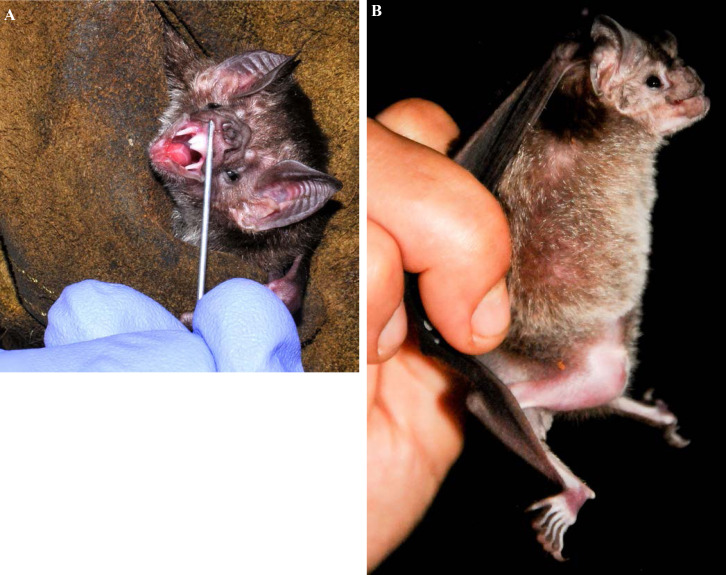
A. Prélèvement de salive pour recherche du virus de la rage par l'Institut Pasteur de la Guyane. Vampire commun (Desmodus rotondus), vecteur de la rage en Guyane. B. D. rotondus capturé lors d'une mission inventaire dans la Réserve du Mont Grand Matoury (crédit photo: L. Epelboin) A. Saliva collection for rabies virus testing by Institut Pasteur in French Guiana. Common vampire bat (Desmodus rotondus), vector of rabies in French Guiana. B. D. rotondus captured during an inventory mission in Mount Grand Matoury Reserve (photo credit: L. Epelboin)
Figure 18
Figure 18
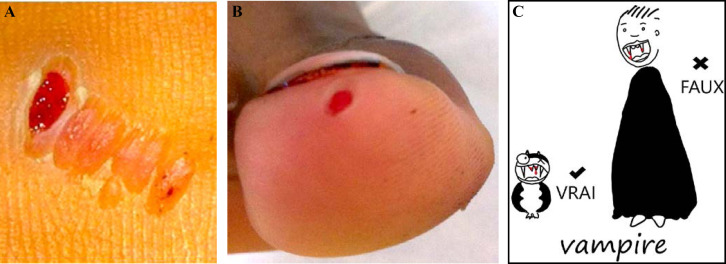
A. Morsure de vampire commun sur le talon (4 morsures consécutives) et B. Morsure sur un gros orteil (crédit photo: L. Epelboin). C. Dents utilisées pour la morsure (Illustration: É. Mosnier) A. Common vampire bite on the heel (4 consecutive bites) and B. Bite on a big toe (photo credit: L. Epelboin). C. Teeth used for biting (Illustration: É. Mosnier)
Figure 19
Figure 19
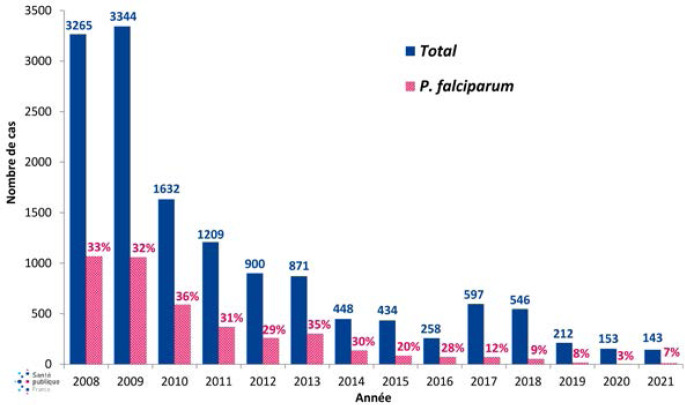
Nombre total d'accès palustres et part d'accès dus à P. falciparum diagnostiqués chaque année par les laboratoires de ville et hospitaliers, les centres de santé et l'Armée, Guyane, janvier 2008 à décembre 2021 (source: CDPS/CH Cayenne, LBM de Guyane, FAG - Exploitation: L. Carvalho, Santé publique France en Guyane) Total number of malaria attacks and proportion of attacks due to P. falciparum diagnosed each year by city and hospital laboratories, health centres and the army, French Guyana, January 2008 to December 2021 (source: CDPS/CH Cayenne, LBM de Guyane, FAG - Analysis: L. Carvalho, Santé publique France en Guyane)
Figure 20
Figure 20
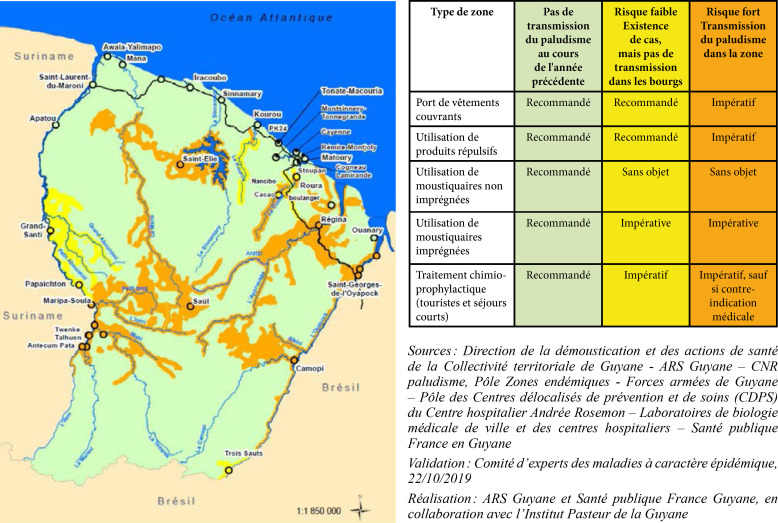
Carte du risque de paludisme en Guyane en 2019 (évalué selon les données épidémiologiques 2018) (source: Rapport 2021 du CNR paludisme) Map of malaria risk in French Guiana in 2019 (evaluated according to 2018 epidemiological data) (source: National Reference Center Malaria report 2021) Sources: Direction de la démoustication et des actions de santé de la Collectivité territoriale de Guyane – ARS Guyane – CNR paludisme, Pôle Zones endémiques – Forces armées de Guyane – Pôle des Centres délocalisés de prévention et de soins (CDPS) du Centre hospitalier Andrée Rosemon – Laboratoires de biologie médicale de ville et des centres hospitaliers – Santé publique France en Guyane Validation: Comité d'experts des maladies à caractère épidémique, 22/10/2019 Réalisation: ARS Guyane et Santé publique France Guyane, en collaboration avec l'Institut Pasteur de la Guyane
Figure 21
Figure 21
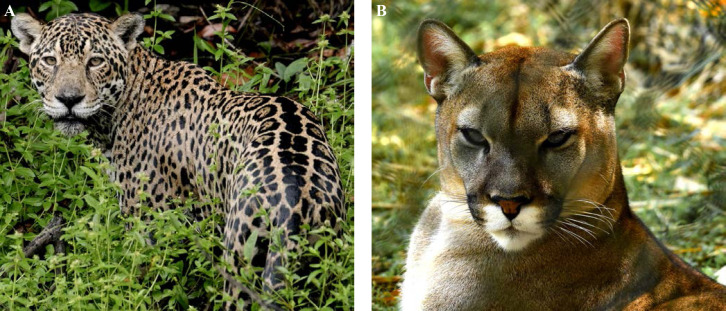
Félidés sauvages hôtes de la souche sauvage de Toxoplasma gondii. A. Jaguar (Pantera onca) au niveau du lac de Petit Saut (crédit photo: N. Defaux). B. Puma (Puma concolor) (crédit photo: L. Epelboin) Wild felid hosts of Toxoplasma gondii wild strain. A. Jaguar (Pantera onca) near the lake of Petit Saut (photo credit: N. Defaux). B. Cougar (Puma concolor) (photo credit: L. Epelboin)
Figure 22
Figure 22
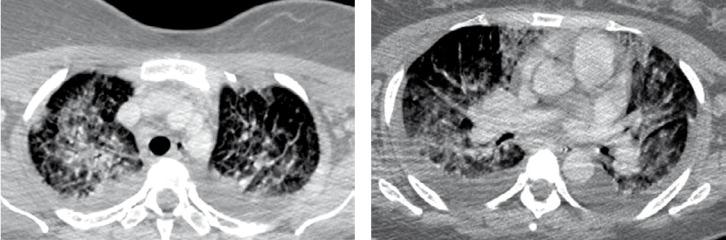
Militaire de 31 ans en mission de lutte contre l'orpaillage illégal, notion de consommation de suidé sauvage en forêt. Toxoplasmose amazonienne à tropisme pulmonaire. Scanner thoracique en fenêtre parenchymateuse montrant des plages de condensation alvéolaire et verre dépoli associés à des lignes septales touchant tous les lobes mais prédominant dans les lobes supérieurs, et un épanchement pleural d'abondance moyenne bilatéral, en rapport avec un SDRA (crédit photo: M. Zappa) 31-year-old soldier on a mission against illegal gold mining, notion of consumption of wild suid in the forest. Amazonian toxoplasmosis with pulmonary tropism. Chest CT scan in parenchymal window showing areas of alveolar condensation and ground glass associated with septal lines affecting all the lobes but predominantly in the upper lobes, and a pleural effusion of medium abundance bilaterally, in connection with ARDS (photo credit: M. Zappa)
Figure 23
Figure 23
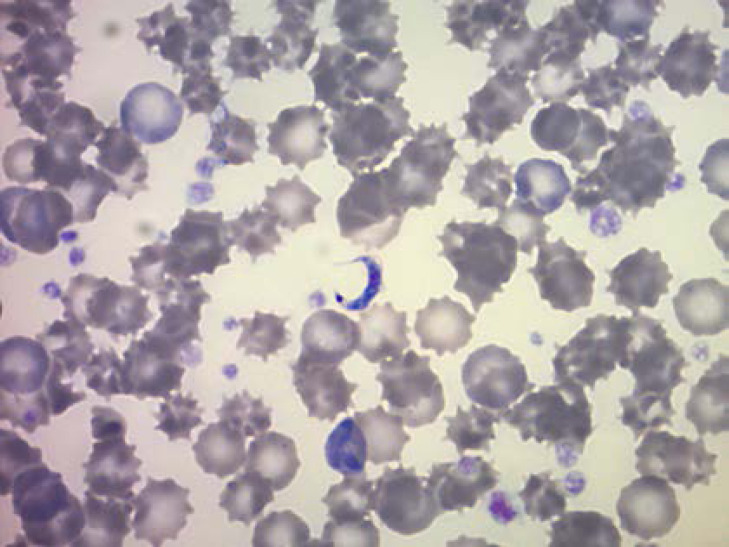
Trypanosoma cruzi dans le sang d'un opossum commun (Didelphis marsupialis). Coloration au May-Grünwald-Giemsa (crédit photo: D. Blanchet) Trypanosoma cruzi in the blood of a common opossum (Didelphis marsupialis). May-Grünwald-Giemsa staining (photo credit: D. Blanchet)
Figure 24
Figure 24
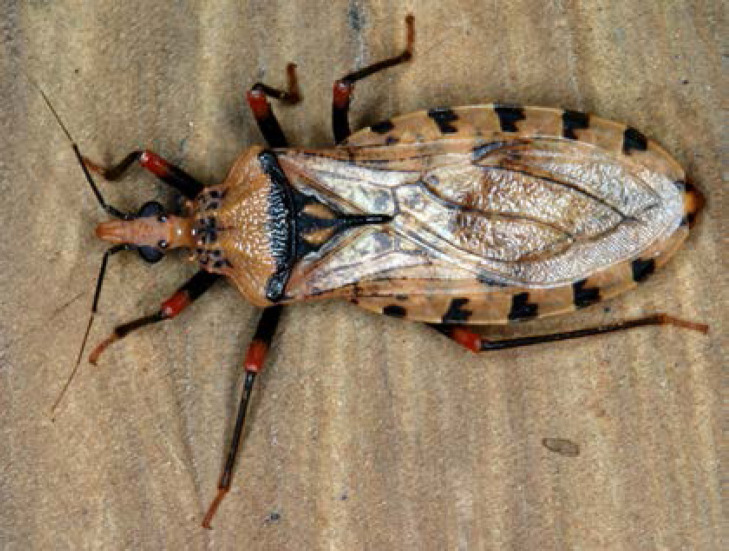
Triatome ou punaise hématophage (Panstrongylus geniculatus) de la famille des Reduviidae (crédit photo: D. Blanchet) Triatomine or hematophagous bug (Panstrongylus geniculatus) of the Reduviidae family (photo credit: D. Blanchet)
Figure 25
Figure 25
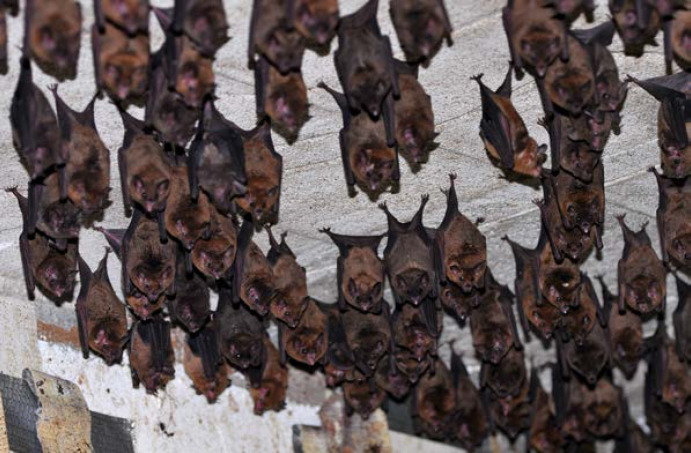
Colonie de chauves-souris dans l'ancienne écloserie de tortues d'Awala-Yalimapo (crédit photo: L. Epelboin) Bat colony in the old turtle hatchery of Awala-Yalimapo (photo credit: L. Epelboin)
Figure 26
Figure 26
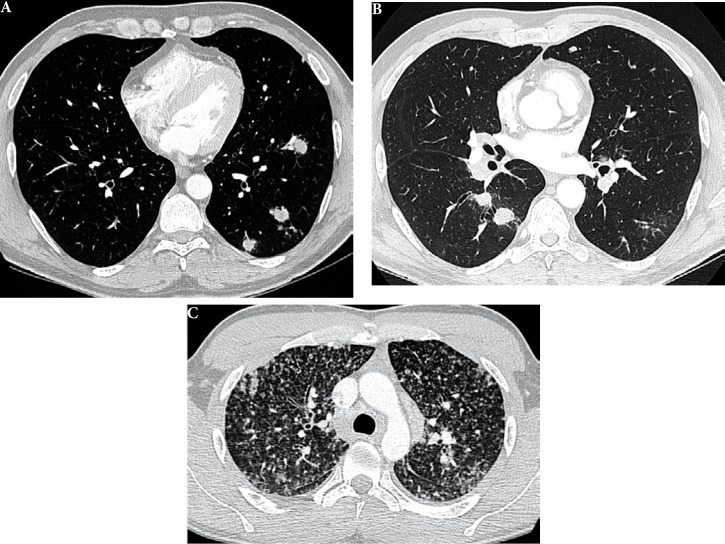
Scanners thoraciques d'histoplasmoses pulmonaires (crédit photo: M. Zappa) Légende: A et B. Scanner thoracique en fenêtre parenchymateuse d'une histoplasmose pulmonaire chez un militaire immunocompétent. Nodules multifocaux bilatéraux du parenchyme pulmonaire. C. Histoplasmose pulmonaire diffuse compliquée de SDRA chez un jeune Guyano-brésilien ayant inhalé une quantité massive de poussière de guano de chauves-souris CTs of pulmonary histoplasmosis (photo credit: M. Zappa) A and B. Parenchymal window chest CT of pulmonary histoplasmosis in an immunocompetent military man. Bilateral multifocal nodules of the lung parenchyma. C. Diffuse pulmonary histoplasmosis complicated by ARDS in a young Guyano-Brazilian man who inhaled massive amounts of bat guano dust
Figure 27
Figure 27
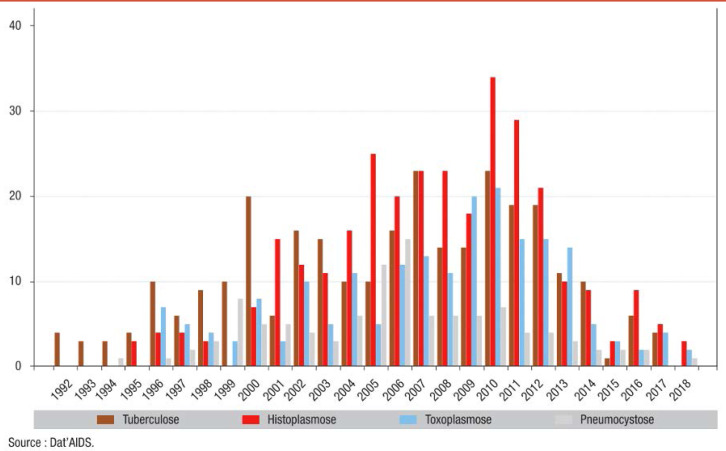
Incidences des 4 principales infections opportunistes en Guyane entre 1992 et 2018 (source: Dat'Aids) Incidence of the 4 main opportunistic infections in French Guiana (source: Dat'Aids)
Figure 28
Figure 28
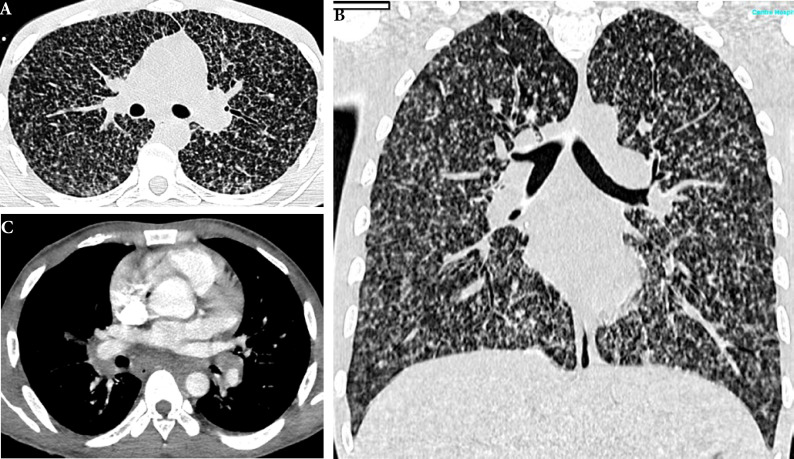
Histoplasmose chez des PVVIH (crédit photo: M. Zappa) Légende: A et B. Miliaire hématogène en coupes axiale (A) et coronale (B) sur un scanner thoracique en fenêtre parenchymateuse. C. Adénopathies médiastinales symétriques (hilaires bilatérales et sous carinaire) sur une coupe axiale d'un scanner thoracique en fenêtre médiastinale (crédit photo: M. Zappa) Histoplasmosis in PLWHIV (photo credit: M. Zappa) A and B. Hematogenous miliary in axial (A) and coronal (B) sections of a chest CT scan in parenchymal window. C. Symmetrical mediastinal adenopathies (bilateral hilar and subcarinal) on an axial section of a chest CT scan in mediastinal window
Figure 29
Figure 29
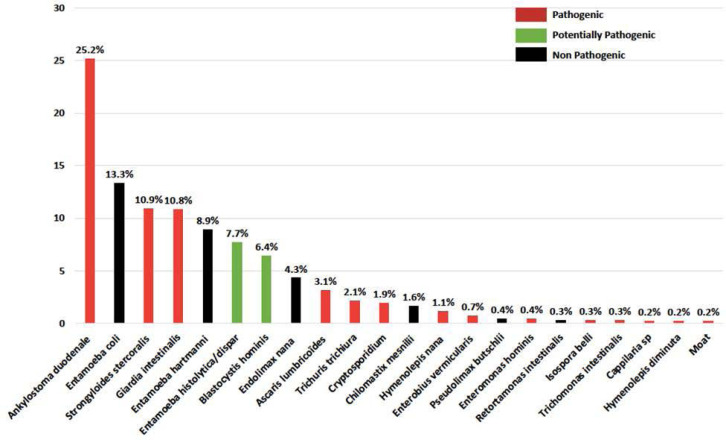
Répartition des espèces de parasites digestifs retrouvés aux laboratoires du CHC et du CHOG entre 2011 et 2016 [2] Distribution of species of digestive parasites found in laboratories of Cayenne general hospital (CHC) and West-Guyanese general hospital (CHOG) between 2011 and 2016 [2]
Figure 30
Figure 30
Répartition du taux d'infestation parasitaire (nombre de patients infestés par rapport au nombre de patients testés) entre 2010 et 2019 au laboratoire du CHC [200] Distribution of parasitic infestation rate (number of infested patients over number of patients tested) between 2010 and 2019 at the laboratory of Cayenne general hospital (CHC) [200]
Figure 31
Figure 31
Tatou à neuf bandes (Dasypus novemcinctus) (crédit photo: S. Sant) Nine-banded armadillo (Dasypus novemcinctus) (photo credit: S. Sant)
Figure 32
Figure 32
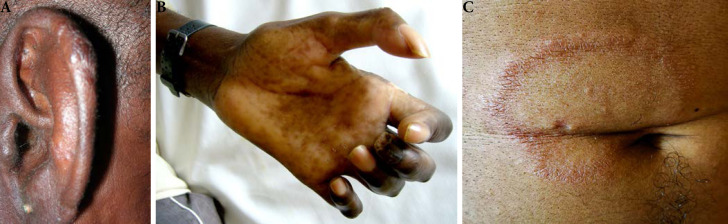
Lèpre Légende: A. Léprome dermique de l'oreille (crédit photo: J. Dufour); B. Griffe cubitale (crédit photo: L. Epelboin); C. Lésion hypochrome péri-ombilicale (crédit photo: J. Destoop) Leprosy A. Dermal leproma of the ear (photo credit: J. Dufour); B. Ulnar claw (photo credit: L. Epelboin); C. Periumbilical hypochromic lesion (photo credit: J. Destoop)
Figure 33
Figure 33
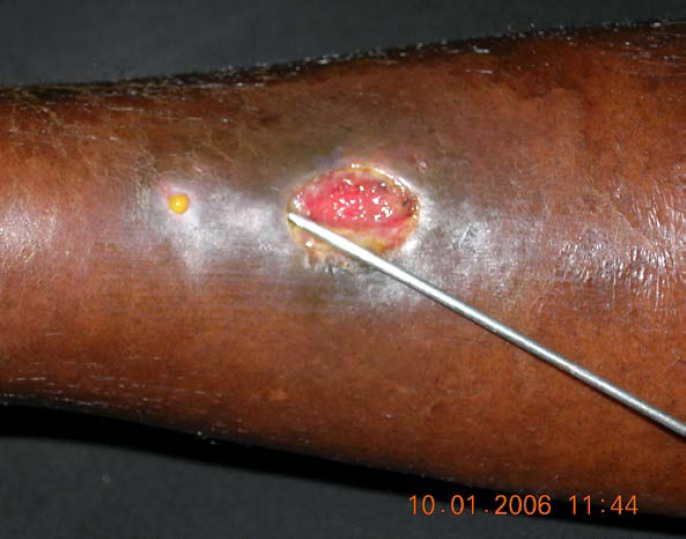
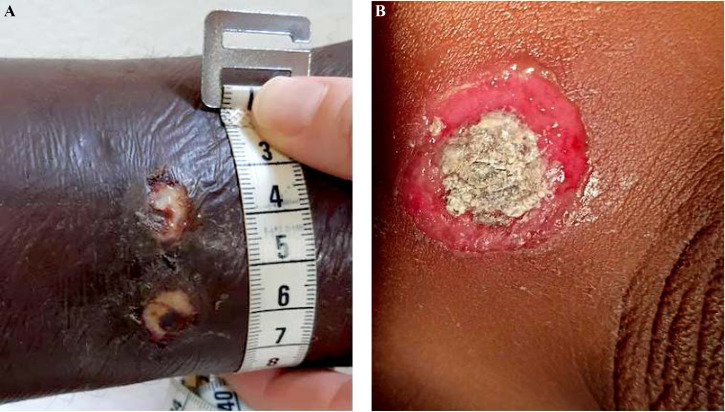
Ulcère de Buruli de la jambe, Guyane (crédit photo: J. Dufour) Buruli ulcer of the leg, French Guiana (photo credit: J. Dufour)
Figure 34
Figure 34
Diphtérie cutanée Légende: A. Patient du Maroni de 46 ans présentant depuis 5 jours des lésions multiples des deux jambes ulcérées, fibrineuses et inflammatoires de 1 à 1,5 cm de diamètre; B. Lésions cutanées multiples et diffuses sur l'ensemble du corps (oreille, visage, aine) associées à des adénopathies sensibles, apparues depuis 3 jours chez un enfant du Maroni de 3 ans (crédit photos: M. Gaillet) Cutaneous diphtheria A. 46-year-old patient from Maroni with multiple ulcerated, fibrinous and inflammatory lesions on both legs, 1 to 1.5 cm in diameter, since 5 days; B. Multiple diffuse skin lesions all over the body (ear, face, groin) associated with tender adenopathies, which appeared 3 days before in a 3-year-old child from Maroni (photo credits: M. Gaillet)
Figure 35
Figure 35
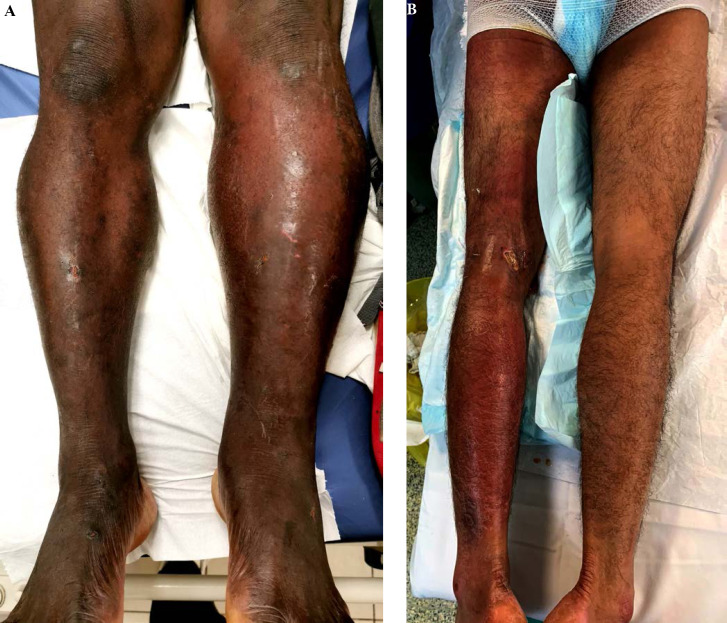
Dermohypodermites bactériennes Légende: A. DHBNN simple de la jambe gauche sur peau noire; B. Fasciite nécrosante du membre inférieur gauche à Aeromonas hydrophila suite à une piqûre de raie au niveau du creux poplité (crédit photos: J. Destoop) Bacterial dermohypodermatitis A. Simple non-necrotizing bacterial dermohypodermatitis of the left leg on black skin; B. Necrotizing fasciitis of the left lower limb with Aeromonas hydrophila following a stingray puncture in the popliteal fossa (photo credits: J. Destoop)
Figure 36
Figure 36
Paresseux à deux doigts ou didactyle (Choloepus didactylus) (crédit photo: N. Defaux) Linnaeus's two-toed sloth (Choloepus didactylus) (photo credit: N. Defaux)
Figure 37
Figure 37
Leishmaniose Légende: A. Leishmaniose typique avec ulcères à bords surélevés avec peau saine entre les deux lésions; B Leishmaniose à L. guyanensis, multiples lésions entraînant un œdème de membre et un handicap à la marche chez une femme de 50 ans au retour de Saül; C. Leishmaniose muqueuse avec atteinte nasale chez un orpailleur, évoluant depuis plusieurs mois, espèce non identifiée (crédit photos: R. Blaizot) Leishmaniasis A. Typical leishmaniasis with ulcers with raised edges and healthy skin between the two lesions; B. L. guyanensis leishmaniasis, multiple lesions leading to limb edema and walking disability in a 50-year-old woman returning from Saül; C. Mucosal leishmaniasis with nasal involvement in a gold digger, evolving for several months, species not identified (photo credits: R.Blaizot)
Figure 38
Figure 38
Lésions de gale (pustules, papules, nodules et sillons au niveau de la jambe) chez un enfant businenge (crédit photo: R. Blaizot) Scabies lesions (pustules, papules, nodules and grooves on the leg) in a Businenge child (photo credit: R.Blaizot)
Figure 39
Figure 39
Œufs de puce chique (crédit photo: J. Destoop) Sand flea eggs (photo credit: J. Destoop)
Figure 40
Figure 40
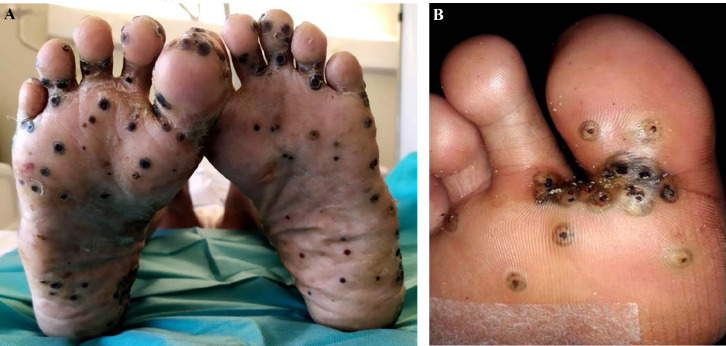
Tungose ou « puce chique » Légende: A. Patient de Cayenne (crédit photo: J. Destoop); B. Tungose profuse chez un patient alcoolique de Saint-Laurent-du-Maroni (crédit photo: P. Naudion) Tungiasis ou sand fleas infection A. Patient from Cayenne (photo credit: J. Destoop); B. Profuse tungiasis in an alcoholic patient from Saint-Laurent-du-Maroni (photo credit: P. Naudion)
Figure 41
Figure 41
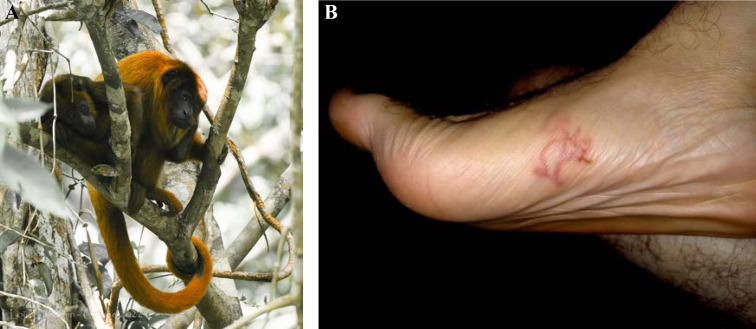
A. Singe hurleur roux (Alouatta macconnelli), femelle et petit, centre de sauvegarde ONCA, Montsinéry (crédit photo: L. Epelboin) B. Lésions de larva migrans cutanée ankylostomienne suite à des missions dans la Réserve naturelle nationale des Nouragues (crédit photo: J. Tribot) A. Red howler monkey (Alouatta macconnelli), female and cub, ONCA rescue centre, Montsinéry (photo credit: L. Epelboin) B. Hookworm larva migrans lesions following missions in the Nouragues National Nature Reserve (photo credit: J. Tribot)
Figure 42
Figure 42
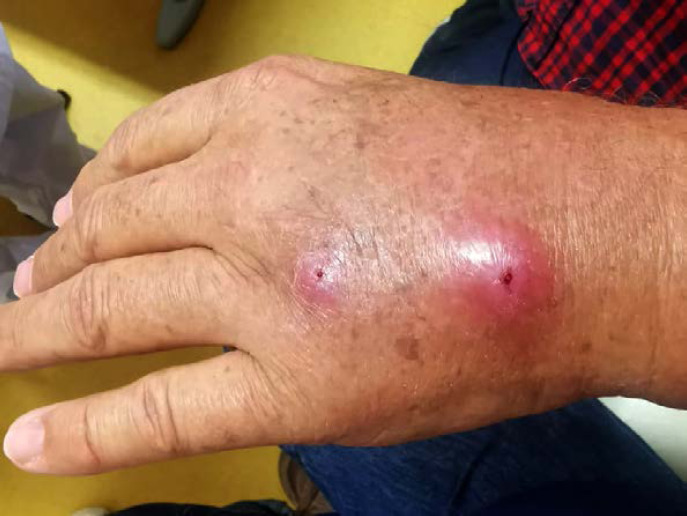
Lésion de ver macaque sur le dos de la main (crédit photo: J. Destoop) Human botfly (Dermatobia hominis) lesion on the back of the hand (photo credit: J. Destoop)
Figure 43
Figure 43
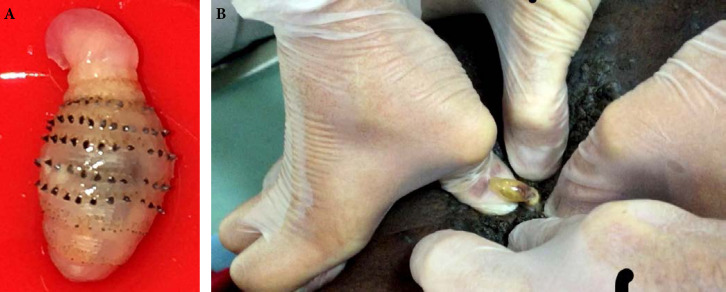
Myiase furonculoïde Légende: A. Larve de Dermatobia hominis (crédit photo: J. Destoop); B. Extraction à 4 mains d'un ver macaque de la fesse, Maripasoula (crédit photo: L. Epelboin) Furuncular myiasis A. Dermatobia hominis larva (photo credit: J. Destoop); B. Four-handed extraction of a botfly from the patient's buttock, Maripasoula (photo credit: L. Epelboin)
Figure 44
Figure 44
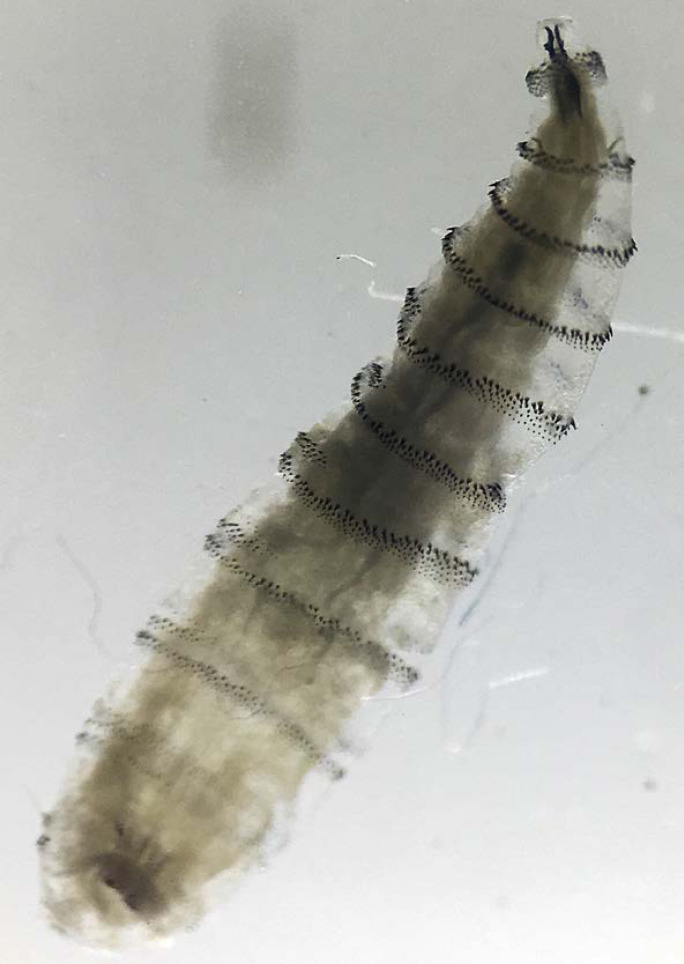
Larve de Cochliomyia hominivorax colonisant une cavité post-chirurgicale de cholestéatome (crédit photo: A. Mathieu) Cochliomyia hominivorax larva colonizing a post-surgical cholesteatoma cavity (photo credit: A. Mathieu)
Figure 45
Figure 45
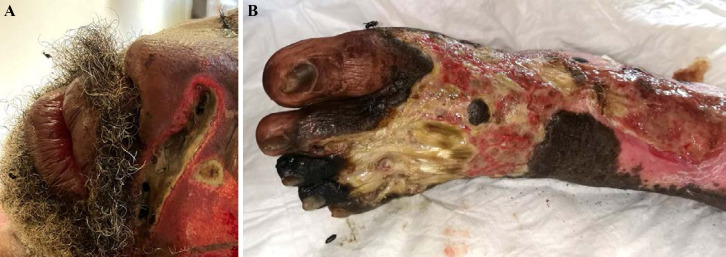
Myiases des plaies Légende: A. Myiases des plaies au niveau de la narine chez un patient épileptique hémiparétique (crédit photo: E. Borg); B. Mouche posée sur une plaie nécrotique lors de la réfection du pansement (crédit photo: M. Bourne Watrin) Wound myiases A. Nostril wound myiases in a hemiparetic epileptic patient (photo credit: E. Borg); B. Fly settled on a necrotic wound during the re-dressing process (photo credit: M. Bourne Watrin)
Figure 46
Figure 46
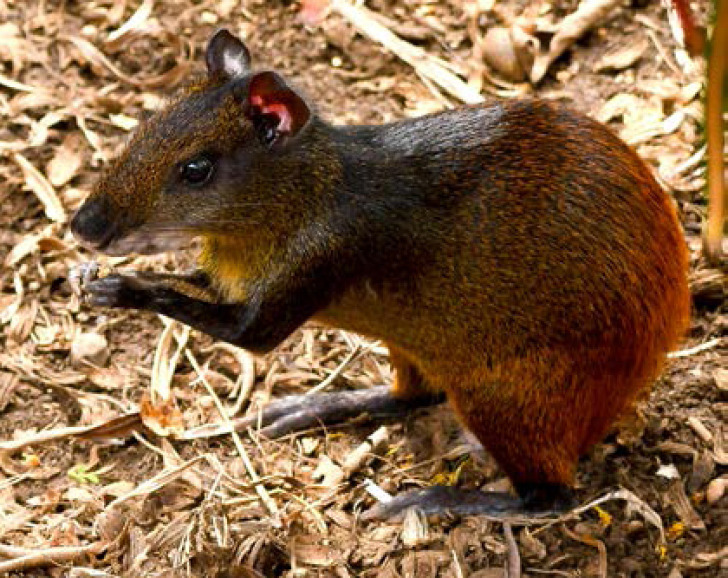
Agouti à cul roux (Dasyprocta leporina) aux Iles du Salut (crédit photo: L Epelboin) Red-rumped agouti (Dasyprocta leporina) in Iles du Salut (photo credit: L. Epelboin)
Figure 47
Figure 47
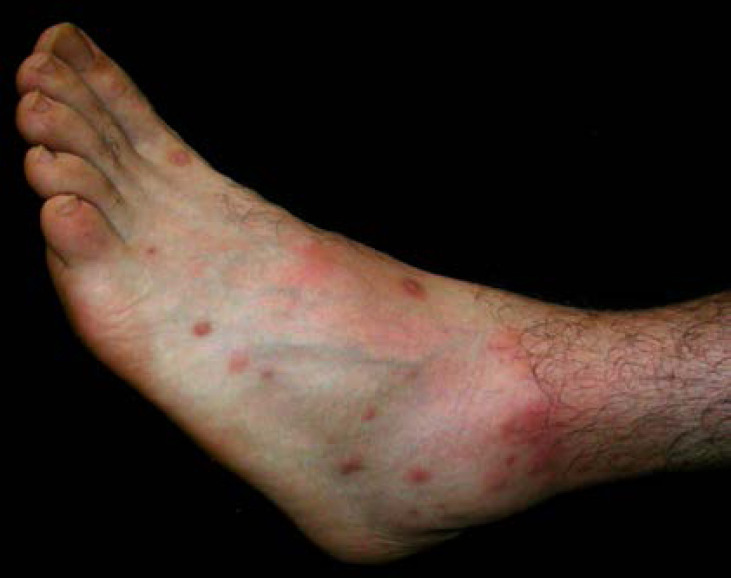
Poux d'agouti du pied gauche (crédit photo: P. Couppié) Agouti lice on left foot (photo credit: P. Couppié)
Figure 48
Figure 48
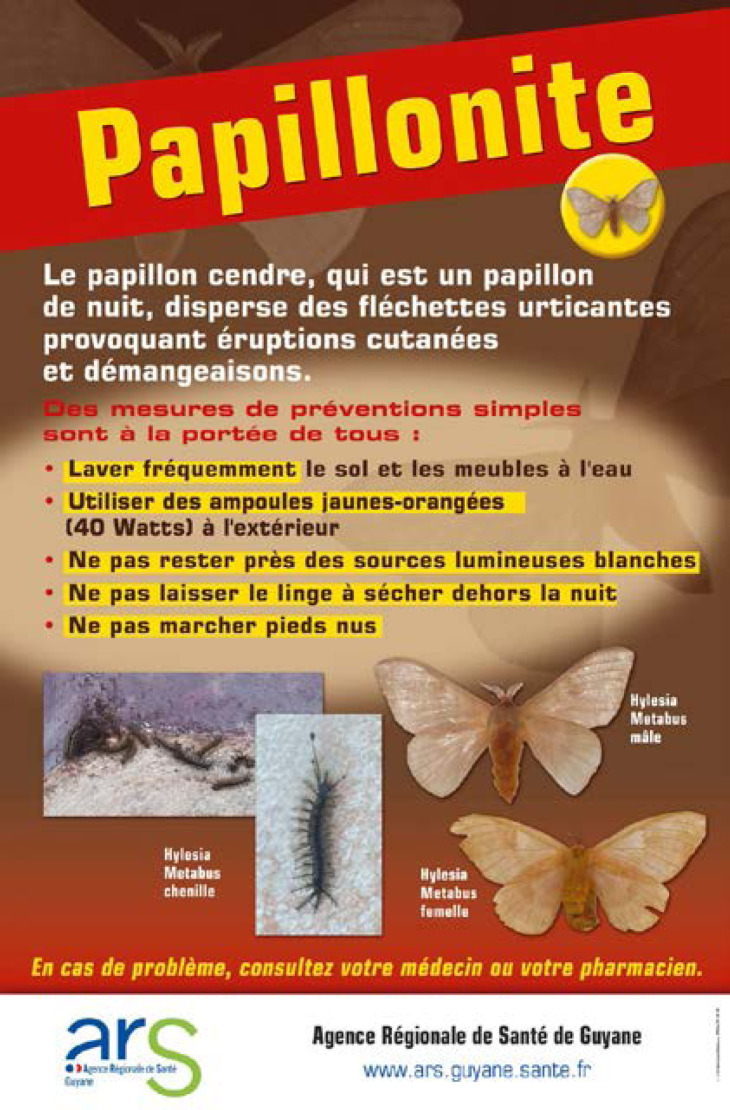
Affiche de prévention contre la papillonite (Hylesia metabus) (source: ARS Guyane) Lepidopterism prevention poster (Hylesia metabus) (source: ARS Guyane)
Figure 49
Figure 49
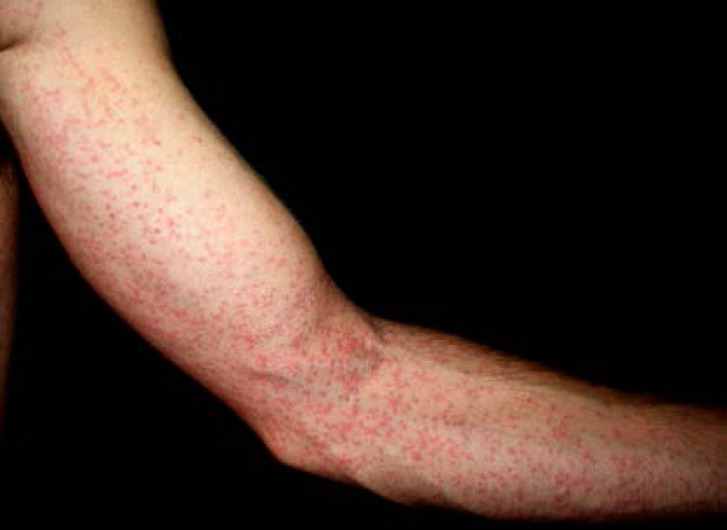
Lésions de papillonite du bras gauche (crédit photo: P. Couppié) Lepidopterism lesions on left arm (photo credit: P. Couppié)
Figure 50
Figure 50
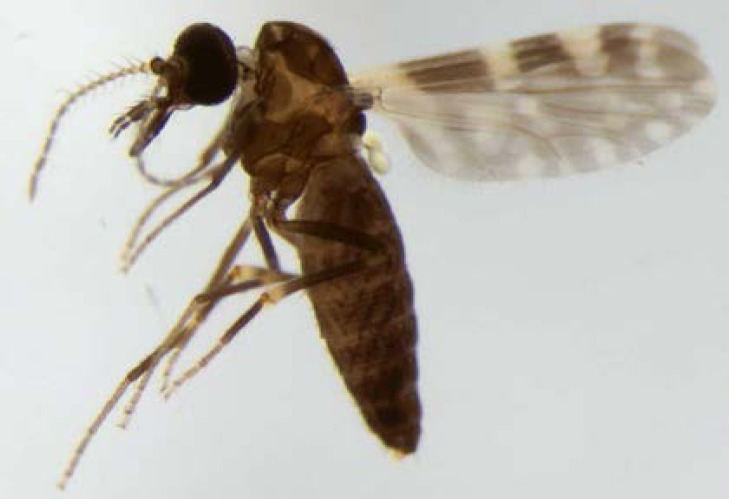
Femelle Culicoides hylas, collectée à Antecume Pata par Talaga, Lacour & Issaly, Mars 2018 (photo et identification: J.-B. Duchemin, IPG) Female Culicoides hylas, collected at Antecume Pata by Talaga, Lacour & Issaly, March 2018 (photo and identification J.-B. Duchemin, IPG)
Figure 51
Figure 51
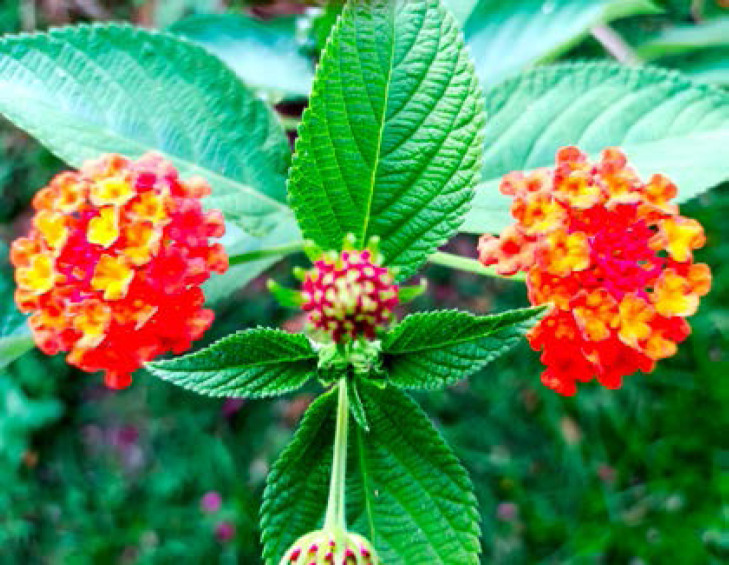
Lontana ou marie-crab (Lontana camara) dans un jardin de Cayenne (crédit photo: T. Blaise) Lantana camara in a Cayenne garden (photo credit: T. Blaise)
Figure 52
Figure 52
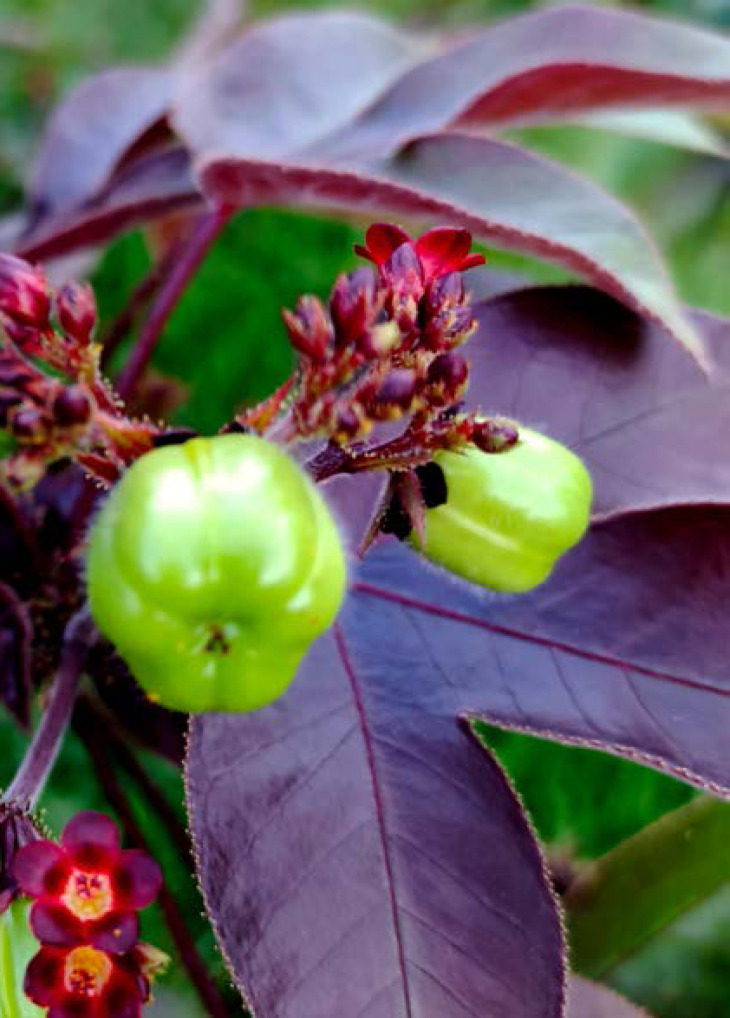
Médicinier Rouge (Jatropha Gossypiifolia) dans un jardin de Cayenne (crédit photo: T. Blaise) Bellyache bush (Jatropha Gossypiifolia) in a Cayenne garden (photo credit: T. Blaise)
Figure 53
Figure 53
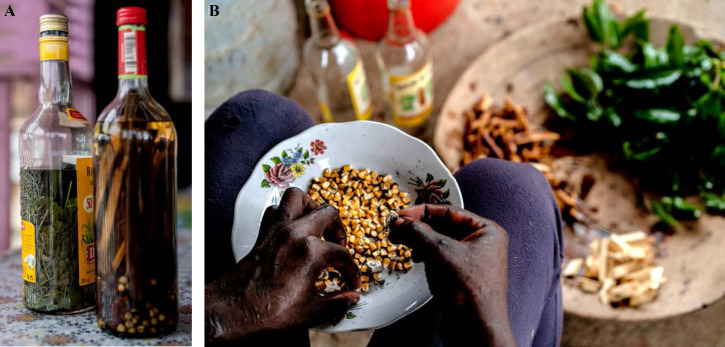
A. Bouteille de bita; B. Préparation d'une bouteille de bita par un tradipraticien ndjuka dans la commune d'Apatou (crédit photos: K. Joseph) A. Bottle of bita; B. Ndyuka tradipratician preparing a bottle of bita in Apatou commune (photo credits: K. Joseph)
Figure 54
Figure 54
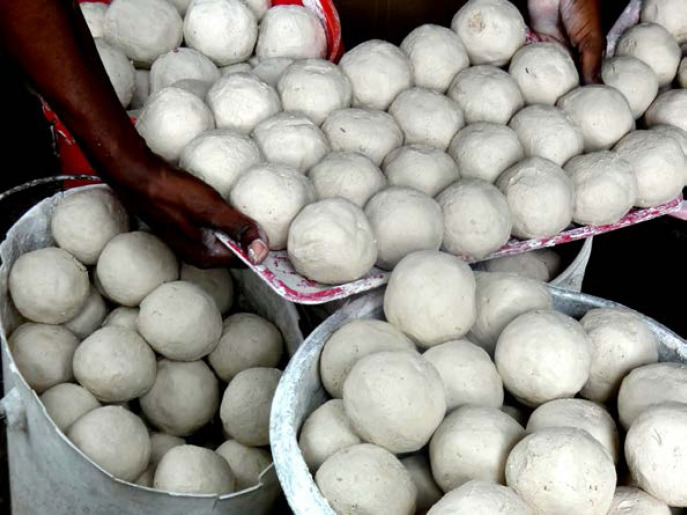
Boules de pemba en préparation dans un village côtier du Suriname (crédit photo: M.-A. Tareau) Preparation of pemba balls in a coastal village of Suriname (photo credit: M.-A. Tareau)
Figure 55
Figure 55
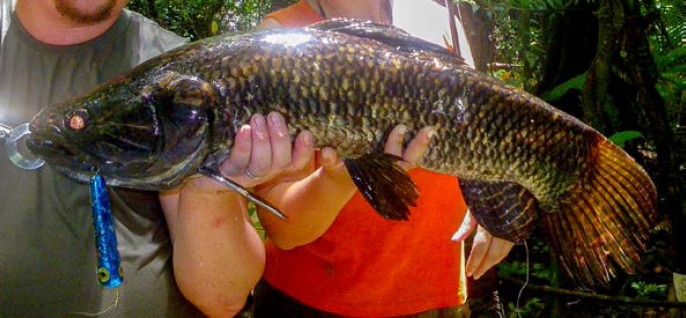
Pêche à l'aïmara au leurre (Hoplias aimara) (crédit photo: L. Epelboin) Haimara (Hoplias aimara) lure fishing (photo credit: L. Epelboin)
Figure 56
Figure 56
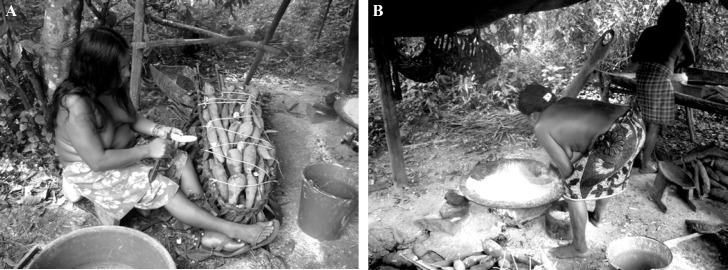
Préparation de la farine de manioc par des femmes Wayãpi à Trois-Sauts. A. Épluchage des tubercules de manioc; B. Cuisson du manioc râpé sur de grandes plaques de métal (crédit photos: L. Epelboin) Wayãpi women preparing manioc flour in Trois-Sauts. A. Peeling cassava tubers; B. Cooking grated manioc on large metal plates (photo credits: L. Epelboin)
Figure 57
Figure 57
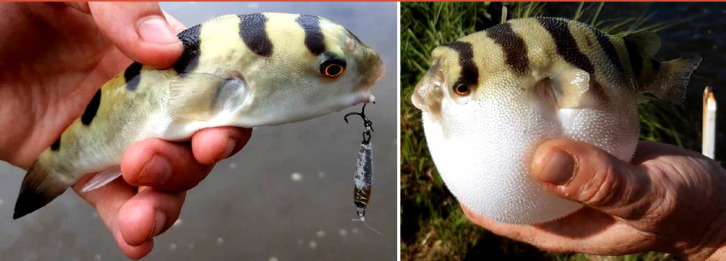
Tétrodon rayé ou poisson-globe (Colomesus psittacus) pêché et relâché à Kourou (crédit photos: E. Caussé) Banded puffer (Colomesus psittacus) caught and released in Kourou (photo credits: E. Caussé)
Figure 58
Figure 58
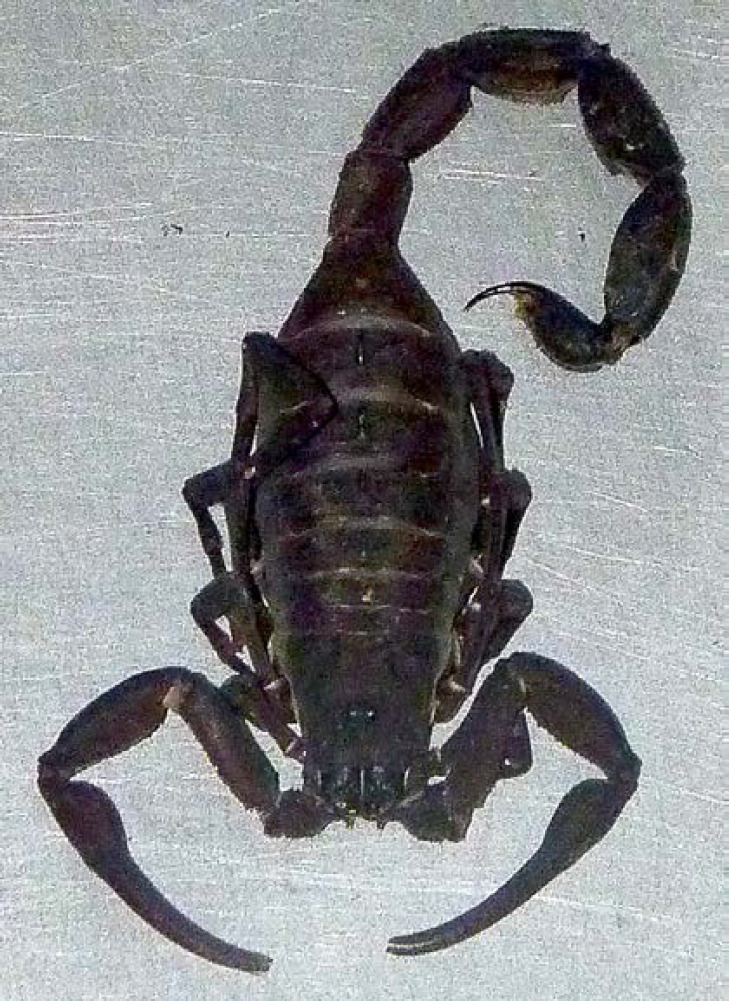
Scorpion « à petites pinces » Tityus obscurus dans un bac à douche à Stoupan (crédit photo: L. Epelboin) Amazonian black scorpion Tityus obscurus in a shower basin in Stoupan (photo credit: L. Epelboin)
Figure 59
Figure 59
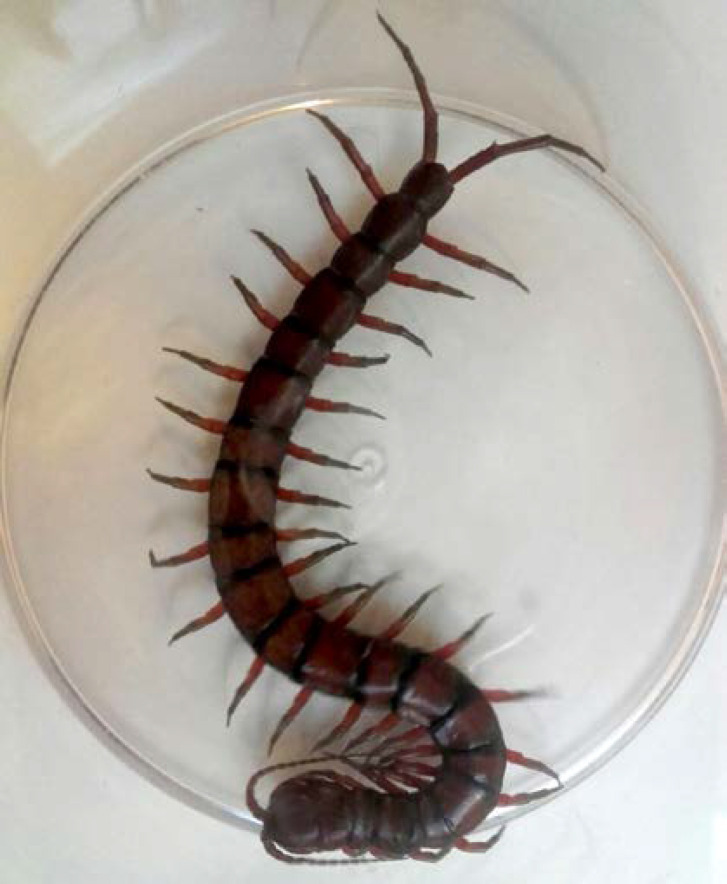
Scolopendre (crédit photo: Y. Epelboin) Scolopendra (photo credit: Y. Epelboin)
Figure 60
Figure 60
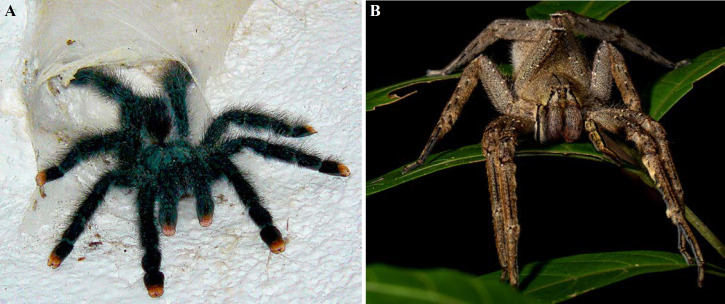
A. Matoutou (Avicularia avicularia), à l'entrée de son nid au plafond d'une maison de Stoupan (crédit photo: L. Epelboin); B. Phoneutria sp. sur une feuille en forêt (crédit photo: A. Merlin) A. Pinktoe tarantula (Avicularia avicularia) at the entrance of its nest on the ceiling of a house in Stoupan (photo credit: L. Epelboin); B. Phoneutria sp. on a leaf in the forest (photo credit: A. Merlin)
Figure 61
Figure 61
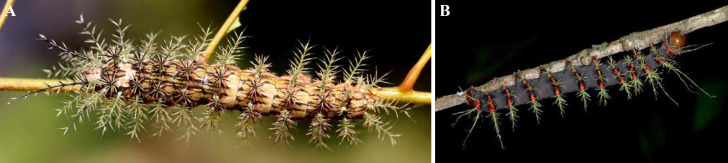
A. Chenille mature de Lonomia diabolus (ex-Lonomia achelous diabolus), La Césarée, Macouria (crédit photo: J.-P. Champenois); B. Chenille de Saturniidae (crédit photo: N. Defaux) A. Mature caterpillar of Lonomia diabolus (formerly Lonomia achelous diabolus), La Césarée, Macouria (photo credit: J.-P. Champenois); B. Caterpillar of Saturniidae (photo credit: N. Defaux)
Figure 62
Figure 62
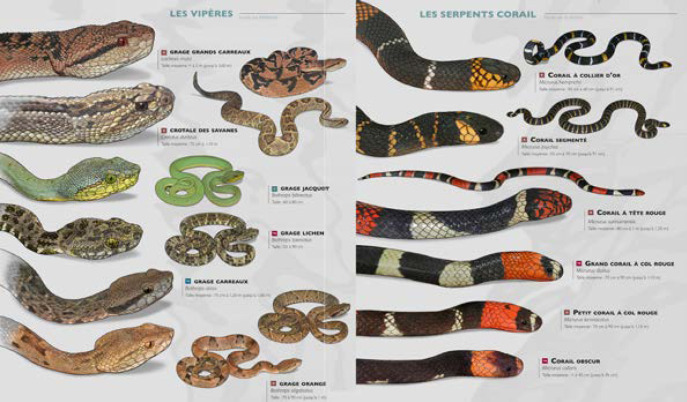
Serpents venimeux et dangereux de Guyane (source Good ID, Cerato et ARS Guyane) Poisonous and dangerous snakes in French Guiana (source: Good ID, Cerato and ARS Guyane)
Figure 63
Figure 63
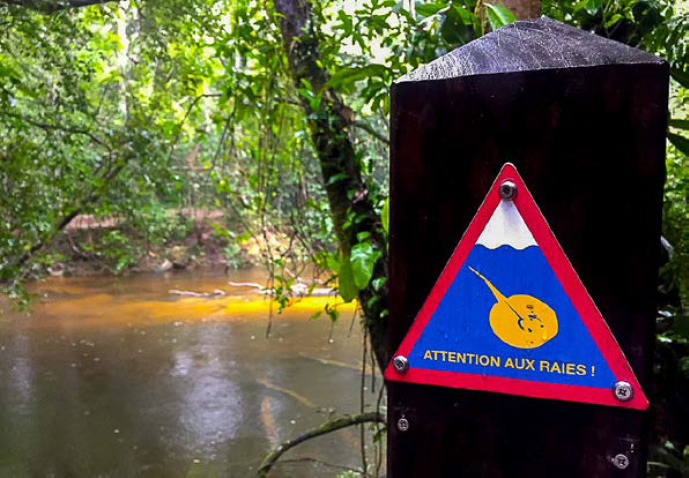
Panneau avertissant du risque de présence de raies au niveau de la crique Tonnégrande, au bout du sentier du Bagne des Annamites (crédit photo: L. Epelboin) Sign warning of the presence of stingrays near the Tonnégrande creek, at the end of Annamites Prison footpath (photo credit: L. Epelboin)
Figure 64
Figure 64
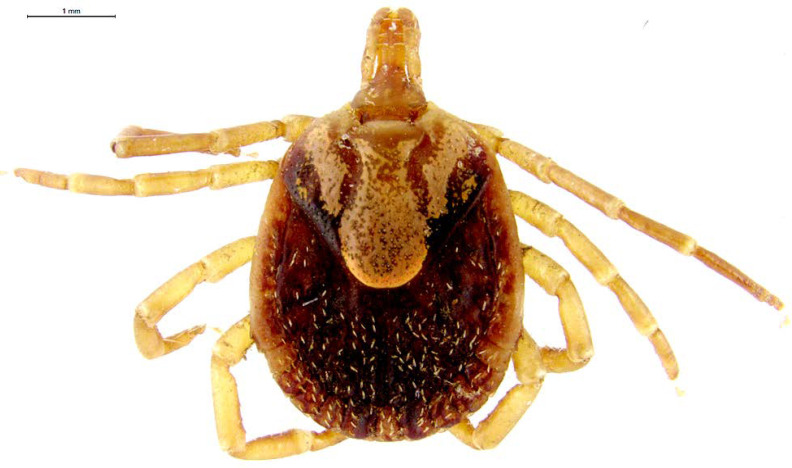
Femelle adulte de la tique Amblyomma cajennense (crédit photo: F. Binetruy, O. Duron) Adult female of the Amblyomma cajennense tick (photo credit: F. Binetruy, O. Duron)
Figure 65
Figure 65
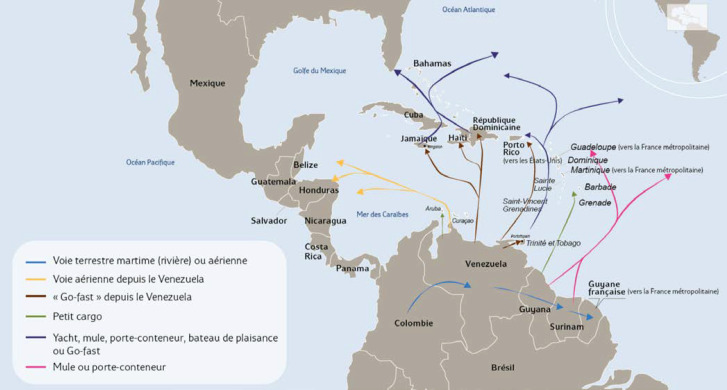
Carte des principales voies du narcotrafic depuis l'Amérique du Sud (source: OFDT, 2016) Map of the major drug trafficking routes from South America (source: OFDT, 2016)
Figure 66
Figure 66
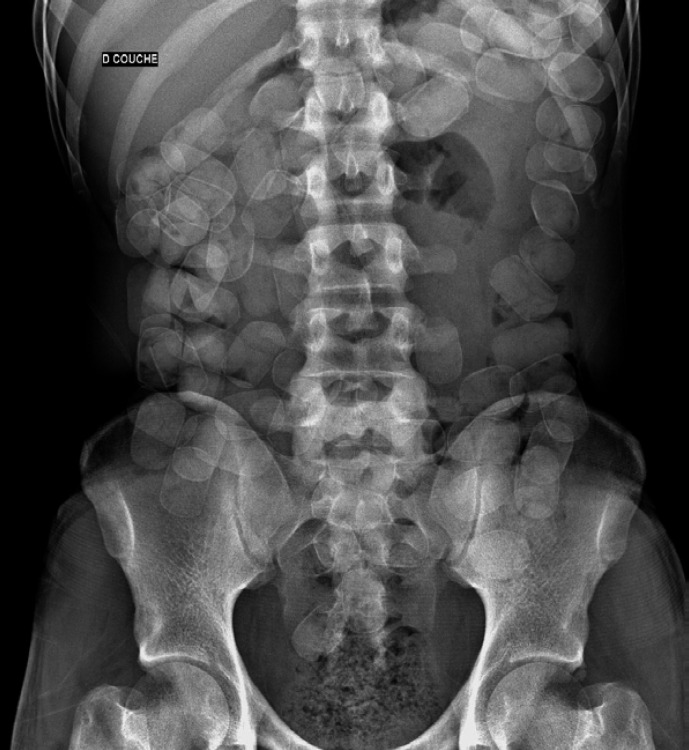
Cliché d'abdomen sans préparation de face montrant de nombreux corps étrangers (ovules de cocaïne ou « boulettes ») opaques dans l'ensemble du cadre colique aux urgences de Cayenne (crédit photo: M. Zappa) Plain abdominal film showing numerous opaque foreign bodies (cocaine eggs or “pellets”) throughout the colonic frame in the Cayenne Hospital emergency room (photo credit: M. Zappa)
Figure 67
Figure 67
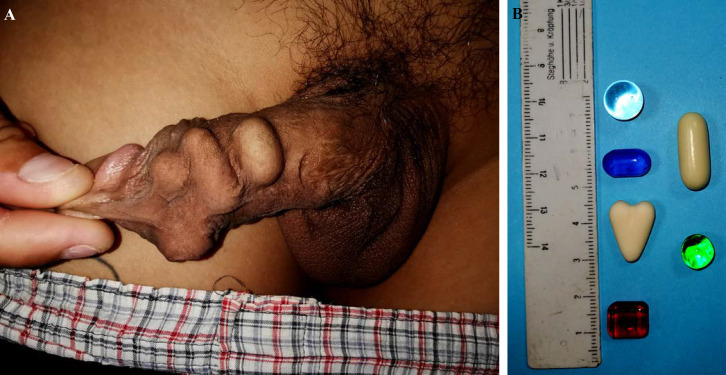
A. Plusieurs « bouglous » ou « dominos » sous-cutanés chez un patient incarcéré au Centre pénitentiaire de Guyane; B. Bouglous après extraction (crédit photos: T. Bonifay) A. Several subcutaneous “bouglous” or “dominoes” in a patient incarcerated at the French Guiana Penitentiary Centre; B. Bouglous after extraction (photo credits: T. Bonifay)
Figure 68
Figure 68
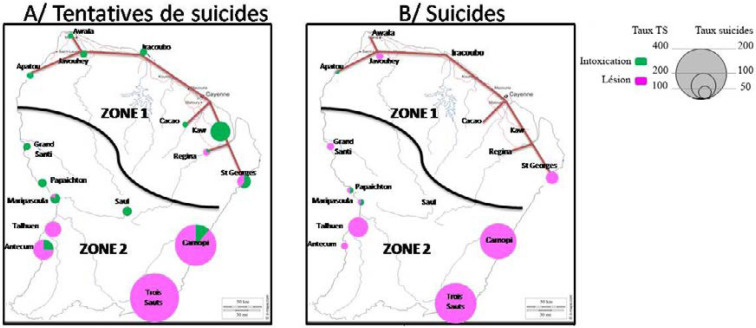
Nombre de cas de suicides et tentatives de suicide par localisation en Guyane, 2007-2016 [154] Number of cases of suicides and suicide attempts by location in French Guiana, 2007-2016 [154]
Figure 69
Figure 69
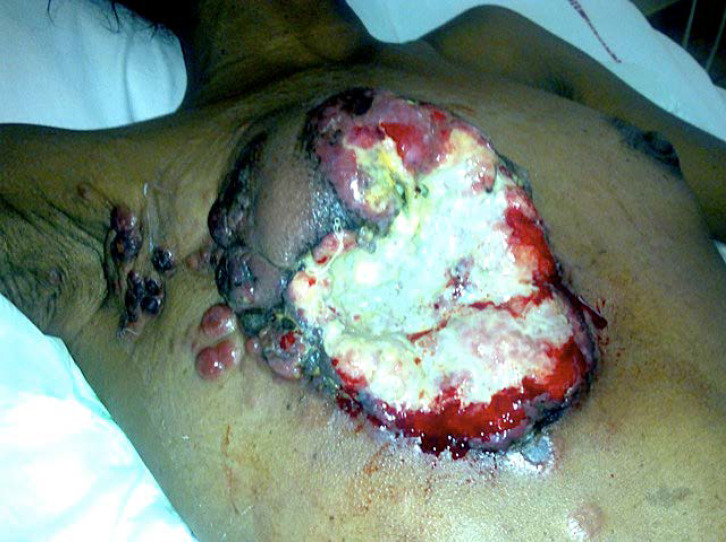
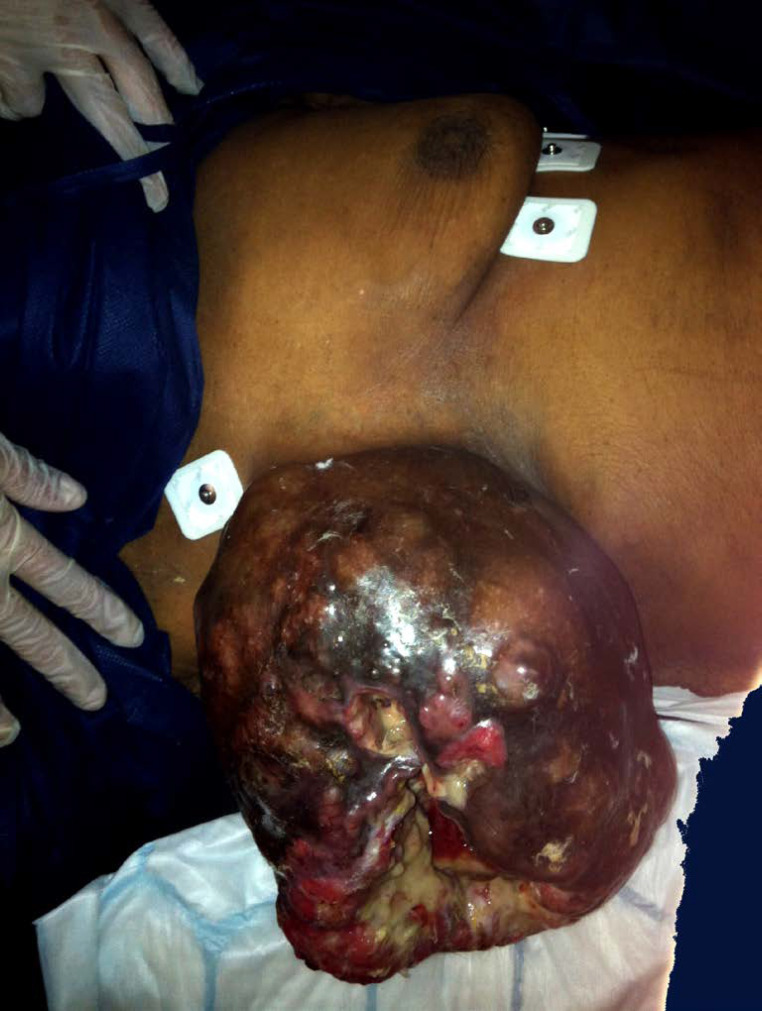
Patiente chinoise de 37 ans habitant Cayenne. Cancer du sein évoluant depuis 2 à 3 ans (caché, déni) et métastatique (os et foie). Carcinome canalaire infiltrant avec récepteurs hormonaux positifs et HER2 négatif (crédit photo: J.-P. Droz) Traitement par chimiothérapie 37-year-old Chinese woman living in Cayenne. Breast cancer evolving since 2 to 3 years (hidden, denial) and metastatic (bone and liver). Invasive ductal carcinoma with hormone receptor positive and HER2 negative (photo credit: J.-P. Droz) Chemotherapy treatment
Figure 70
Figure 70
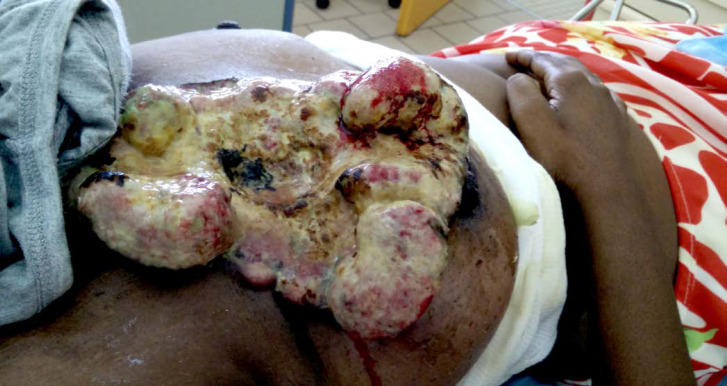
Patiente créole de 70 ans habitant Kourou, atteinte de cancer du sein droit classé T4BN0M1 (os, poumon). Carcinome canalaire infiltrant avec récepteurs hormonaux positifs et HER2 négatif (crédit photo: J.-P. Droz) Traitement par mastectomie, chimiothérapie et evasan dans l'Hexagone pour radiothérapie et chirurgie de consolidation rachidienne (métastases osseuses) 70-year-old Creole woman living in Kourou with right breast cancer classified T4BN0M1 (bone, lung). Invasive ductal carcinoma with hormone receptor positive and HER2 negative (photo credit: J.-P. Droz) Treatment by mastectomy, chemotherapy and medical evacuation to the Hexagon for radiotherapy and spinal consolidation surgery (bone metastases)
Figure 71
Figure 71
Patiente ndjuka, de nationalité surinamaise, de 45 ans habitant Mana (près de Saint-Laurent-du-Maroni) atteinte d'un cancer du sein T4dN1M0. Carcinome canalaire infiltrant avec récepteurs hormonaux et HER2 positifs (crédit photo: J.-P. Droz) Traitement par chimiothérapie et anticorps monoclonaux contre HER2 et inhibiteur de l'aromatase, puis prise en charge au Suriname pour radiothérapie de la paroi thoracique (réponse complète) 45-year-old Ndyuka woman, Surinamese nationality, living in Mana (near Saint-Laurent-du-Maroni), with T4dN1M0 breast cancer. Invasive ductal carcinoma with hormone receptor and HER2 positive (photo credit: J.-P. Droz) Treatment by chemotherapy and monoclonal antibodies against HER2 and aromatase inhibitor, then taken to Suriname for chest wall radiotherapy (complete response)
Figure 72
Figure 72
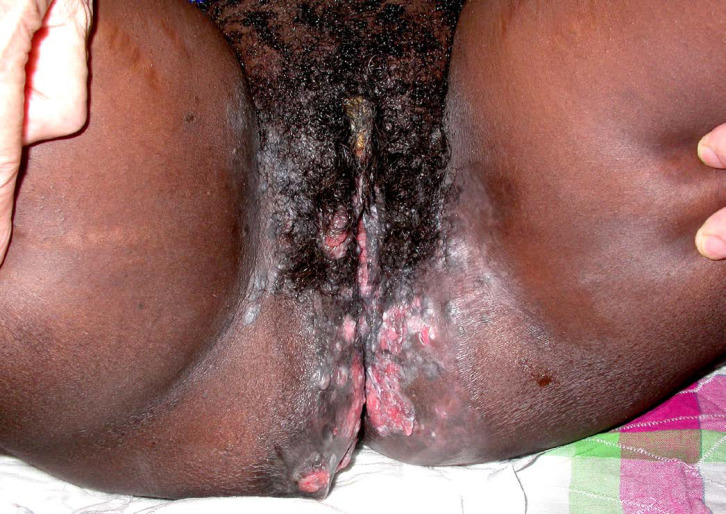
Patiente ndjuka de 29 ans, surinamaise, habitant Saint-Laurent-du-Maroni, VIH+ connue depuis l’âge de 17 ans, toxicomane au cannabis. Elle est atteinte d'une condylomatose HPV+ de tout le périnée avec des zones de carcinome in situ et micro-infiltration (crédit photo: J.-P. Droz) Traitement par chirurgie d'exérèse cutanée locale (avec autogreffe), contrôle de l'infection VIH. Développement d'un carcinome épidermoïde de la vulve traité par radiochimiothérapie (evasan dans l'Hexagone). Puis développement de métastases. 29-year-old Ndyuka Surinamese woman living in Saint-Laurent-du-Maroni, HIV+ known since the age of 17, cannabis addict. She has HPV+ condylomatosis of the entire perineum with areas of carcinoma in situ and microinfiltration. Treatment by local skin excision surgery (with autograft), control of HIV infection (photo credit: J.-P. Droz) Development of squamous cell carcinoma of the vulva treated with radiochemotherapy (medical evacuation to the Hexagon). Followed by development of metastases.
Figure 73
Figure 73
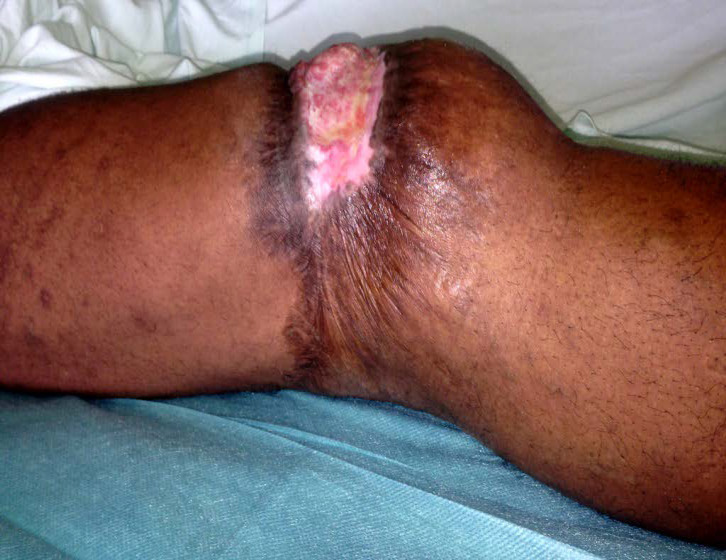
Patient brésilien de 58 ans, sans aucune prise en charge médico-sociale ni administrative, orpailleur sur le Maroni. Carcinome spinocellulaire infiltrant sur ancienne cicatrice de traumatisme de la cuisse droite audessus du genou, ganglion du triangle de Scarpa lié à une mycose (crédit photo: J.-P. Droz) Sur le scanner, découverte d'une passe surrénale droite qui évoque un incidentalome. En IRM, atteinte des muscles de la loge antérieure de la cuisse et de la partie supérieure de la loge antéro-externe de la jambe. Surrénalectomie montrant une métastase nécrosée du carcinome épidermoïde puis amputation tiers de cuisse. 58-year-old Brazilian gold digger on the Maroni, without any medical, social or administrative care. Invasive squamous cell carcinoma on old trauma scar of the right thigh above the knee, Scarpa's triangle lymph node related to a mycosis (photo credit: J.-P. Droz) On the CT scan, discovery of a right adrenal pass that suggests an incidentaloma. On MRI, involvement of the muscles of the anterior thigh and the upper part of the antero-external bed of the leg. Adrenalectomy showing necrotic metastasis of squamous cell carcinoma and third of thigh amputation.
Figure 74
Figure 74
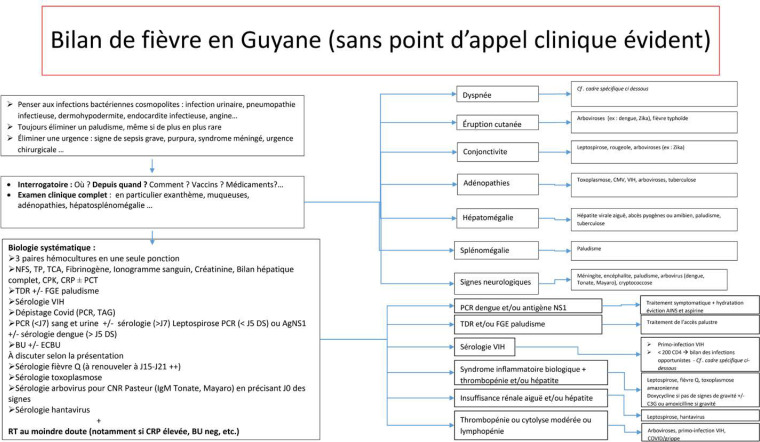
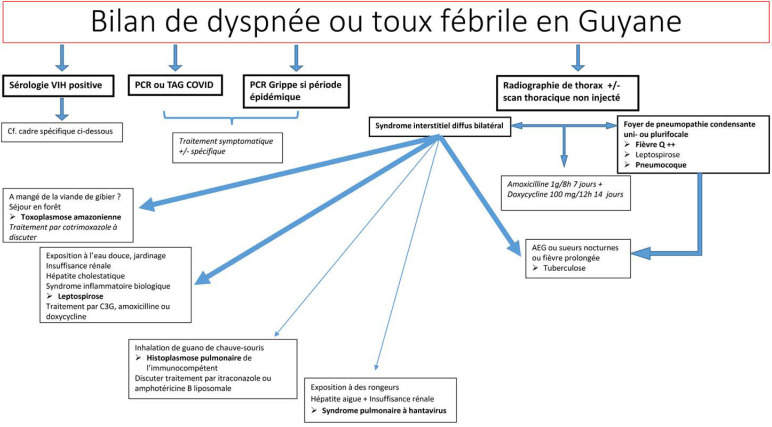
Algorithme décisionnel devant une fièvre chez un adulte immunocompétent vivant en Guyane ou en revenant Decision-making algorithm for fever in an immunocompetent adult living in or returning from French Guiana
Figure 75
Figure 75
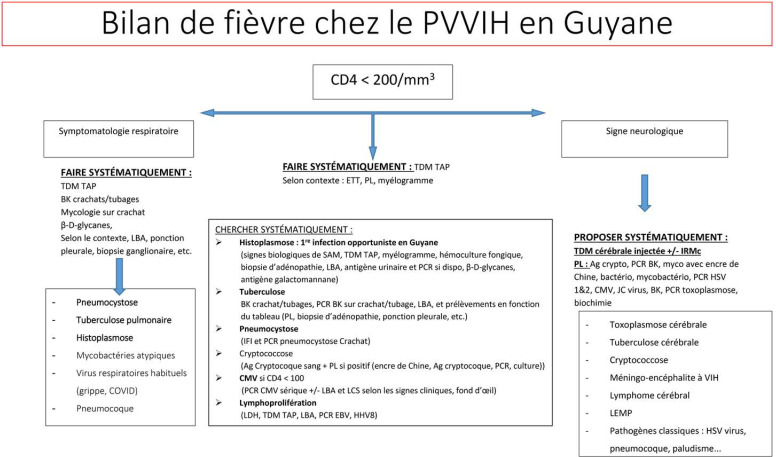
Algorithme décisionnel devant une fièvre chez un patient adulte vivant avec le VIH habitant en Guyane ou en revenant Decision-making algorithm for fever in an adult patient living with HIV residing in or returning from French Guiana
Figure 76
Figure 76
Algorithme décisionnel devant une fièvre chez un adulte immunocompétent vivant en Guyane ou en revenant Decision-making algorithm for fever in an immunocompetent adult living in or returning from French Guiana
None

References

    1. Abdelmoumen K, Drak Alsibai K, Rabier S, Nacher M, Wankpo N-B, Gessain A, Santa F, Hermine O, Marçais A, Couppié P, Droz JP, Epelboin L. HTLV Adult T-cell Leukemia and Lymphoma in French Guiana: Real Life Data from 2009 to 2019. The Lancet Regional Health - Americas. 2022 publ. en cours. - PMC - PubMed
    1. Aboikoni A, Allaire M, Louvel D, Blanchet D, Dao T, Carod JF, Demar M. Prevalence of intestinal parasite among patients attending two hospitals in French Guiana: A 6-year retrospective study. PLoS Negl Trop Dis. 2021;15(2):e0009087. doi:10.1371/journal.pntd.0009087 . - DOI - PMC - PubMed
    1. About F, Pastre T, Boutrou M, Yahiaoui Martinez A, Melzani A, Peugny S, Michaud C, Zouaoui S, Carage T, Sainte-Rose V, Demar M, Lavigne J-P, Djossou F, O'Callaghan D, Epelboin L, Keriel A. A novel species of Brucella causing human brucellosis in Amazonia. Emerg Inf Dis. 2022 publ. en cours. - PMC - PubMed
    1. Acosta-Ampudia Y, Monsalve DM, Rodriguez Y, Pacheco Y, Anaya JM, Ramirez-Santana C. Mayaro: an emerging viral threat? Emerging microbes & infections. 2018;7(1):163. - PMC - PubMed
    1. Adenis A, Du fit V, Douine M, Corlin F, Ayhan G, Najioullah F, Molinie V, Brousse P, Carles G, Lacoste V, Cesaire R, Nacher M. High prevalence of HPV infection in the remote villages of French Guiana: an epidemiological study. Epidemiol Infect. 2017;145(6):1276–1284. doi:10.1017/S0950268816003319 . - DOI - PMC - PubMed

LinkOut - more resources