


Extracorporeal membrane oxygenation as a bridge to lung transplantation: Practice patterns and patient outcomes
- PMID: 37394023
- PMCID: PMC10756924
- DOI: 10.1016/j.healun.2023.06.016
Extracorporeal membrane oxygenation as a bridge to lung transplantation: Practice patterns and patient outcomes
Abstract
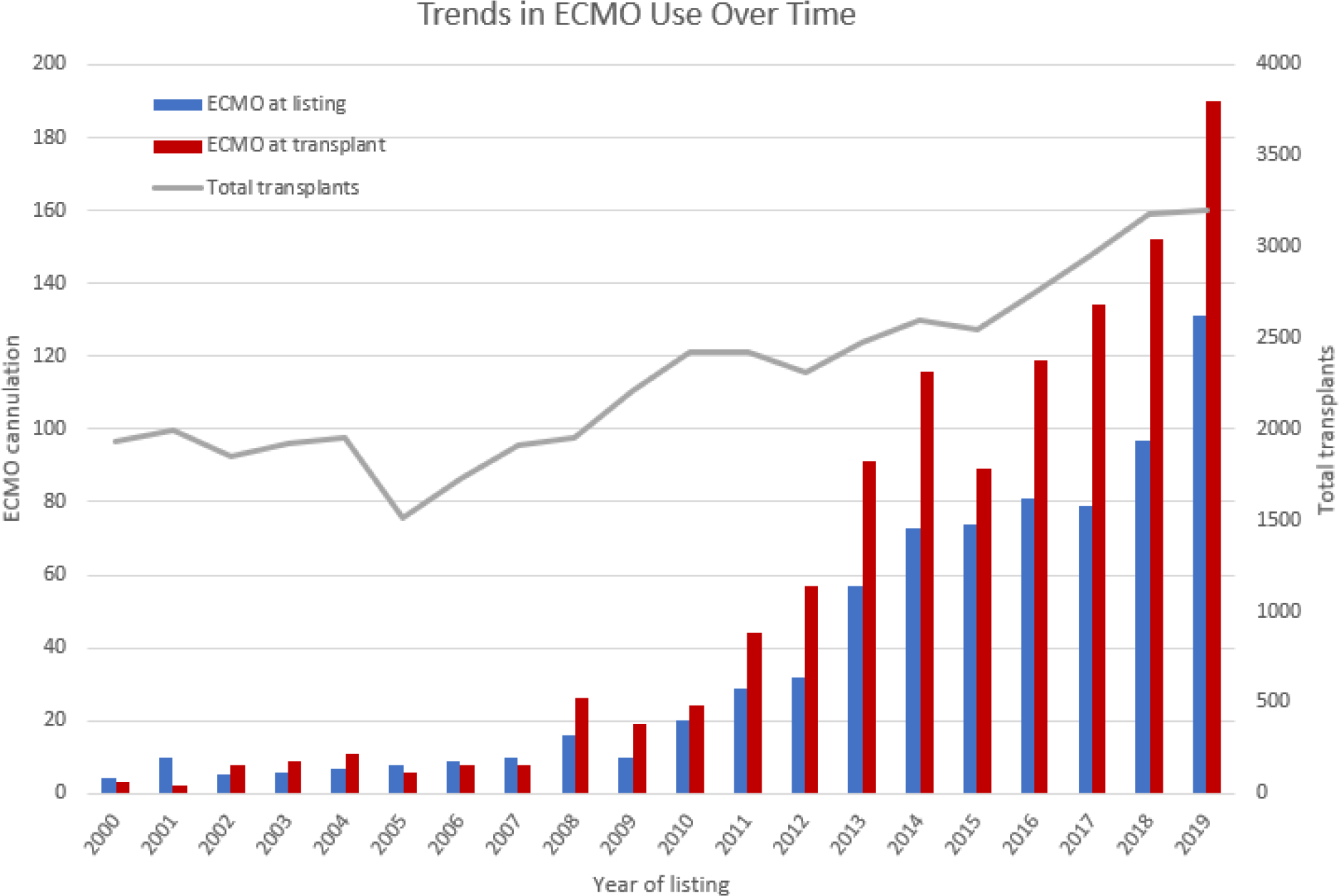
Background: Extracorporeal membrane oxygenation (ECMO) is increasingly relied on to bridge patients with respiratory failure to lung transplantation despite limited evidence for its use in this setting. This study evaluated longitudinal trends in practice patterns, patient characteristics, and outcomes in patients bridged with ECMO to lung transplant.
Methods: A retrospective review of all adult isolated lung transplant patients in the United Network for Organ Sharing database between 2000 and 2019 was performed. Patients were classified as "ECMO" if supported with ECMO at the time of listing or transplantation and "non-ECMO" otherwise. Linear regression was used to evaluate trends in patient demographics during the study period. Trends in mortality were evaluated using Cox proportional hazards modeling, with time period as the primary covariate (2000-2004, 2005-2009, 2010-2014, or 2015-2019) and age, time on the waitlist, and underlying diagnosis as covariates.
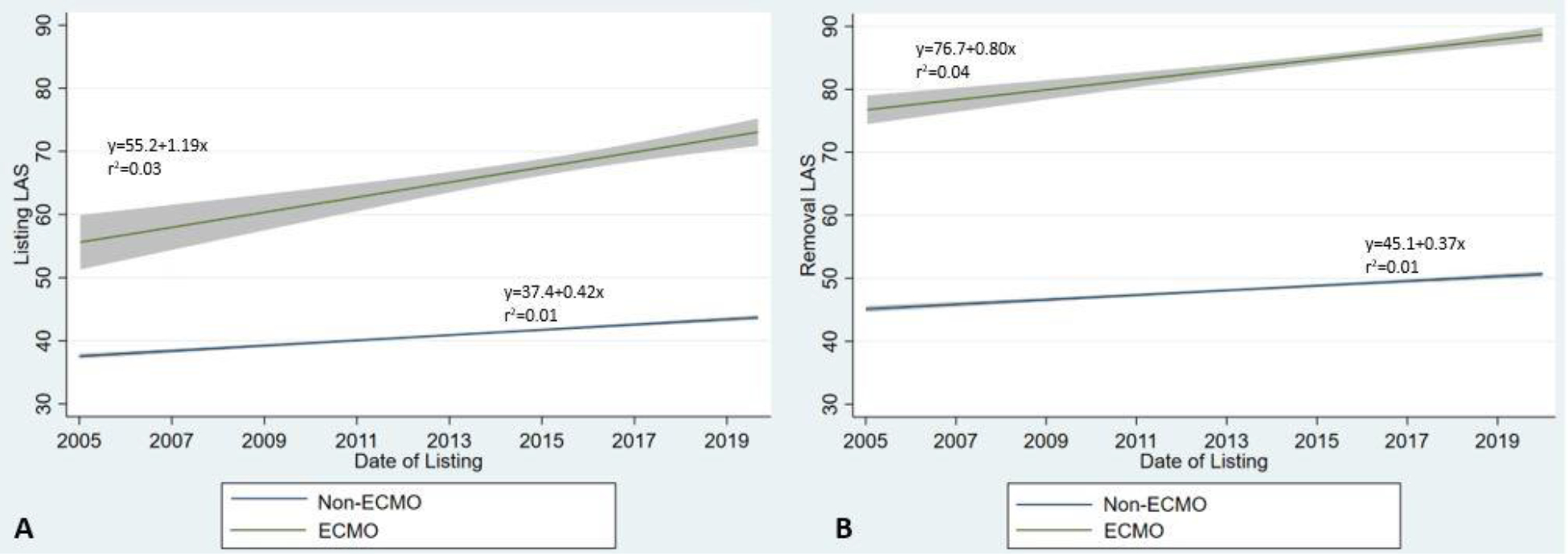
Results: The number of patients included were 40,866, of whom 1,387 (3.4%) were classified as ECMO and 39,479 (96.6%) as no ECMO. Average age and initial Lung Allocation Score increased significantly during the study period in both cohorts, but occurred at a slower rate in the ECMO population. The hazard of death was significantly lower in more recent years (2015-2019) for both the ECMO and non-ECMO cohorts (aHR (adjusted hazards ratio) 0.59, 95% confidence interval (CI) 0.37-0.96 and aHR 0.74, 95% CI 0.70-0.79) when compared to the early years (2000-2004) of the study period.
Conclusions: Post-transplantation survival for patients bridged to transplantation with ECMO demonstrates ongoing improvement despite cannulation of progressively older and sicker patients.
Keywords: ECMO; bridge to transplant; lung transplant; trends.
Copyright © 2023 International Society for the Heart and Lung Transplantation. Published by Elsevier Inc. All rights reserved.
Conflict of interest statement
DECLARATION OF COMPETING INTEREST:
There are no relevant financial disclosures.
Figures


References
MeSH terms
Grants and funding
LinkOut - more resources
Full Text Sources
Medical
