Review
. 2023 Sep;27(9):791-804.
doi: 10.1016/j.tics.2023.06.003. Epub 2023 Jul 1.

Color appearance and the end of Hering's Opponent-Colors Theory

Affiliations
Review

Color appearance and the end of Hering's Opponent-Colors Theory

Bevil R Conway et al. Trends Cogn Sci. 2023 Sep.

Abstract

Hering's Opponent-Colors Theory has been central to understanding color appearance for 150 years. It aims to explain the phenomenology of colors with two linked propositions. First, a psychological hypothesis stipulates that any color is described necessarily and sufficiently by the extent to which it appears reddish-versus-greenish, bluish-versus-yellowish, and blackish-versus-whitish. Second, a physiological hypothesis stipulates that these perceptual mechanisms are encoded by three innate brain mechanisms. We review the evidence and conclude that neither side of the linking proposition is accurate: the theory is wrong. We sketch out an alternative, Utility-Based Coding, by which the known retinal cone-opponent mechanisms represent optimal encoding of spectral information given competing selective pressure to extract high-acuity spatial information; and phenomenological color categories represent an adaptive, efficient, output of the brain governed by behavioral demands.

Keywords: color perception; cones; linking hypothesis; neural networks; perceptual mechanisms.


Conflict of interest statement

Declaration of interests No interests are declared.

Figures
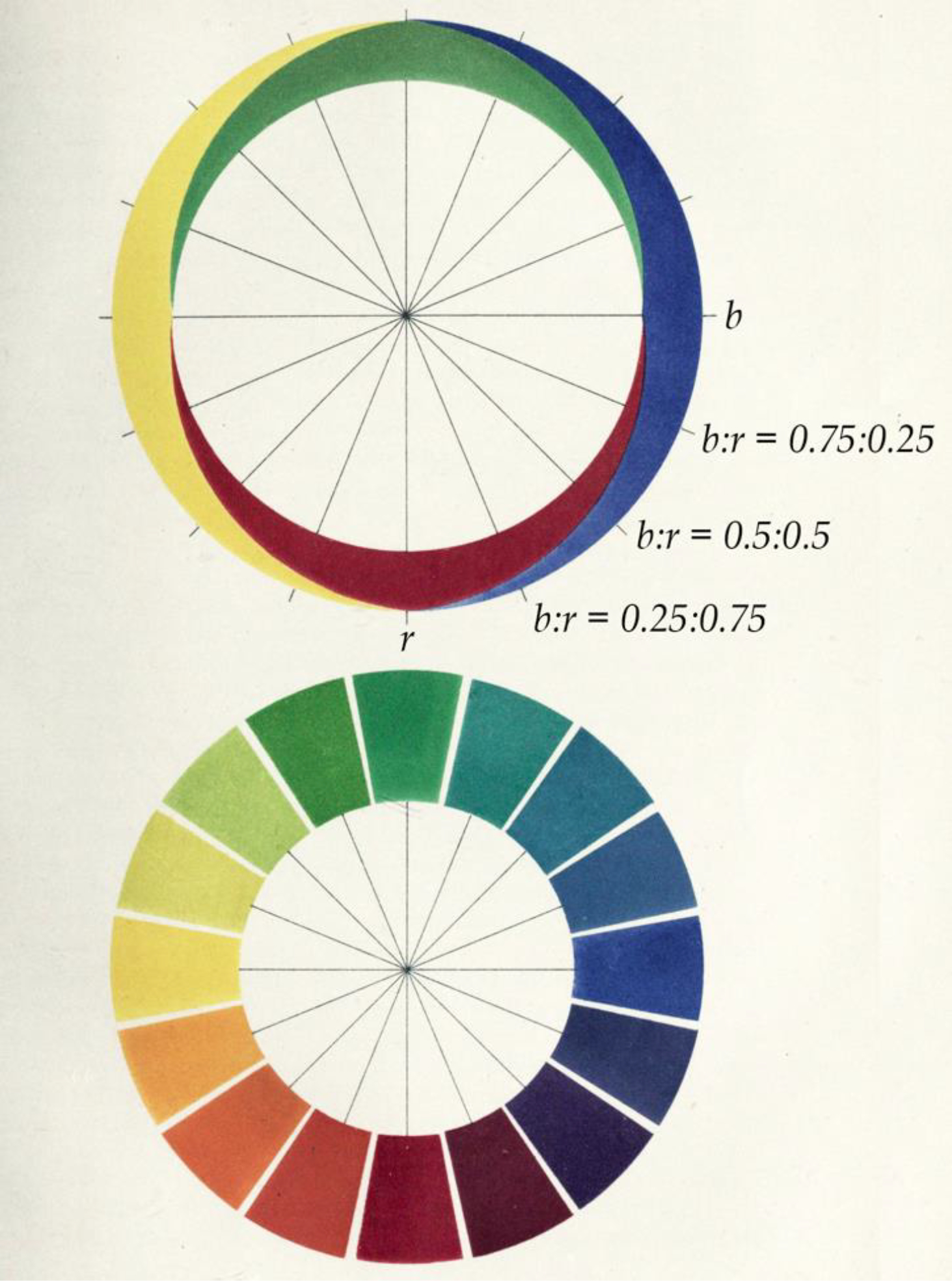
Figure 1.
Figure 1.. Opponent-Colors Theory.
Diagram by Ewald Hering illustrating Opponent-Colors Theory. According to Hering, “the six basic sensations of the visual substance are arranged in three pairs: Black and white, blue and yellow, green and red. Each of these three pairs corresponds to a distinct process of dissimilation and assimilation, such that the visual substance can undergo chemical or metabolic change in three different ways” ([2], §. 42.). In the top panel, “r” is red, “b” is blue, and the ratios indicate the combinations of these components in each color mixture of the bottom panel. So, purple has a ratio of blue to red (b:r) of 0.5:0.5. Hering’s theory boils down to two ideas (1) that the appearance of any color is necessarily and sufficiently described by the extent to which it is reddish-versus-greenish, bluish-versus-yellowish, and blackish-versus-whitish; and (2) that these appearance mechanisms are hardwired in the nervous system.
Figure 2.
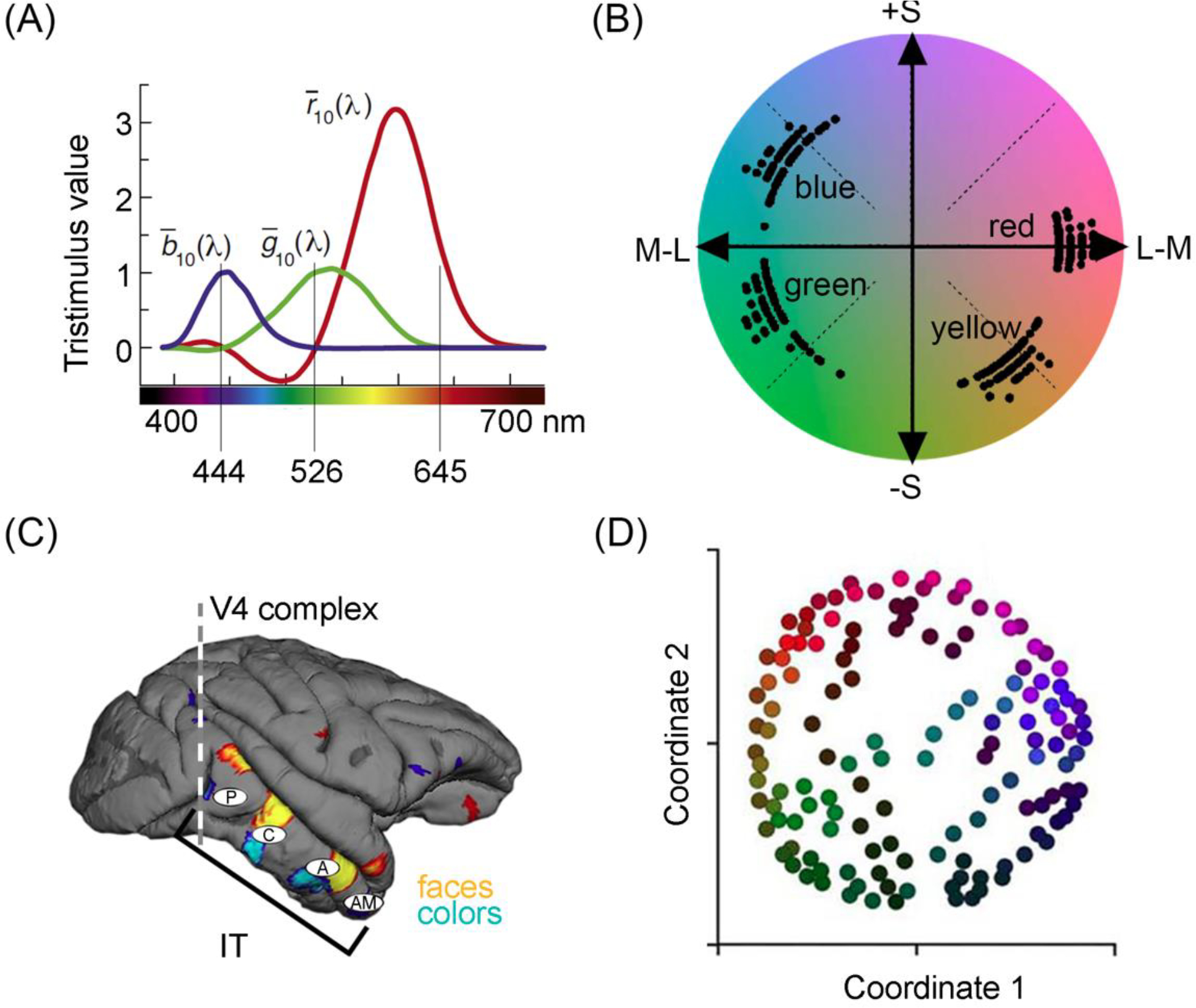
Figure 2.. Color encoding and neural representation.
(A). Color matching functions [28]. The y-axis shows the value of each of three primary lights (444nm, 526nm, 645nm) required to match each monochromatic test light on the x-axis. To match some test lights, the primary must be added to the test not to the other primaries, indicated by negative numbers. Color matching data provide evidence of the essential trichromacy of human color vision. (B) Distribution of unique hue settings for 51 observers projected onto a cone-opponent color space [33]. The axes isolate the two cone-opponent mechanisms of the retina; colors along the x-axis vary only in their L and M modulation; colors along the y-axis vary only in modulation of the S cone. (C). Lateral view of the macaque brain showing functional domains biased for colors and faces, identified with fMRI. The vertical line shows the plane of section of the V4 complex. The white ovals indicate four stages in inferior temporal cortex defined by functional and anatomical data (P, posterior; C, central; A, anterior; AM anterior-medial) [55,59]. The existence of color-biased domains in inferior temporal cortex implies that color depends on high-level perceptual and cognitive operations. (D). Geometry of the neural representation of color for neurons within the color-responsive subcompartments of the V4 Complex, calculated by multidimensional scaling [57]. Stimuli are plotted by the two-dimensional embedding determined by the responses of 300 cells.
Figure 3.
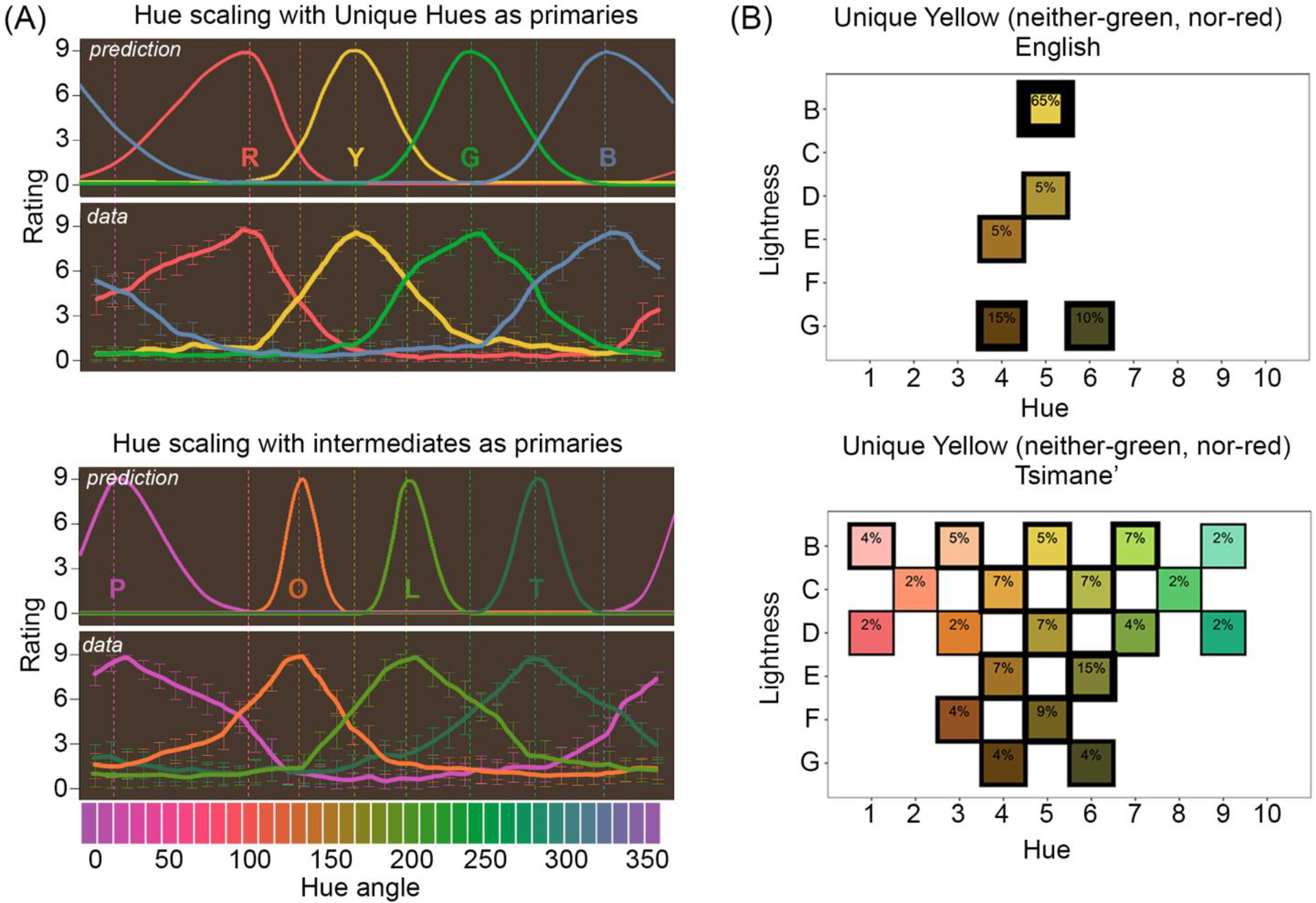
Figure 3.. Lime, purple, orange and teal can be taken as unique hues
(A). Hue scaling in which participants rated the proportion of unique hues (top) or intermediate colors (bottom) for a complete set of colors; each panel shows predictions from Opponent-Colors Theory and the data, adapted from [63]. The data in the top panel are consistent with the theory and the classic hue-cancellation experiments; the data in the bottom panel violates the predictions because participants observed unique hues as composed of proportions of intermediate colors. (B) Distribution of color chips selected by English speakers (top) or mono-lingual Tsimane’ speakers (bottom) tasked with picking the color chip that is neither reddish nor greenish, adapted from [131]. The experiment focused on yellow, the most consistent unique hue in classic studies, and it used a paradigm that is thought to be effortless. Participants in both language groups first identified the best exemplars of their terms for red and blue/green. Answers are comparable across groups, showing that the Tsimane’ understand the task instructions. The results support the conclusion that the Tsimane’ do not have an innate sense of unique yellow.
Box 1 Figure.
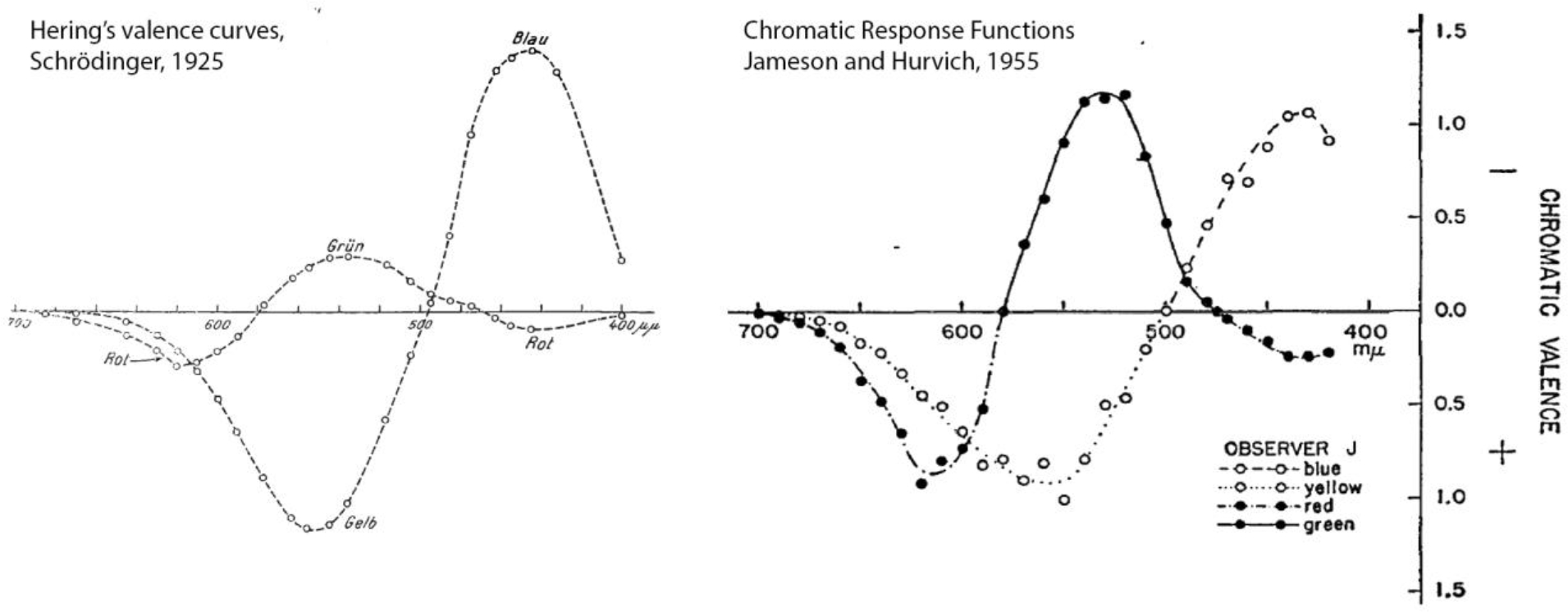
Box 1 Figure.. Hering’s valence curves (left) and Hurvich and Jameson’s hue-cancelation curves (right).
The y-axis scaling is arbitrary. Both curves plot the amount of redness, greenness, blueness, and yellowness associated with each wavelength, and show the same pattern of results (note the location of the curve crossings; grün, green; rot, red; blau, blue; gelb, yellow). The valence curves were derived on introspection; the hue-cancelation curves were based on hue-cancelation experiments.

References

    1. Brainard DH and Hurlbert AC (2015) Colour Vision: Understanding #TheDress. Curr Biol 25, R551–554. 10.1016/j.cub.2015.05.020 - DOI - PubMed
    1. Hering E (1878) Zur Lehre vom Lichtsinne Carl Gerold’s Sohn, pp141.

      This reference is the revised and collated selection of papers originally published between 1872–1875. A posthumous summary was published in 1920 and translated by Hurvich and Jameson as Outlines of a theory of the light sense (Harvard University Press, 1964).

    1. Teller DY (1984) Linking propositions. Vision Research 24, 1233–1246 - PubMed
    1. Abramov I and Gordon J (1994) Color appearance: on seeing red--or yellow, or green, or blue. Annu Rev Psychol 45, 451–485 - PubMed
    1. Mollon JD and Jordan G (1997) On the nature of unique hues. In John Dalton’s Colour Vision Legacy (Dickenson C et al. , eds), pp. 381–392, Taylor & Francis

Publication types

LinkOut - more resources