Review
. 2023 Jul 3;14(1):114.
doi: 10.1186/s13244-023-01458-x.

A clinician's guide to understanding aortic 4D flow MRI

Affiliations
Review

A clinician's guide to understanding aortic 4D flow MRI

Mitch J F G Ramaekers et al. Insights Imaging. .

Abstract

Four-dimensional flow magnetic resonance imaging is an emerging technique which may play a role in diagnosis and risk-stratification of aortic disease. Some knowledge of flow dynamics and related parameters is necessary to understand and apply this technique in clinical workflows. The purpose of the current review is to provide a guide for clinicians to the basics of flow imaging, frequently used flow-related parameters, and their relevance in the context of aortic disease.Clinical relevance statement Understanding normal and abnormal aortic flow could improve clinical care in patients with aortic disease.

Keywords: 4D flow MRI; Aorta; Blood flow; MRI; Vessels.


Conflict of interest statement

The authors declare that they have no competing interests.

Figures
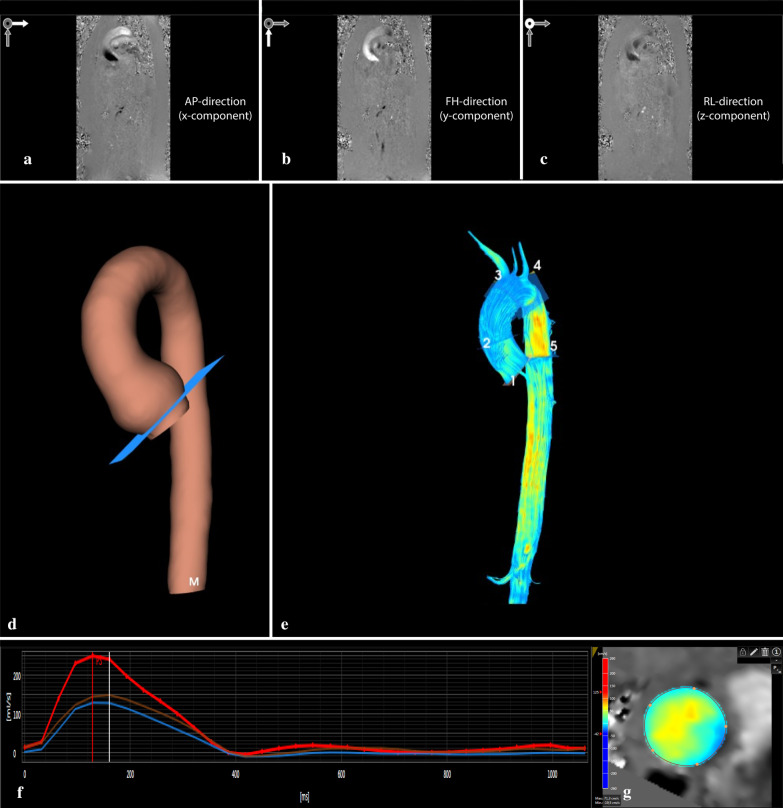
Fig. 1
Fig. 1
General workflow of analyzing aortic 4D flow MRI data. ac depict the phase images of the phase contrast data with velocity encoding in three directions (i.e. anterior–posterior (AP; X-component), feet-head (FH; Y-component), and left–right (LR, Z-component). After the pre-processing steps, including phase offset and anti-aliasing correction, luminal segmentation is performed on the combined phase contrast images. This results in a 3D model as seen in image d. Image e represents the streamlines of blood flow within the aortic volume. Manual placement of 2D planes along the centerline results in a quantified flow graph (f). Each line represents a 2D plane and a cross-sectional image of through plane velocity profile (g). Red depicts high velocity; blue depicts low and retrograde velocity
Fig. 2
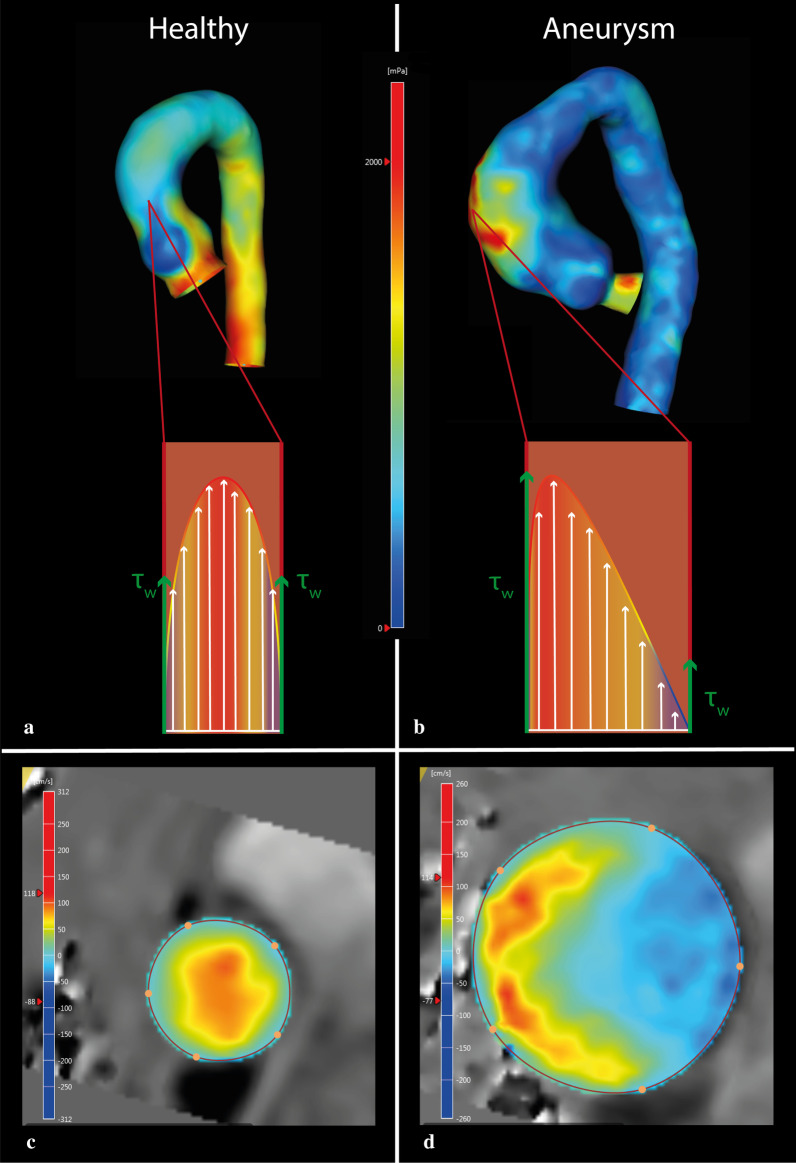
Fig. 2
Distribution of wall shear stress in the thoracic aorta of a healthy control (a and c) and a patient with an aneurysm of the ascending aorta (b and d). The schematic image illustrates a laminar-like flow pattern in a, with high velocities in the center of the vessel and low velocities along the vessel wall. In b, the schematic image shows a skewed flow profile with highest velocities away from the center of the vessel. In the healthy volunteer (a), an even distribution of WSS (τw) is seen, whereas the patient with the aneurysm (b), shows higher WSS at the anterior side of the ascending aorta and lower WSS on the opposite side. c, d depict corresponding cross-sectional flow profiles. c (healthy control) depicts a flow pattern with almost no flow displacement, whereas d (degenerative ascending aortic aneurysm) depicts a flow pattern with large flow displacement. a and b Red depicts high WSS; blue depicts low WSS. c and d Red depicts high velocity; blue depicts low and retrograde velocity
Fig. 3
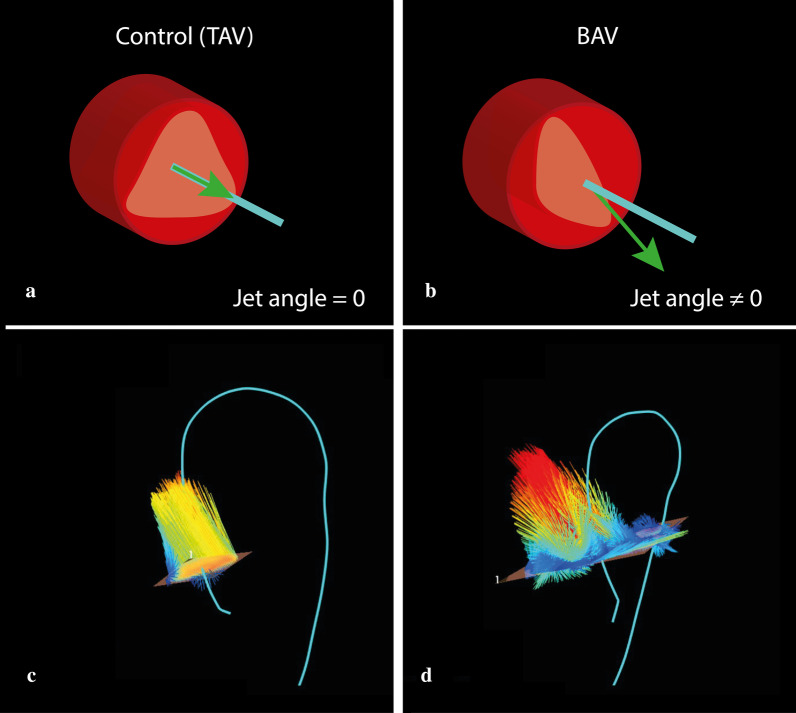
Fig. 3
Schematic representations of normal and abnormal aortic jet angles (between the centerline and the direction of the velocity vector). a A normal jet angle (≈ 0°), with normally functioning tricuspid aortic valve: the green arrow, representing the velocity vector, is perfectly aligned with the light blue line, representing the geometric centerline of the aorta. b Abnormal jet angle (≠ 0˚), with bicuspid aortic valve (BAV): the velocity vector is misaligned with the aorta centerline. c Velocity vectors at the level of the aortic annulus with a normal flow jet angle: the vectors are generally aligned to the (light blue) centerline. d Velocity vectors at the level of the aortic annulus with abnormal flow jet angle: the vectors are generally pointed away from the centerline and thus are directed towards the aortic wall
Fig. 4
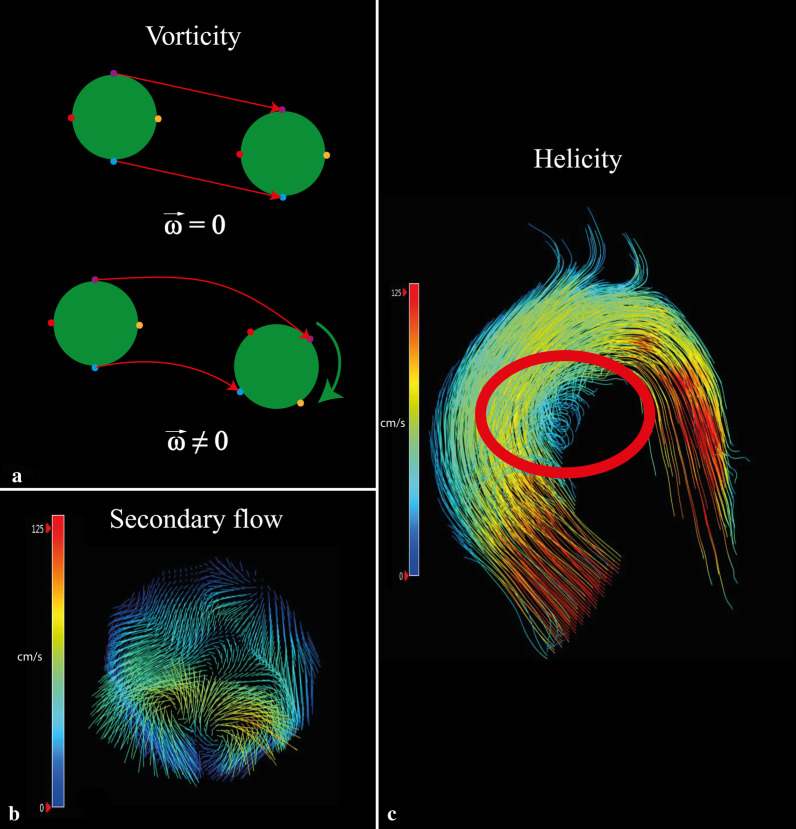
Fig. 4
Schematic and in vivo visualization of rotational flow parameters (vorticity and helicity). a A schematic representation of vorticity (ω). The upper particle moves in space without rotating. The bottom particle moves in the same direction but also spins around its own axis, resulting in a curl. b Vorticity is clearly seen when looking at the in-plane vectors. This plane is located in the aortic arch where secondary flow patterns are physiological. In this case, two counter-rotating vortices are seen. c An example of helical flow (red circle)
Fig. 5
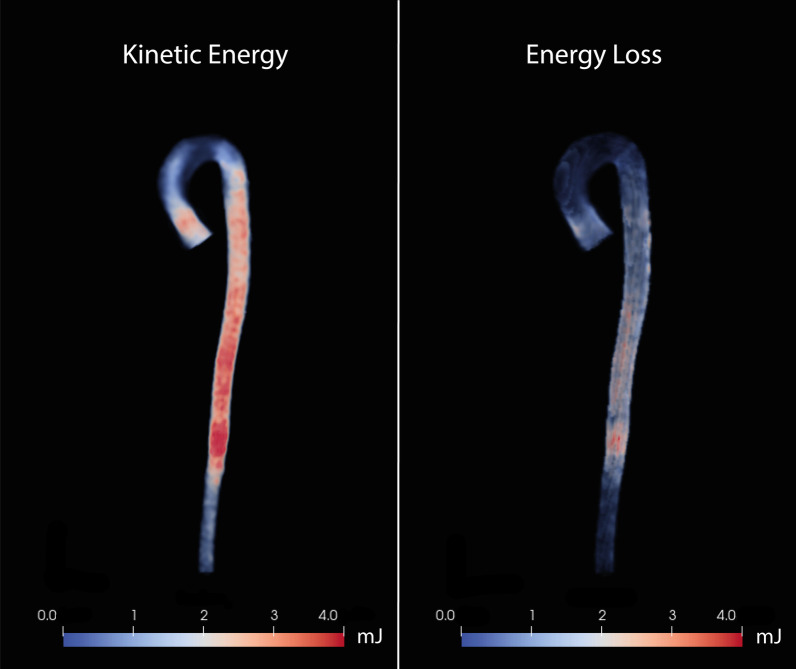
Fig. 5
Color maps of kinetic energy (left) and viscous energy loss (right) in the total aorta in a healthy volunteer at peak systole (in millijoules [mJ])
Fig. 6
Fig. 6
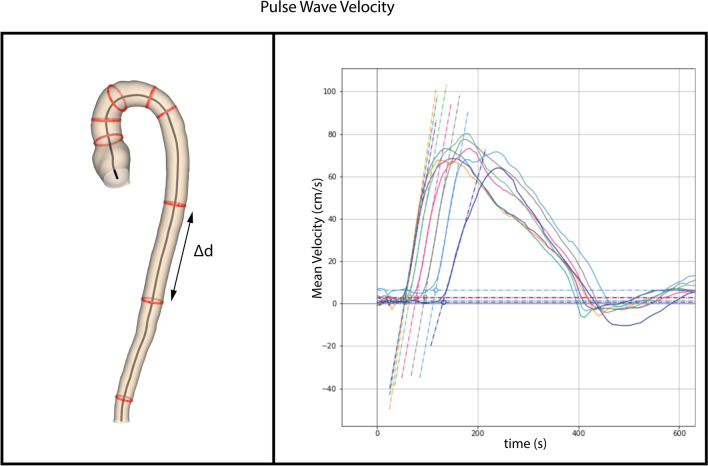
Measuring pulse wave velocity. The red circles on the aortic model (on the left) represent the planes at which flow is calculated using 4D flow data of the entire aorta. The distance between two consecutive planes (Δd) is subsequently divided by the time difference (Δt) between the start of respective pulse waves to yield mean pulse wave velocity (on the right)

References

    1. Nayak KS, Nielsen J-F, Bernstein MA, Markl M, Gatehouse PD, Botnar RM, Saloner D, Lorenz C, Wen H, Hu BS, Epstein FH, Oshinski JN, Raman SV. Cardiovascular magnetic resonance phase contrast imaging. J Cardiovasc Magn Reson. 2015;17(1):71. doi: 10.1186/s12968-015-0172-7. - DOI - PMC - PubMed
    1. Adriaans BP, Westenberg JJM, van Cauteren YJM, Gerretsen S, Elbaz MSM, Bekkers S, Veenstra LF, Crijns H, Wildberger JE, Schalla S. Clinical assessment of aortic valve stenosis: comparison between 4D flow MRI and transthoracic echocardiography. J Magn Reson Imaging. 2020;51(2):472–480. doi: 10.1002/jmri.26847. - DOI - PMC - PubMed
    1. Markl M, Frydrychowicz A, Kozerke S, Hope M, Wieben O. 4D Flow MRI. J Magn Reson Imaging. 2012;36(5):1015–1036. doi: 10.1002/jmri.23632. - DOI - PubMed
    1. Markl M, Schnell S, Wu C, Bollache E, Jarvis K, Barker AJ, Robinson JD, Rigsby CK. Advanced flow MRI: emerging techniques and applications. Clin Radiol. 2016;71(8):779–795. doi: 10.1016/j.crad.2016.01.011. - DOI - PMC - PubMed
    1. Hope TA, Markl M, Wigström L, Alley MT, Miller DC, Herfkens RJ. Comparison of flow patterns in ascending aortic aneurysms and volunteers using four-dimensional magnetic resonance velocity mapping. J Magn Reson Imaging. 2007;26(6):1471–1479. doi: 10.1002/jmri.21082. - DOI - PubMed

LinkOut - more resources