


Stimulus Clarity and the Emission of Descriptive Autoclitics
- PMID: 37397132
- PMCID: PMC10313608
- DOI: 10.1007/s40616-023-00184-1
Stimulus Clarity and the Emission of Descriptive Autoclitics
Abstract
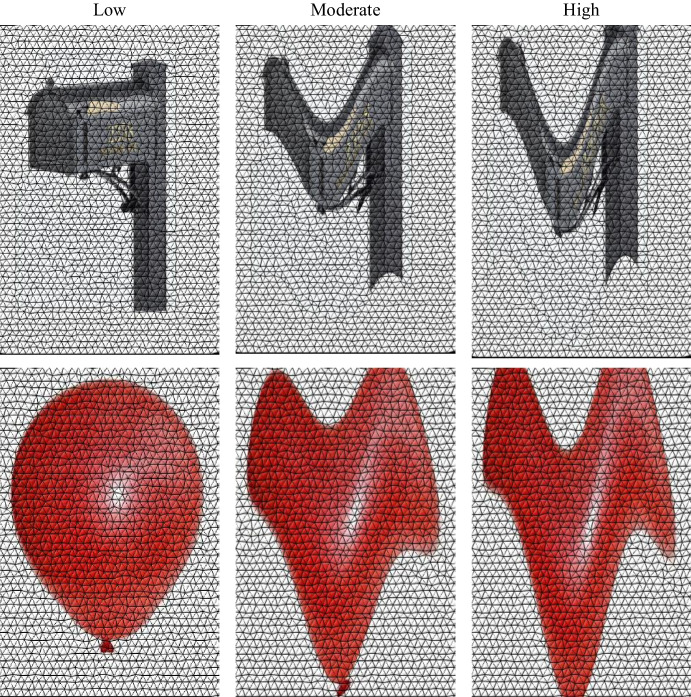
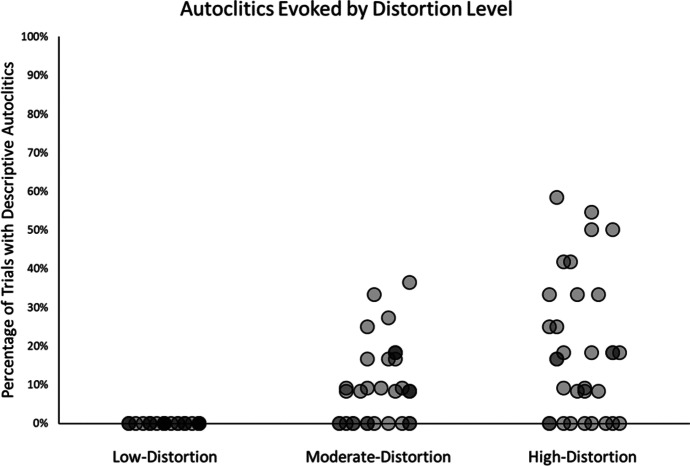
The autoclitic is among the least studied and most complex verbal operant named and described by Skinner. The descriptive autoclitic is one subtype, which among other functions can describe the strength of the response. If the clarity of the stimulus is one source of response strength for tacts, manipulating stimulus clarity should evoke different frequencies of descriptive autoclitics. In an experiment with adults, digitally distorting pictures of common objects predicted the relative frequency of descriptive autoclitics that accompanied tacts. The most distorted images evoked twice as many autoclitics as moderately distorted images, and low-distortion images evoked no autoclitics. We encourage other researchers to interpret Skinner's conceptualization of the autoclitic and its various forms and test them empirically to evaluate how their functional definitions can be clarified, refined, or altered.
Supplementary information: The online version contains supplementary material available at 10.1007/s40616-023-00184-1.
Keywords: Autoclitic tacts; Autoclitics; Descriptive autoclitic; Stimulus clarity; Verbal behavior.
© Association for Behavior Analysis International 2023. Springer Nature or its licensor (e.g. a society or other partner) holds exclusive rights to this article under a publishing agreement with the author(s) or other rightsholder(s); author self-archiving of the accepted manuscript version of this article is solely governed by the terms of such publishing agreement and applicable law.
Conflict of interest statement
Conflict of InterestsThe authors have no known conflicts of interest.
Figures

References
-
- Belisle J, Dixon MR, Malkin A, Hollie J, Stanley CR. Exploratory factor analysis of the VB-MAPP: Support for the interdependency of elementary verbal operants. Journal of Behavioral Education. 2022;31(3):503–523. doi: 10.1007/s10864-020-09413-2. - DOI
LinkOut - more resources
Full Text Sources
