


Status and factors associated with patient activation and its relationship with HIV clinic outcomes among Yi minority people living with HIV in Liangshan, China: a cross-sectional study
- PMID: 37397752
- PMCID: PMC10309002
- DOI: 10.3389/fpubh.2023.1114561
Status and factors associated with patient activation and its relationship with HIV clinic outcomes among Yi minority people living with HIV in Liangshan, China: a cross-sectional study
Abstract
Introduction: Patient activation is determined by an individual's knowledge, skills and confidence in managing his/her health. It is vital for people living with HIV (PLWH) to enhance their self-management skills and health outcomes, especially those from low- and middle-income regions, since they are at higher risk of worse health outcomes. However, literature from those regions is limited, especially in China.
Objectives: This study aimed to explore the status and factors associated with patient activation among Yi minority PLWH in Liangshan, China and to determine whether patient activation is associated with HIV clinic outcomes.
Methods: This cross-sectional study included 403 Yi minority people living with HIV in Liangshan between September and October 2021. All participants completed an anonymous survey measuring sociodemographic characteristics, HIV-related information, patient activation and illness perception. Multivariate linear regression and multivariate binary logistic regression were used to explore factors associated with patient activation and the association between patient activation and HIV outcomes, respectively.
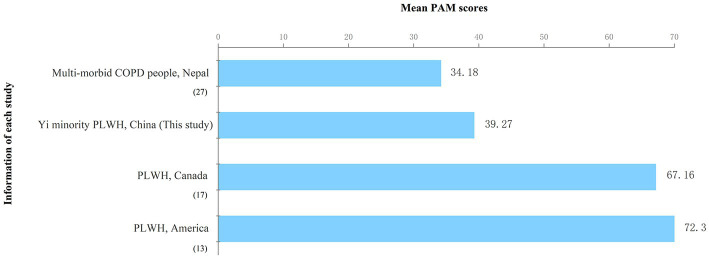
Results: The Patient Activation Measure (PAM) score was low (mean = 29.8, standard deviation = 4.1). Participants with negative illness perception, low income, and self-rated antiretroviral therapy (ART) effect based on self-perception were most likely to have a lower PAM score (β = -0.3, -0.2, -0.1, respectively; all p < 0.05); those with having disease knowledge learning experiences and an HIV-positive spouse were more likely to have a higher PAM score (β = 0.2, 0.2, respectively; both p < 0.001). A higher PAM score (AOR=1.08, 95% CI: 1.02, 1.14) was associated with viral suppression, mediated by gender (AOR=2.25, 95% CI: 1.38, 3.69).
Conclusion: Low patient activation level among Yi minority PLWH impacts HIV care. Our findings indicate patient activation is associated with viral suppression for minority PLWH in low- and middle-income settings, suggesting that tailored interventions enhancing patient activation may improve viral suppression.
Keywords: HIV; Yi minority; illness perception; low-and middle-income; patient activation.
Copyright © 2023 An, Tang, Xiao, Aku and Wang.
Conflict of interest statement
The authors declare that the research was conducted in the absence of any commercial or financial relationships that could be construed as a potential conflict of interest.
Figures
References
-
- Who . Who fact sheet on hiv/aids with key facts and information on signs and symptoms, transmission, risk factors, testing and counselling, prevention, treatment and who response. (2022). Available at: https://www.who.int/news-room/fact-sheets/detail/hiv-aids (Accessed September 15, 2022).
-
- Yuan D, Liu M, Jia P, Li Y, Huang Y, Ye L, et al. Prevalence and determinants of virological failure, genetic diversity and drug resistance among people living with hiv in a minority area in China: a population-based study. BMC Infect Dis. (2020) 20:443. doi: 10.1186/s12879-020-05124-1, PMID: - DOI - PMC - PubMed
Publication types
MeSH terms
LinkOut - more resources
Full Text Sources
Medical
Miscellaneous
