


Disparities in access to COVID-19 vaccine in Verona, Italy: a cohort study using local health immunization data
- PMID: 37397767
- PMCID: PMC10310303
- DOI: 10.3389/fpubh.2023.1167414
Disparities in access to COVID-19 vaccine in Verona, Italy: a cohort study using local health immunization data
Abstract
Introduction: Migrant populations worldwide were disproportionately impacted by the COVID-19 pandemic. Although substantial resources have been invested in scaling COVID-19 vaccination campaigns, globally vaccine rate and uptake remained low among migrants from across many countries. This study aimed to explore the country of birth as a factor influencing access to the COVID-19 vaccine.
Methods: This retrospective cohort study included adults vaccinated against SARS-CoV-2 receiving at least one dose in the Verona province between 27 December 2020 and 31 December 2021. Time-to-vaccination was estimated as the difference between the actual date of each person's first dose of COVID-19 vaccination and the date in which the local health authorities opened vaccination reservations for the corresponding age group. The birth country was classified based on both the World Health Organization regions and the World Bank country-level economic classification. Results were reported as the average marginal effect (AME) with corresponding 0.95 confidence intervals (CI).
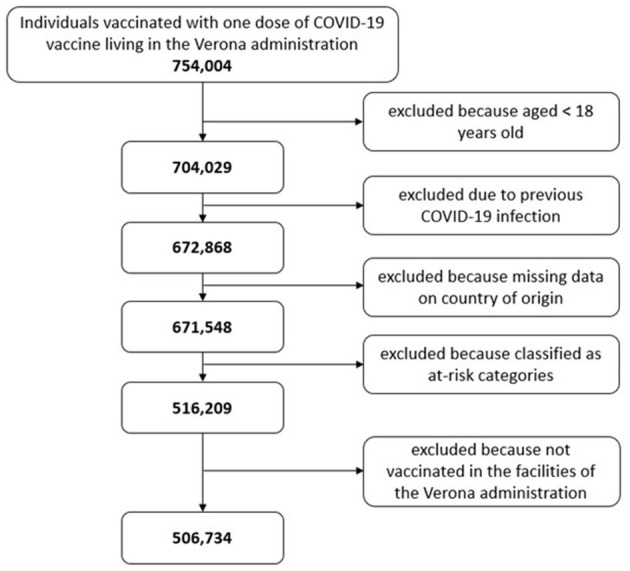
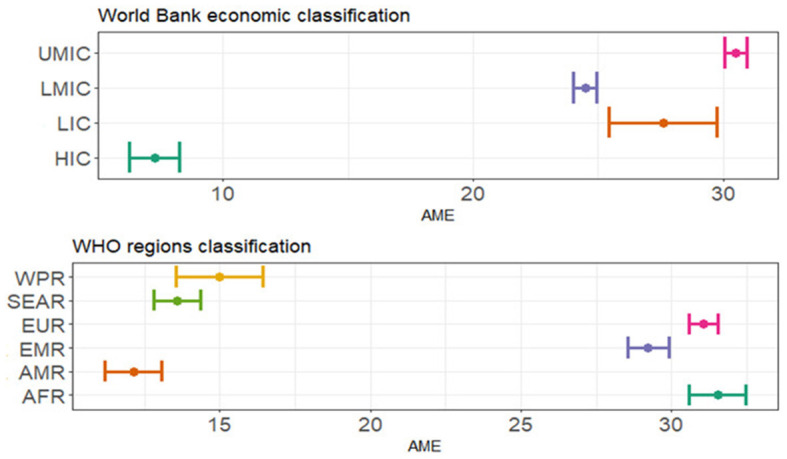
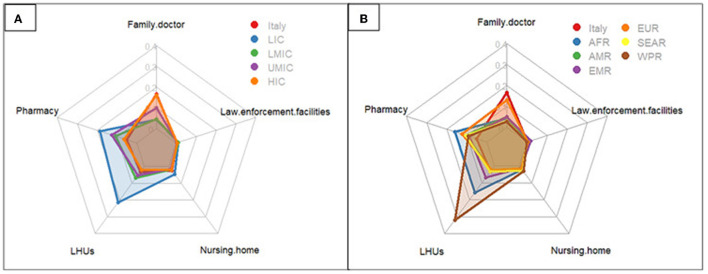
Results: During the study period, 7,54,004 first doses were administered and 5,06,734 (F = 2,46,399, 48.6%) were included after applying the exclusion criteria, with a mean age of 51.2 years (SD 19.4). Migrants were 85,989 (17.0%, F = 40,277, 46.8%), with a mean age of 42.4 years (SD 13.3). The mean time-to-vaccination for the whole sample was 46.9 days (SD 45.9), 41.8 days (SD 43.5) in the Italian population, and 71.6 days (SD 49.1) in the migrant one (p < 0.001). The AME of the time-to-vaccination compared to the Italian population was higher by 27.6 [0.95 CI 25.4-29.8], 24.5 [0.95 CI 24.0-24.9], 30.5 [0.95 CI 30.1-31.0] and 7.3 [0.95 CI 6.2-8.3] days for migrants from low-, low-middle-, upper-middle- and high-income countries, respectively. Considering the WHO region, the AME of the time-to-vaccination compared to the Italian group was higher by 31.5 [0.95 CI 30.6-32.5], 31.1 [0.95 CI 30.6-31.5], and 29.2 [0.95 CI 28.5-29.9] days for migrants from African, European, and East-Mediterranean regions, respectively. Overall, time-to-vaccination decreased with increasing age (p < 0.001). Although both migrants and Italians mainly used hub centers (>90%), migrants also used pharmacies and local health units as alternative sites (2.9% and 1.5%, respectively), while Italians (3.3%) and migrants from the European region (4.2%) relied more on family doctors.
Conclusion: The birth country of migrants influenced access to COVID-19 vaccine both in terms of time-to-vaccination and vaccination points used, especially for the LIC migrant group. Public health authorities should take socio-cultural and economic factors into consideration for tailored communication to people from migrant communities and for planning a mass vaccination campaign.
Keywords: COVID-19; COVID-19 vaccine; SARS-CoV-2; claims database; health inequities; healthcare access; migrants.
Copyright © 2023 Benoni, Sartorello, Moretti, Marchiori, Accordini, Postiglione, Coffele and Tardivo.
Conflict of interest statement
The authors declare that the research was conducted in the absence of any commercial or financial relationships that could be construed as a potential conflict of interest.
Figures
References
-
- Hayward SE, Deal A, Cheng C, Crawshaw A, Orcutt M, Vandrevala TF, et al. ESCMID Study Group for Infections in Travellers and Migrants (ESGITM). Clinical outcomes and risk factors for COVID-19 among migrant populations in high-income countries: a systematic review. J Migr Health. (2021) 3:100041. 10.1101/2020.12.21.20248475 - DOI - PMC - PubMed
-
- OECD/European Union. Settling In 2018: Indicators of Immigrant Integration. Brussels: OECD Publishing, Paris/European Union. (2018).
-
- Public Health England . COVID-19: Review of Disparities in Risks and Outcomes, 2020. PHE publications, GW-1447. (2020). Available online at: https://www.gov.uk/government/publications/covid-19-review-of-disparitie... (accessed December 15, 2022).
-
- Jaljaa A, Caminada S, Tosti ME, D'Angelo F, Angelozzi A, Isonne C et al. Risk of SARS-CoV-2 infection in migrants and ethnic minorities compared with the general population in the European WHO region during the first year of the pandemic: a systematic review. BMC Public Health. (2022) 22:143. 10.1186/s12889-021-12466-1 - DOI - PMC - PubMed
MeSH terms
Substances
LinkOut - more resources
Full Text Sources
Medical
Miscellaneous
