


Motion distractors perturb saccade programming later in time than static distractors
- PMID: 37397809
- PMCID: PMC10313862
- DOI: 10.1016/j.crneur.2023.100092
Motion distractors perturb saccade programming later in time than static distractors
Abstract
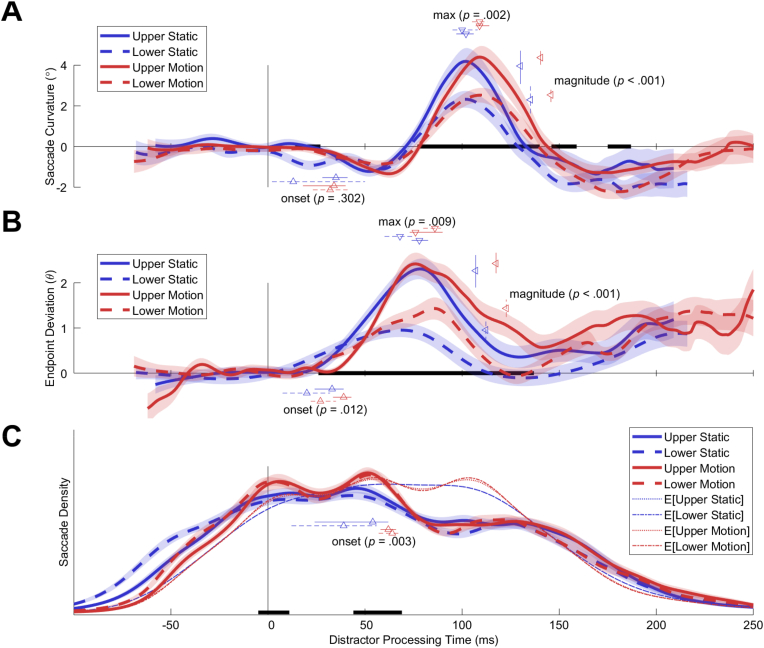
The mechanism that reweights oculomotor vectors based on visual features is unclear. However, the latency of oculomotor visual activations gives insight into their antecedent featural processing. We compared the oculomotor processing time course of grayscale, task-irrelevant static and motion distractors during target selection by continuously measuring a battery of human saccadic behavioral metrics as a function of time after distractor onset. The motion direction was towards or away from the target and the motion speed was fast or slow. We compared static and motion distractors and observed that both distractors elicited curved saccades and shifted endpoints at short latencies (∼25 ms). After 50 ms, saccade trajectory biasing elicited by motion distractors lagged static distractor trajectory biasing by 10 ms. There were no such latency differences between distractor motion directions or motion speeds. This pattern suggests that additional processing of motion stimuli occurred prior to the propagation of visual information into the oculomotor system. We examined the interaction of distractor processing time (DPT) with two additional factors: saccadic reaction time (SRT) and saccadic amplitude. Shorter SRTs were associated with shorter DPT latencies of biased saccade trajectories. Both SRT and saccadic amplitude were associated with the magnitude of saccade trajectory biases.
Keywords: Behavioral chronometry; Eye movements; Saccade averaging; Saccade curvature; Sensorimotor processing; Target selection.
© 2023 The Authors.
Conflict of interest statement
The authors declare that they have no known competing financial interests or personal relationships that could have appeared to influence the work reported in this paper
Figures






References
-
- Aizawa H., Wurtz R.H. Reversible inactivation of monkey superior colliculus. I. Curvature of saccadic trajectory. J. Neurophysiol. 1998;79:2082–2096. - PubMed
-
- Albright T.D. Direction and orientation selectivity of neurons in visual area MT of the macaque. J. Neurophysiol. 1984;52:1106–1130. - PubMed
-
- Azzopardi P., Fallah M., Gross C.G., Rodman H.R. Response latencies of neurons in visual areas MT and MST of monkeys with striate cortex lesions. Neuropsychologia. 2003;41:1738–1756. - PubMed
-
- Basso M.A., Liu P. Context-dependent effects of substantia nigra stimulation on eye movements. J. Neurophysiol. 2007;97:4129–4142. - PubMed
-
- Basso M.A., Wurtz R.H. Modulation of neuronal activity by target uncertainty. Nature. 1997;389:66–69. - PubMed
LinkOut - more resources
Full Text Sources
