[Preprint]. 2023 Jun 15:2023.06.14.23291396.
doi: 10.1101/2023.06.14.23291396.

Heterogeneous treatment effects of intensive glycemic control on kidney microvascular outcomes in ACCORD

Affiliations

Heterogeneous treatment effects of intensive glycemic control on kidney microvascular outcomes in ACCORD

Vivek Charu et al. medRxiv. .

Update in

Abstract

Objective: Clear criteria to individualize glycemic targets are lacking. In this post-hoc analysis of the Action to Control Cardiovascular Risk in Diabetes trial (ACCORD), we evaluate whether the kidney failure risk equation (KFRE) can identify patients who disproportionately benefit from intensive glycemic control on kidney microvascular outcomes.

Research design and methods: We divided the ACCORD trial population in quartiles based on 5-year kidney failure risk using the KFRE. We estimated conditional treatment effects within each quartile and compared them to the average treatment effect in the trial. The treatment effects of interest were the 7-year restricted-mean-survival-time (RMST) differences between intensive and standard glycemic control arms on (1) time-to-first development of severely elevated albuminuria or kidney failure and (2) all-cause mortality.

Results: We found evidence that the effect of intensive glycemic control on kidney microvascular outcomes and all-cause mortality varies with baseline risk of kidney failure. Patients with elevated baseline risk of kidney failure benefitted the most from intensive glycemic control on kidney microvascular outcomes (7-year RMST difference of 115 v. 48 days in the entire trial population) However, this same patient group also experienced shorter times to death (7-year RMST difference of -57 v. -24 days).

Conclusions: We found evidence of heterogenous treatment effects of intensive glycemic control on kidney microvascular outcomes in ACCORD as a function of predicted baseline risk of kidney failure. Patients with higher kidney failure risk experienced the most pronounced benefits of treatment on kidney microvascular outcomes but also experienced the highest risk of all-cause mortality.


Conflict of interest statement

Conflicts of interest: The authors have no conflicts of interest to disclose.

Figures
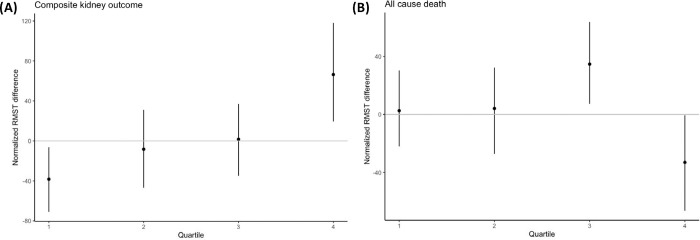
Figure 1.
Figure 1.
Heterogeneous treatment effects of intensive glycemic control on (A) the composite kidney outcome and (B) all-cause death. The x-axis displays each subgroup of patients, defined by quartiles of 5-year predicted risk by the KFRE. The y-axis displays the normalized restricted mean survival time (RMST) difference in days, defined as the RMST difference in the subgroup of interest minus the RMST difference in the entire trial. Normalized RMST values of zero indicate that the treatment effect in the subgroup of interest is equivalent to that in the entire trial population (no evidence of heterogeneous treatment effects). Normalized RMST values above zero (including the 95% confidence interval) indicate that the treatment effect in the subgroup of interest is larger than the treatment effect in the entire trial population (more beneficial); values below zero indicate that the treatment effect in the subgroup of interest is below that in the entire trial population (more harmful).
Figure 2.
Figure 2.
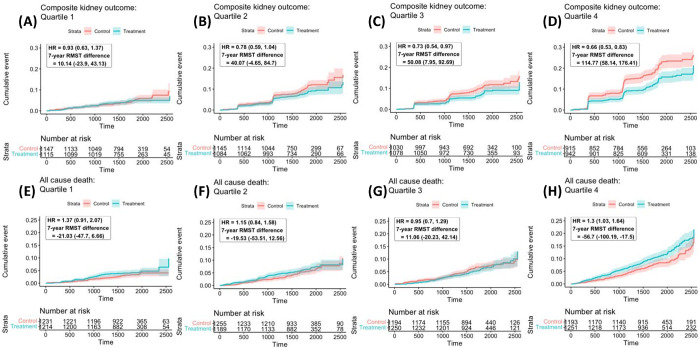
(A-D): Heterogeneous treatment effects of intensive versus standard glycemic control on the composite kidney outcome, by quartile of KFRE 5-year predicted risk at baseline. Plots demonstrate cumulative incidence curves by quartile of KFRE 5-year predicted risk at baseline; hazard ratios and the 7-year restricted mean survival time difference between treatment and control arms are presented in days. (E-H) Heterogeneous treatment effects of intensive versus standard glycemic control on all-cause mortality, by quartile of KFRE 5-year predicted risk at baseline. Plots demonstrate cumulative incidence curves by quartile of KFRE 5-year predicted risk at baseline; hazard ratios and the 7-year restricted mean survival time difference between treatment and control arms are presented in days.

References

    1. Khan MAB, Hashim MJ, King JK, Govender RD, Mustafa H, Al Kaabi J. Epidemiology of Type 2 Diabetes – Global Burden of Disease and Forecasted Trends. J Epidemiol Glob Health. 2020;10(1):107–111. doi: 10.2991/jegh.k.191028.001 - DOI - PMC - PubMed
    1. Rodriguez-Gutierrez R, Gonzalez-Gonzalez JG, Zuñiga-Hernandez JA, McCoy RG. Benefits and harms of intensive glycemic control in patients with type 2 diabetes. BMJ. 2019;367:l5887. doi: 10.1136/bmj.l5887 - DOI - PubMed
    1. Rodríguez-Gutiérrez R, Montori VM. Glycemic Control for Patients With Type 2 Diabetes Mellitus: Our Evolving Faith in the Face of Evidence. Circulation: Cardiovascular Quality and Outcomes. 2016;9(5):504–512. doi: 10.1161/CIRCOUTCOMES.116.002901 - DOI - PMC - PubMed
    1. Action to Control Cardiovascular Risk in Diabetes Study Group, Gerstein HC, Miller ME, et al. Effects of intensive glucose lowering in type 2 diabetes. N Engl J Med. 2008;358(24):2545–2559. doi: 10.1056/NEJMoa0802743 - DOI - PMC - PubMed
    1. ADVANCE Collaborative Group, Patel A, MacMahon S, et al. Intensive blood glucose control and vascular outcomes in patients with type 2 diabetes. N Engl J Med. 2008;358(24):2560–2572. doi: 10.1056/NEJMoa0802987 - DOI - PubMed

Publication types