Review
. 2023 Aug 1;325(2):C519-C537.
doi: 10.1152/ajpcell.00059.2023. Epub 2023 Jul 3.

V3: an enigmatic isoform of the proteoglycan versican

Affiliations
Review

V3: an enigmatic isoform of the proteoglycan versican

Thomas N Wight et al. Am J Physiol Cell Physiol. .

Abstract

V3 is an isoform of the extracellular matrix (ECM) proteoglycan (PG) versican generated through alternative splicing of the versican gene such that the two major exons coding for sequences in the protein core that support chondroitin sulfate (CS) glycosaminoglycan (GAG) chain attachment are excluded. Thus, versican V3 isoform carries no GAGs. A survey of PubMed reveals only 50 publications specifically on V3 versican, so it is a very understudied member of the versican family, partly because to date there are no antibodies that can distinguish V3 from the CS-carrying isoforms of versican, that is, to facilitate functional and mechanistic studies. However, a number of in vitro and in vivo studies have identified the expression of the V3 transcript during different phases of development and in disease, and selective overexpression of V3 has shown dramatic phenotypic effects in "gain and loss of function" studies in experimental models. Thus, we thought it would be useful and instructive to discuss the discovery, characterization, and the putative biological importance of the enigmatic V3 isoform of versican.

Keywords: atherosclerosis; cell proliferation; hyaluronan; inflammation; versican.


Conflict of interest statement

No conflicts of interest, financial or otherwise, are declared by the authors.

Figures

Figure 1.
Figure 1.
The gene structure of human versican is composed of 15 exons (I–XV) that together encode the V0 isoform. The V0 pre-protein consists of a signal peptide (S), an Ig-like module (Ig), two contiguous Link modules [Link1 (L1) and Link2 (L2)] the α-glycosaminoglycan (GAG) and β-GAG chondroitin sulfate attachment regions, two contiguous epidermal growth factor (EGF) modules [EGF1 (E1) and EGF2 (E2)] a C-type Lectin module (CLEC), a Complement Control Protein module (CCP), and a C-terminal region (C). The V3 isoform is generated when exons VII and VIII are spliced out fusing together the G1 and G3 domains. In the versican gene, the positions of the ATG start codon and TGA stop codon are indicated.
Figure 2.
Figure 2.
The four main isoforms of versican (V0, V1, V2, and V3) are formed through alternative spicing of the versican gene. Top: all isoforms contain G1 and G3 domains with both glycosaminoglycan (GAG)-attachment regions, α-GAG (pink) and β-GAG (yellow), present in V0, only β-GAG in V1, only α-GAG in V2, and none in V3. Bottom: chondroitin sulfate/dermatan sulfate (CS/DS) GAG chains are attached to the α-GAG and β-GAG regions, where representative numbers of GAGs and their approximate positions are indicated; CS/DS chains are shown schematically, where these can be up to ∼120 disaccharides in length. The G1 domain mediates the attachment of the four versican isoforms to hyaluronan (HA), where the modules that comprise G1 (and those in G3) are color-coded as in Figs. 1 and 3. Right-hand side: the protein and carbohydrate ligands that have been demonstrated to bind to the G1 and G3 domains of versican are shown, with further details in the text. Figure was created using BioRender.com and adapted from Wight (2).
Figure 3.
Figure 3.
A structural model of the versican V3 protein bound to an oligosaccharide of hyaluronan (HA). The V3 isoform is composed of adjacent G1 and G3 domains that are homologous to the N- and C-terminal regions of other members of the lectican family. The G1 domain of V3 is comprised of an immunoglobulin-like module [Ig-like (colored blue)], and two contiguous Link modules [Link1 (cyan) and Link2 (green)] that mediate the interaction of V3 with hyaluronan (HA). The G3 domain is comprised of two epidermal growth factor-like modules [EGF1 (pale green) and EGF2 (yellow)], a C-type Lectin (CLEC) module (orange), and a Complement Control Protein (CCP) module (red). This is followed by a 42-amino acid sequence that is not homologous to any known module/domain (not included in this model). A low-resolution structure of the versican G1 domain was determined based on small angle X-ray scattering (SAXS) of recombinant VG1 protein, expressed in E. coli (149), in complex with a decasaccharide of HA (VG1/HA10) (56). This structure was used to inform the relative positions of the individual modules, where homology models of the Ig-like module (generated using Phyre2) and the Link1_Link2 module pair, in its HA-bound conformation (50), were fitted into the SAXS envelop using Situs. The resulting model of VG1/HA10 was validated by predicting its hydrodynamic properties using SoMo bead modeling and showing these compared well with experimental values obtained for the VG1/HA10 complex using analytical ultracentrifugation and SAXS. The modules in the G3 domain were modeled using HHPred and Modeller, assembled in COOT and energy minimized with Rosetta/FoldIt; known structures of EGF-EGF, EGF-CLEC, and CLEC-CCP module pairs were used to inform the module orientations with a small adjustment made to avoid a steric clash between CCP and EGF2. The relative orientation of the G1 and G3 domains in the V3 model was defined arbitrarily albeit restrained by the linkage between Link2 and EGF1. The overall model of the V3 isoform was generated by David C. Briggs (D.C. Briggs, A.J. Day, unpublished observations), where this includes structural data, modeling, and validation for the VG1/HA10 complex (56).
Figure 4.
Figure 4.
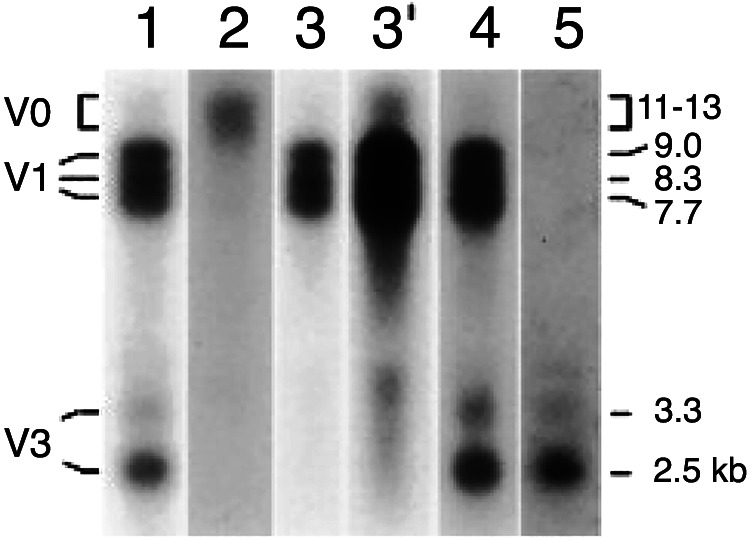
Domain-specific oligonucleotide probes were used to evaluate versican RNA from rat arterial smooth muscle cells (ASMCs). Northern blot of RNA derived from adult rat ASMC probed with domain specific probes. Lane 1 plasmid; Lane 2 α-glycosaminoglycan (GAG) oligo. Lane 3 β-GAG oligo; Lane 3′ longer exposure of Lane 3; Lane 4 PCR product; Lane 5 oligo to putative splice junction. The two smallest RNA bands (3.3 and 2.5 kb) hybridized to both amino and carboxy-terminal probes as well as to splice junction probe only present in V3 (Lane 5). Figure reprinted from Lemire et al. (91). Copyright 1999, with permission from the American Heart Association, Inc.
Figure 5.
Figure 5.
A: experimental protocol to test the impact of V3 expression on the phenotype of arterial smooth muscle cell (ASMC) and vascular lesion development in a rabbit animal model following vascular injury and lipid feeding. Rabbit ASMCs were transduced with a retroviral vector containing the V3 gene and seeded into balloon-injured rabbit carotid arteries. The animals were then placed on a normal diet for 4 wk and then a cholesterol rich diet for 4 wk and then the arteries were processed for histology. B, left: ASMCs were transduced with an empty viral vector and immunostained for elastin after 7 days in culture. Right: ASMCs were transduced with V3 containing vector and immunostained for elastin after 7 days in culture. C: sections from balloon-injured carotid arteries seeded with ASMCs containing empty viral vector (left) or vector containing V3 (right). Notice multiple laminae of elastic fibers in the arteries containing the ASMCs carrying the V3-expressing vector. Reprinted from Wight et al. (117). Copyright 2014, with permission from Elsevier.
Figure 6.
Figure 6.
Impact of V3 expression on experimental vascular lesion development in balloon-injured carotid arteries from New Zealand White rabbits placed on a cholesterol-enriched diet. Controlled expression of V3 caused increased elastic fiber accumulation, decreased lipid and macrophage accumulation and decrease in the accumulation of the glycosaminoglycan (GAG) containing isoforms of versican. Reprinted from Wight (114). Copyright 2018, with permission from Elsevier.
Figure 7.
Figure 7.
A: heat map of 521 genes that differ in expression between rat arterial smooth muscle cells (ASMCs) transduced with empty vector control compared to rat ASMCs transduced with V3 at 3 wk. The 3-wk time point was chosen because that was the peak for elastic fiber accumulation. Upregulated genes are shown in red and downregulated genes are shown in blue. B: changes in key gene expression involved in ASMC differentiation induced by V3 expression as evaluated by qPCR. C: promotion of anti-inflammatory gene expression by ASMC transduced by V3 expression. *P < 0.05 in unpaired t test. Figure adapted from Kang et al. (111). Copyright 2015 by The American Society for Biochemistry and Molecular Biology, Inc.

References

    1. Zimmermann D. Versican. In: Proteoglycans: Structure, Biology and Molecular Interactions, edited by Iozzo R. New York: Marcel Dekker, Inc., 2000, p. 327–341.
    1. Wight TN. Versican: a versatile extracellular matrix proteoglycan in cell biology. Curr Opin Cell Biol 14: 617–623, 2002. doi:10.1016/s0955-0674(02)00375-7. - DOI - PubMed
    1. Nandadasa S, Foulcer S, Apte SS. The multiple, complex roles of versican and its proteolytic turnover by ADAMTS proteases during embryogenesis. Matrix Biol 35: 34–41, 2014. doi:10.1016/j.matbio.2014.01.005. - DOI - PMC - PubMed
    1. Islam S, Watanabe H. Versican: a dynamic regulator of the extracellular matrix. J Histochem Cytochem 68: 763–775, 2020. doi:10.1369/0022155420953922. - DOI - PMC - PubMed
    1. Watanabe H. Aggrecan and versican: two brothers close or apart. Am J Physiol Cell Physiol 322: C967–C976, 2022. doi:10.1152/ajpcell.00081.2022. - DOI - PubMed

Publication types

LinkOut - more resources