


The Full Value of Vaccine Assessments (FVVA): a framework for assessing and communicating the value of vaccines for investment and introduction decision-making
- PMID: 37400797
- PMCID: PMC10318807
- DOI: 10.1186/s12916-023-02929-0
The Full Value of Vaccine Assessments (FVVA): a framework for assessing and communicating the value of vaccines for investment and introduction decision-making
Abstract
Background: Several economic obstacles can deter the development and use of vaccines. This can lead to limited product options for some diseases, delays in new product development, and inequitable access to vaccines. Although seemingly distinct, these obstacles are actually interrelated and therefore need to be addressed through a single over-arching strategy encompassing all stakeholders.
Methods: To help overcome these obstacles, we propose a new approach, the Full Value of Vaccines Assessments (FVVA) framework, to guide the assessment and communication of the value of a vaccine. The FVVA framework is designed to facilitate alignment across key stakeholders and to enhance decision-making around investment in vaccine development, policy-making, procurement, and introduction, particularly for vaccines intended for use in low- and middle-income countries.
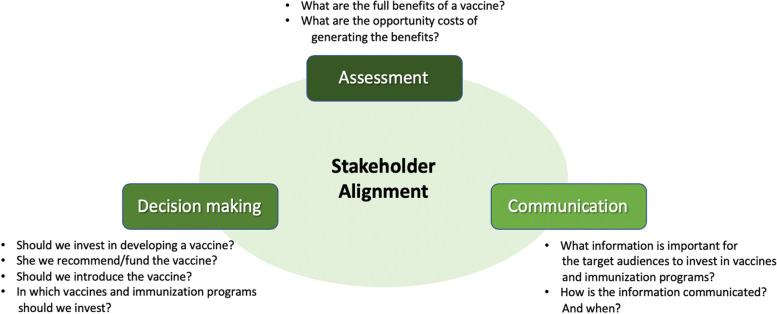
Results: The FVVA framework has three key elements. First, to enhance assessment, existing value-assessment methods and tools are adapted to include broader benefits of vaccines as well as opportunity costs borne by stakeholders. Second, to improve decision-making, a deliberative process is required to recognize the agency of stakeholders and to ensure country ownership of decision-making and priority setting. Third, the FVVA framework provides a consistent and evidence-based approach that facilitates communication about the full value of vaccines, helping to enhance alignment and coordination across diverse stakeholders.
Conclusions: The FVVA framework provides guidance for stakeholders organizing global-level efforts to promote investment in vaccines that are priorities for LMICs. By providing a more holistic view of the benefits of vaccines, its application also has the potential to encourage greater take-up by countries, thereby leading to more sustainable and equitable impacts of vaccines and immunization programmes.
Keywords: Economic evaluations; Health technology assessment; Immunization; Public health; Research and development; Vaccines.
© 2023. The Author(s).
Conflict of interest statement
The authors declare that they have no competing interests.
Figures
References
-
- Piot P, Larson HJ, O’Brien KL, N’kengasong J, Ng E, Sow S, et al. Immunization: vital progress, unfinished agenda. Nature. 2019;575:119–29. - PubMed
-
- Kochhar S, Barreira D, Beattie P, Cavaleri M, Cravioto A, Frick MW, et al. Building the concept for WHO Evidence Considerations for Vaccine Policy (ECVP): Tuberculosis vaccines intended for adults and adolescents as a test case. Vaccine. 2022;40:1681–1690. doi: 10.1016/j.vaccine.2021.10.062. - DOI - PMC - PubMed
-
- Clark RA, Mukandavire C, Portnoy A, Weerasuriya CK, Deol A, Scarponi D, et al. The impact of alternative delivery strategies for novel tuberculosis vaccines in low-income and middle-income countries: a modelling study. Lancet Glob Heal. 2023;11:e546–e555. doi: 10.1016/S2214-109X(23)00045-1. - DOI - PMC - PubMed
-
- WHO. PDVAC and IVIRAC Joint Review of Group A Streptococcus Vaccines. https://www.who.int/news-room/events/detail/2022/09/30/default-calendar/....
MeSH terms
Substances
Grants and funding
LinkOut - more resources
Full Text Sources
Medical
