. 2023 Jul 4;14(1):3954.
doi: 10.1038/s41467-023-39452-y.

Pattern recognition in reciprocal space with a magnon-scattering reservoir

Affiliations

Pattern recognition in reciprocal space with a magnon-scattering reservoir

Lukas Körber et al. Nat Commun. .

Abstract

Magnons are elementary excitations in magnetic materials and undergo nonlinear multimode scattering processes at large input powers. In experiments and simulations, we show that the interaction between magnon modes of a confined magnetic vortex can be harnessed for pattern recognition. We study the magnetic response to signals comprising sine wave pulses with frequencies corresponding to radial mode excitations. Three-magnon scattering results in the excitation of different azimuthal modes, whose amplitudes depend strongly on the input sequences. We show that recognition rates as high as 99.4% can be attained for four-symbol sequences using the scattered modes, with strong performance maintained with the presence of amplitude noise in the inputs.


Conflict of interest statement

The authors declare no competing interests.

Figures
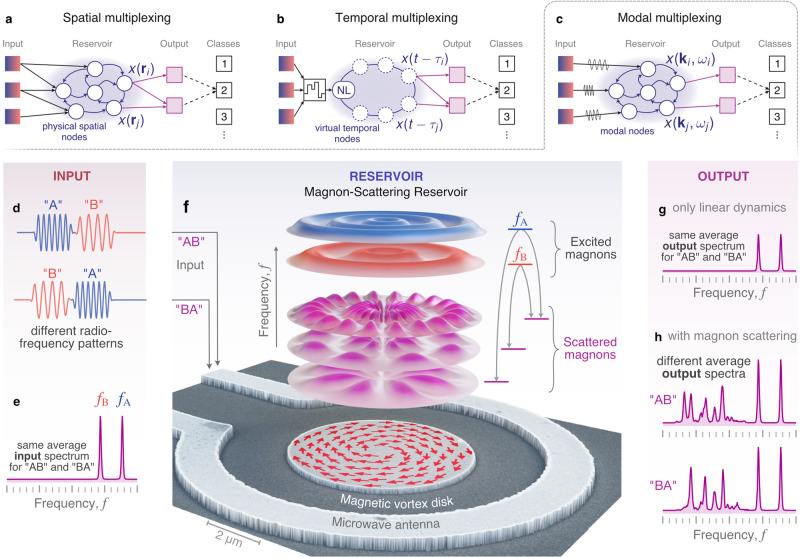
Fig. 1
Fig. 1. Working principle of a magnon-scattering reservoir (MSR).
Sketches of different reservoirs based on a spatial, b temporal, and c modal multiplexing, the concept behind the MSR. d Radiofrequency pulses with different temporal order but e the same average frequency content are used to trigger f nonlinear scattering between the magnon eigenmodes in a magnetic vortex disk. The dynamic response is experimentally detected using Brillouin-light-scattering microscopy (see Methods). In contrast to a linear system (g), the MSR produces different outputs depending on the temporal order of the input (h).
Fig. 2
Fig. 2. Physical background of the magnon-scattering reservoir (MSR).
When pumped strongly by microwave fields (a), a directly-excited primary magnon splits into two secondary magnons (b) via spontaneous 3MS (c). b Time-resolved frequency response of the MSR to two different input frequencies experimentally measured with TR-μBLS. d Driving the MSR with two different, temporally overlapping microwave pulses “A” and “B” leads to e, f cross-stimulated 3MS between the channels and to additional peaks in the measured frequency response. g Experimentally measured output spectra integrated over time which is different depending on the temporal order of the pulses. Different colors denote different contributions from the two input signals. Blue peaks result from input “A” only, red peaks from “B'', and purple peaks from cross-stimulation. h The integrated difference between the spectra of “AB” and “BA” shows that the responses are different when the pulses overlap in time.
Fig. 3
Fig. 3. Performance of the MSR for longer temporal patterns characterized experimentally.
a Time-resolved spectral response of the MSR to a four-symbol microwave pattern “ABAB”, detected experimentally with TR-μBLS. b For reference, the spectrum of “AB” is overlayed with a shifted version of itself. Differences between composed and real spectrum (due to cross-stimulated magnon scattering) are highlighted by shaded and circled areas. c Average output spectra of the MSR for different four-symbol patterns with the same average input-frequency content but clearly different nonlinear responses.
Fig. 4
Fig. 4. Micromagnetic modeling of pattern recognition capabilities.
a Simulated spectrum of the pattern “ABAB” with the definition of different output spaces (scattered and directly excited modes) for the MSR. b Average detection accuracy of four-symbol patterns for different output spaces and excitation frequency and power combinations as a function of frequency bin sizes. c Accuracy for different output spaces and bin sizes as a function of power fluctuations in the input signals (depicted by the insets). d, e Corresponding confusion matrices for the two output spaces, respectively, both for the same frequency combination, bin size, and input power fluctuation.

References

    1. Jaeger H. The “echo state” approach to analysing and training recurrent neural networks-with an erratum note. Bonn, Germany: German National Research Center for Information Technology GMD Technical Report. 2001;148:13.
    1. Nakajima K. Physical reservoir computing–an introductory perspective. Jpn. J. Appl. Phys. 2020;59:060,501. doi: 10.35848/1347-4065/ab8d4f. - DOI
    1. Tanaka G, et al. Recent advances in physical reservoir computing: a review. Neural Netw. 2019;115:100–123. doi: 10.1016/j.neunet.2019.03.005. - DOI - PubMed
    1. Maass W, Natschlger T, Markram H. Real-time computing without stable states: a new framework for neural computation based on perturbations. Neural Comput. 2002;14:2531–2560. doi: 10.1162/089976602760407955. - DOI - PubMed
    1. Fernando, C., Sojakka, S. Pattern Recognition in a Bucket. pp. 588–59710.1007/978-3-540-39432-7_63 (2003).
