


Prevalence and metabolic determinants of abnormal alanine aminotransferase: A cross-sectional study of Iranian adults, 2018-2022
- PMID: 37403787
- PMCID: PMC10431421
- DOI: 10.1002/jcla.24937
Prevalence and metabolic determinants of abnormal alanine aminotransferase: A cross-sectional study of Iranian adults, 2018-2022
Abstract
Background: Alanine aminotransferase (ALT) is an enzyme whose activity became the principal biomarker for liver disease. In the current study, we aimed to determine the prevalence of abnormal ALT, as a surrogate of nonalcoholic fatty liver disease (NAFLD) and its associated determinants using different criteria among Tehranian subjects between 2018 and 2022.
Methods: This is a cross-sectional study on 5676 Tehranian individuals aged 20-70 years. The weighted prevalence of abnormal ALT was calculated using both the National Health and Nutrition Examination Survey in the United States (US-NHANCE; ALT ≥30 U/L for females and ≥40 U/L for males) and the American College of Gastroenterology (ACG) guideline (ALT >25 U/L for females, and >33 U/L for males) thresholds. Moreover, uni/multivariable logistic regression analysis was performed to find the determinants of abnormal ALT.
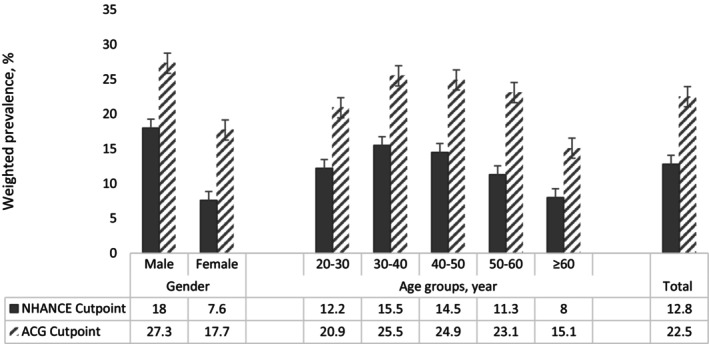
Results: The weighted prevalence of abnormal ALT was 12.8% (7.6% females and 18% males) and 22.5% (17.7% females and 27.3% males) based on US-NHANCE and ACG criteria, respectively. Our results showed every decade increase in age decreased the risk of abnormal ALT by 32%. We also found that generally male gender, being overweight/obese, central adiposity, TG ≥6.9 mmol/L, non-HDL-C ≥3.37 mmol/L, lipid-lowering medications, pre-diabetes/T2DM were associated with abnormal ALT using different cutoff points. Moreover, among men resting tachycardia (≥90 beats per min), hypertension, and females past-smoker were also found as other determinants of abnormal ALT.
Conclusion: High prevalence of abnormal ALT among non-elderly Iranian adults, especially among men, necessitates immediate multifaceted strategies by policymakers to prevent potential complications caused by NAFLD.
Keywords: alanine aminotransferase; logistic regression; metabolic determinants; prevalence.
© 2023 The Authors. Journal of Clinical Laboratory Analysis published by Wiley Periodicals LLC.
Conflict of interest statement
None declared.
Figures
References
-
- Senior J. Alanine aminotransferase: a clinical and regulatory tool for detecting liver injury–past, present, and future. Clin Pharmacol Ther. 2012;92(3):332‐339. - PubMed
-
- Ballestri S, Zona S, Targher G, et al. Nonalcoholic fatty liver disease is associated with an almost twofold increased risk of incident type 2 diabetes and metabolic syndrome. Evidence from a systematic review and meta‐analysis. J Gastroenterol Hepatol. 2016;31(5):936‐944. - PubMed
-
- Lonardo A, Ballestri S, Marchesini G, Angulo P, Loria P. Nonalcoholic fatty liver disease: a precursor of the metabolic syndrome. Dig Liver Dis. 2015;47(3):181‐190. - PubMed
-
- Ioannou GN, Boyko EJ, Lee SP. The prevalence and predictors of elevated serum aminotransferase activity in the United States in 1999‐2002. Am J Gastroenterol. 2006;101(1):76‐82. - PubMed
MeSH terms
Substances
LinkOut - more resources
Full Text Sources
Medical
Molecular Biology Databases
Miscellaneous
