


Exercise Intolerance That Resolved After venous Stenting of the Inferior Vena Cava
- PMID: 37403814
- PMCID: PMC10644689
- DOI: 10.1177/15385744231188801
Exercise Intolerance That Resolved After venous Stenting of the Inferior Vena Cava
Abstract
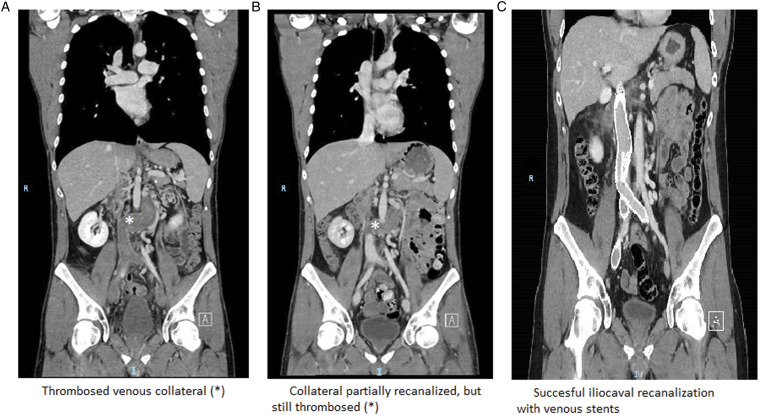
Venous stenting could alleviate exercise intolerance associated with chronic inferior vena cava (IVC) obstruction. We describe a 36-year-old male patient with an unknown IVC-obstruction. The obstruction was discovered after a bi-iliac deep vein thrombosis (DVT). The thrombus was resolved using thrombolysis. In the chronic phase, the patient developed exercise intolerance without any leg-specific symptoms or signs. Venous stenting was performed to open the IVC-obstruction, 1 year after the acute DVT. His physical condition improved, but cardiac magnetic resonance imaging at rest did not reveal hemodynamical changes after stenting. The Short Form Health Survey (SF-36) physical and mental component summaries were increased from 40.3 to 46.1 and 42.2 to 53.7, respectively. In patients with iliocaval obstruction, improved venous flow without changes in resting hemodynamics can enhance exercise intolerance and quality of life, even in the absence of leg symptoms. Diagnostic tools performed only at rest may miss abnormalities.
Keywords: Cardiovascular abnormalities; endovascular procedures; hemodynamics; venous thrombosis.
Conflict of interest statement
Declaration of Conflicting InterestsThe author(s) declared no potential conflicts of interest with respect to the research, authorship, and/or publication of this article.
Figures
References
-
- Kim H, Labropoulos N, Blake AM, Desai K. Prevalence of inferior vena cava anomalies and their significance and impact in clinical practice. Eur J Vasc Endovasc Surg. 2022;64(4):388-394. - PubMed
-
- Kahn SR, Comerota AJ, Cushman M, et al. The postthrombotic syndrome: evidence-based prevention, diagnosis, and treatment strategies: A scientific statement from the American Heart Association. Circulation. 2014;130(18):1636-1661. - PubMed
-
- De Maeseneer MG, Kakkos SK, Aherne T, et al. Corrigendum to “European Society for Vascular Surgery” (ESVS) 2022 clinical practice guidelines on the management of chronic venous disease of the lower limbs. Eur J Vasc Endovasc Surg. 2022;64:284-285. - PubMed
Publication types
MeSH terms
LinkOut - more resources
Full Text Sources
Medical
