


Hazardous drinking by older adults with chronic conditions during the COVID-19 pandemic: Evidence from a Chicago-based cohort
- PMID: 37403969
- PMCID: PMC10766865
- DOI: 10.1111/jgs.18497
Hazardous drinking by older adults with chronic conditions during the COVID-19 pandemic: Evidence from a Chicago-based cohort
Abstract
Background: It is unclear how older adults with chronic conditions, who have greater risk of alcohol-related adverse outcomes, used alcohol throughout the COVID-19 pandemic. We assess changes in hazardous drinking prevalence May 2020-December 2021 and factors associated with hazardous drinking.
Methods: Data are from structured phone interviews of older adults (age 60+) with chronic conditions (e.g., hypertension, diabetes, pulmonary disease, heart disease) in a Chicago-based longitudinal cohort (Chicago COVID-19 Comorbidities survey, Waves 3-7, n = 247). We tested differences in the prevalence of hazardous drinking (defined as AUDIT-C score of 3+ for women and 4+ for men) across waves for the full sample, by demographic group (sex, race, and ethnicity), and by chronic condition burden (<3 conditions, 3+ conditions). Generalized estimating equations investigated associations of hazardous drinking with sociodemographic and pandemic coping-related factors (stress, loneliness, outside contacts, depression, anxiety).
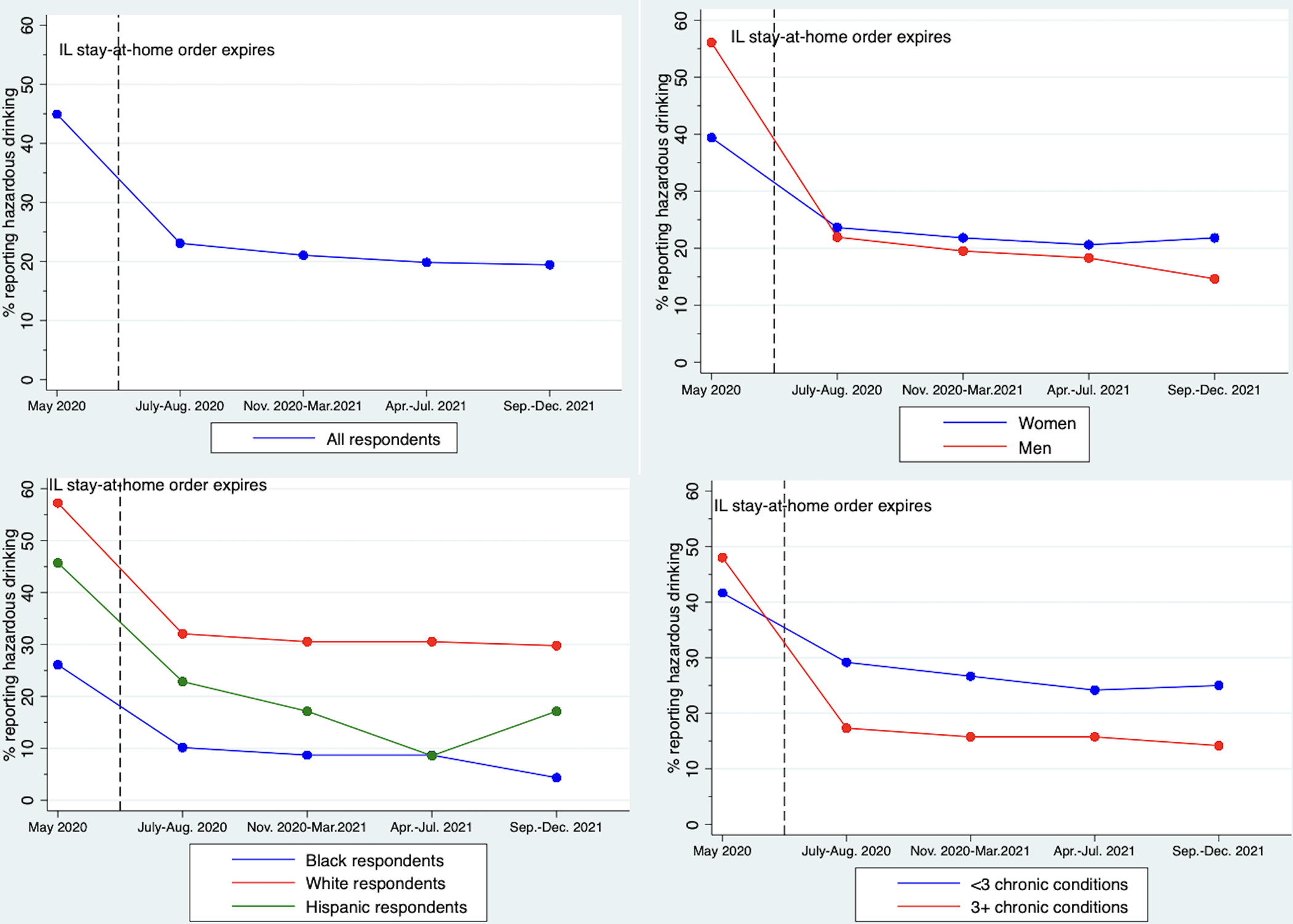
Results: Participants were 66.8% female; 27.9% non-Hispanic Black, 14.2% Hispanic, 4.9% other race. Hazardous drinking was reported by 44.9% of participants in May 2020, but declined to 23.1% by July-August 2020 and continued to slowly decline to 19.4% by September-December 2021. Differences from May 2020 were significant at the 0.05 level. Subgroups followed similar trajectories. Hazardous drinking prevalence was initially higher but declined more among men than women, consistently higher among non-Hispanic White respondents than among Hispanic and non-Hispanic Black respondents, and declined more rapidly among adults with 3+ chronic conditions. In adjusted models, race and ethnicity were associated with lower prevalence of hazardous drinking (non-Hispanic Black: adjusted prevalence ratio [aPR] = 0.50, 95% confidence interval [CI] = 0.33, 0.74; other race: aPR = 0.26, 95% CI = 0.09, 0.81, compared with non-Hispanic White). No coping-related factors were significantly associated with hazardous drinking.
Conclusion: Among a cohort of older adults with chronic conditions, almost half engaged in hazardous drinking in early summer of the COVID-19 pandemic. While prevalence fell, these rates reinforce the need for alcohol screening and intervention in clinical settings among this population.
Keywords: COVID-19; chronic conditions; hazardous drinking.
© 2023 The Authors. Journal of the American Geriatrics Society published by Wiley Periodicals LLC on behalf of The American Geriatrics Society.
Conflict of interest statement
MSW reports grants from the NIH during the conduct of the study; grants from Merck, the Gordon and Betty Moore Foundation, the NIH, and Eli Lilly outside the submitted work; and personal fees from Sanofi, Pfizer, and Luto outside the submitted work. MRC reports grants from the NIH during the conduct of the study and personal fees from the Centers for Disease Control and Prevention for contract work outside the submitted work. RML reports grants from the NIH (NIA, NINDS) and awards from the Health Assessment Lab. AZP was supported by a NIH T32 training grant from NHLBI. MB has no conflicts.
Figures
References
-
- Cooper ML, Kuntsche E, Levitt A, Barber LL, Wolf S. Motivational Models of Substance Use. Vol 1. (Sher KJ, ed.). Oxford University Press; 2015. doi: 10.1093/oxfordhb/9780199381678.013.017 - DOI
Publication types
MeSH terms
Substances
Grants and funding
LinkOut - more resources
Full Text Sources
Medical
Miscellaneous
