


Impact of HIV-1 Vpu-mediated downregulation of CD48 on NK-cell-mediated antibody-dependent cellular cytotoxicity
- PMID: 37404017
- PMCID: PMC10470595
- DOI: 10.1128/mbio.00789-23
Impact of HIV-1 Vpu-mediated downregulation of CD48 on NK-cell-mediated antibody-dependent cellular cytotoxicity
Abstract
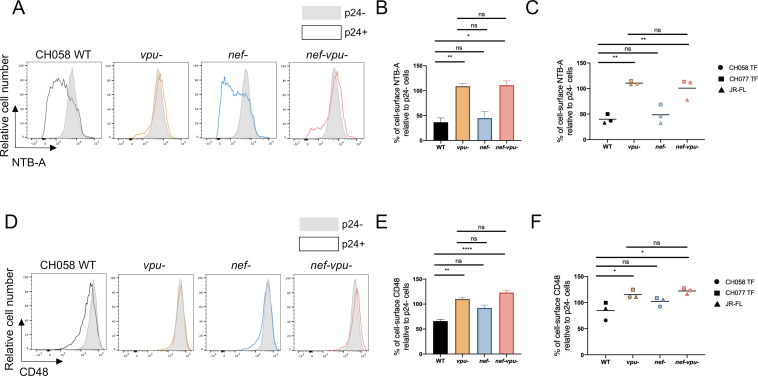
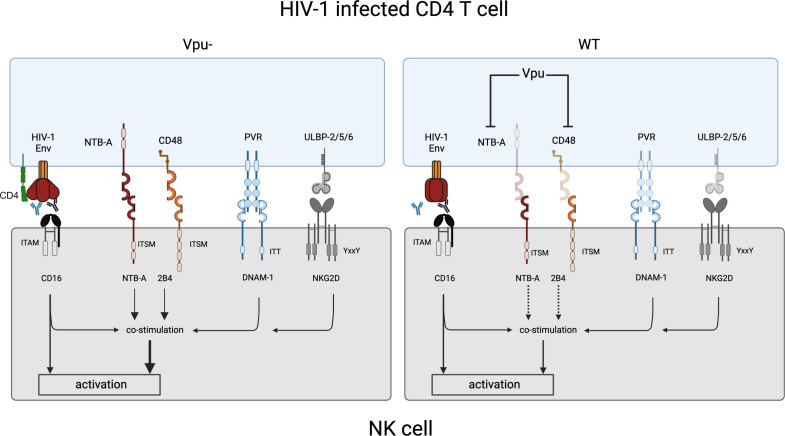
HIV-1 evades antibody-dependent cellular cytotoxicity (ADCC) responses not only by controlling Env conformation and quantity at the cell surface but also by altering NK cell activation via the downmodulation of several ligands of activating and co-activating NK cell receptors. The signaling lymphocyte activation molecule (SLAM) family of receptors, which includes NTB-A and 2B4, act as co-activating receptors to sustain NK cell activation and cytotoxic responses. These receptors cooperate with CD16 (FcγRIII) and other activating receptors to trigger NK cell effector functions. In that context, Vpu-mediated downregulation of NTB-A on HIV-1-infected CD4 T cells was shown to prevent NK cell degranulation via an homophilic interaction, thus contributing to ADCC evasion. However, less is known on the capacity of HIV-1 to evade 2B4-mediated NK cell activation and ADCC. Here, we show that HIV-1 downregulates the ligand of 2B4, CD48, from the surface of infected cells in a Vpu-dependent manner. This activity is conserved among Vpu proteins from the HIV-1/SIVcpz lineage and depends on conserved residues located in its transmembrane domain and dual phosphoserine motif. We show that NTB-A and 2B4 stimulate CD16-mediated NK cell degranulation and contribute to ADCC responses directed to HIV-1-infected cells to the same extent. Our results suggest that HIV-1 has evolved to downmodulate the ligands of both SLAM receptors to evade ADCC. IMPORTANCE Antibody-dependent cellular cytotoxicity (ADCC) can contribute to the elimination of HIV-1-infected cells and HIV-1 reservoirs. An in-depth understanding of the mechanisms used by HIV-1 to evade ADCC might help develop novel approaches to reduce the viral reservoirs. Members of the signaling lymphocyte activation molecule (SLAM) family of receptors, such as NTB-A and 2B4, play a key role in stimulating NK cell effector functions, including ADCC. Here, we show that Vpu downmodulates CD48, the ligand of 2B4, and this contributes to protect HIV-1-infected cells from ADCC. Our results highlight the importance of the virus to prevent the triggering of the SLAM receptors to evade ADCC.
Keywords: ADCC; BST-2; CD4; CD48; HIV-1; NK cell; NTB-A; Nef; SLAM; Vpu.
Conflict of interest statement
The authors declare no conflict of interest.
Figures





References
-
- Bonsignori M, Pollara J, Moody MA, Alpert MD, Chen X, Hwang KK, Gilbert PB, Huang Y, Gurley TC, Kozink DM, Marshall DJ, Whitesides JF, Tsao CY, Kaewkungwal J, Nitayaphan S, Pitisuttithum P, Rerks-Ngarm S, Kim JH, Michael NL, Tomaras GD, Montefiori DC, Lewis GK, DeVico A, Evans DT, Ferrari G, Liao HX, Haynes BF. 2012. Antibody-dependent cellular cytotoxicity-mediating antibodies from an HIV-1 vaccine efficacy trial target multiple epitopes and preferentially use the Vh1 Gene family. J Virol 86:11521–11532. doi: 10.1128/JVI.01023-12 - DOI - PMC - PubMed
-
- Alpert MD, Harvey JD, Lauer WA, Reeves RK, Piatak M, Carville A, Mansfield KG, Lifson JD, Li W, Desrosiers RC, Johnson RP, Evans DT. 2012. ADCC develops over time during persistent infection with live-attenuated SIV and is associated with complete protection against SIV(Mac)251 challenge. PLoS Pathog 8:e1002890. doi: 10.1371/journal.ppat.1002890 - DOI - PMC - PubMed
Publication types
MeSH terms
Substances
Grants and funding
LinkOut - more resources
Full Text Sources
Medical
Research Materials
Miscellaneous
