


A New Prognostic Parameter Associated With Recurrence in Patients With Nasopharyngeal Cancer Treated With Chemoradiotherapy: The Ratio of the Hemoglobin-to-Red Cell Distribution Width
- PMID: 37404429
- PMCID: PMC10317079
- DOI: 10.7759/cureus.39907
A New Prognostic Parameter Associated With Recurrence in Patients With Nasopharyngeal Cancer Treated With Chemoradiotherapy: The Ratio of the Hemoglobin-to-Red Cell Distribution Width
Abstract
Introduction: This study aims to investigate the prognostic significance of the pre-treatment hemoglobin-red blood cell distribution width (RDW) ratio (HRR) in terms of overall survival (OS) and disease-free survival (DFS) in patients with locally advanced nasopharyngeal cancer (LANC) treated with chemoradiotherapy.
Methods: Patients with LANC who attended the oncology clinic between October 2010 and June 2020 were retrospectively screened. HRR was calculated as hemoglobin (g/dL) divided by the RDW (%). Patients were assigned to either the low HRR group or the high HRR group.
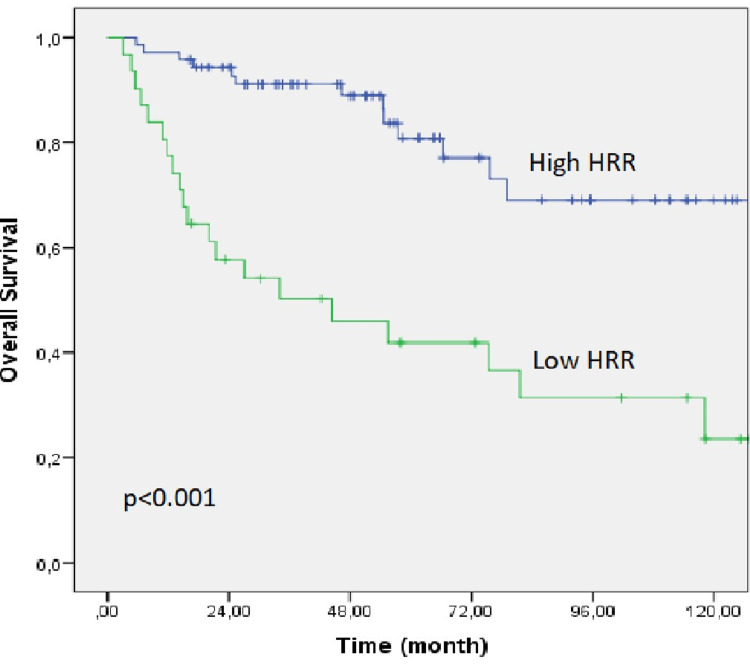
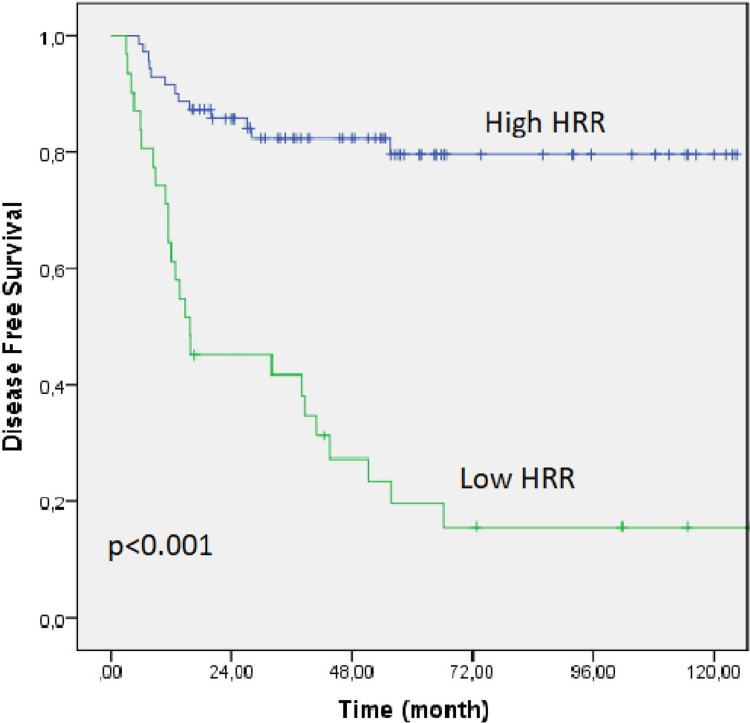
Results: A total of 102 patients were included in the study. The cut-off value for HRR was taken as 0.97. Between the low and high HRR groups, mean age, Eastern Cooperative Oncology Group (ECOG) performance score, gamma-glutamyl transferase (GGT), albumin and lactate dehydrogenase (LDH) levels, weight loss at diagnosis, and recurrence and metastasis rate were significantly different. In the low HRR group, OS and DFS were 44.4 (95% CI: 4.9-83.8) and 15.7 months (95% CI: 0.1-36.2), respectively, but could not be reached in the high HRR group (p<0.001). In the multivariate analysis, low HRR was shown to be an independent factor in terms of both OS (p=0.004, hazard ratio (HR)=3.07, 95% CI: 1.444-6.529) and DFS (p<0.001, HR=3.94, 95% CI: 1.883-8.244).
Conclusion: This is the first study showing that HRR is an independent prognostic marker for OS and DFS in patients with LANC treated with chemoradiotherapy. Thus, HRR can be used as an easily applicable, inexpensive marker in clinical practice in this patient group.
Keywords: chemo-radiotherapy; hemoglobin; locally advanced nasopharyngeal cancer; prognostic factor; red cell distribution width.
Copyright © 2023, Bozkaya et al.
Conflict of interest statement
The authors have declared that no competing interests exist.
Figures
References
-
- Chemoradiotherapy versus radiotherapy in patients with advanced nasopharyngeal cancer: phase III randomized Intergroup study 0099. Al-Sarraf M, LeBlanc M, Giri PG, et al. J Clin Oncol. 1998;16:1310–1317. - PubMed
-
- Concurrent chemoradiotherapy in locally advanced nasopharyngeal carcinoma: a treatment paradigm also applicable to patients in Southeast Asia. Lu H, Peng L, Yuan X, et al. Cancer Treat Rev. 2009;35:345–353. - PubMed
-
- The American Joint Committee on Cancer: the 7th edition of the AJCC cancer staging manual and the future of TNM. Edge SB, Compton CC. Ann Surg Oncol. 2010;17:1471–1474. - PubMed
-
- Different clinical significance of pre- and post-treatment plasma Epstein-Barr virus DNA load in nasopharyngeal carcinoma treated with radiotherapy. Hou X, Zhao C, Guo Y, et al. Clin Oncol. 2011;23:128–133. - PubMed
LinkOut - more resources
Full Text Sources
Miscellaneous