


Associations of intakes of total protein, protein from dairy sources, and dietary calcium with risks of colorectal, breast, and prostate cancer: a prospective analysis in UK Biobank
- PMID: 37407836
- PMCID: PMC10421858
- DOI: 10.1038/s41416-023-02339-2
Associations of intakes of total protein, protein from dairy sources, and dietary calcium with risks of colorectal, breast, and prostate cancer: a prospective analysis in UK Biobank
Abstract
Background: Evidence concerning intakes of protein or sources of dairy protein and risks of colorectal, breast, and prostate cancers is inconclusive.
Methods: Using a subsample of UK Biobank participants who completed ≥2 (maximum of 5) 24-h dietary assessments, we estimated intakes of total protein, protein from total dairy products, milk, and cheese, and dietary calcium in 114,217 participants. Hazard ratios (HRs) and 95% confidence intervals (CI) were estimated using multivariable-adjusted Cox regression.
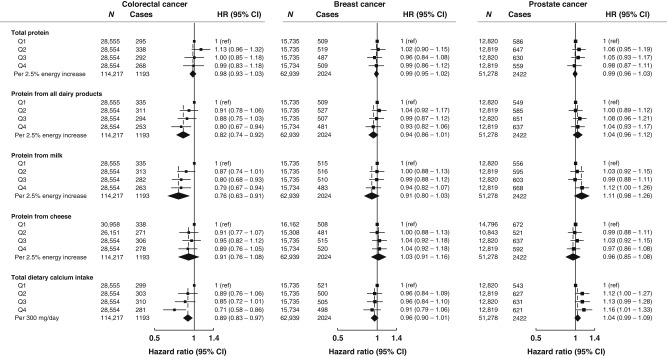
Results: After a median of 9.4 years of follow-up, 1193 colorectal, 2024 female breast, and 2422 prostate cancer cases were identified. There were inverse associations of total dairy protein, protein from milk, and dietary calcium intakes with colorectal cancer incidence (HRQ4 vs Q1:0.80, 95% CI: 0.67-0.94; 0.79, 0.67-0.94; 0.71, 0.58-0.86, respectively). We also observed positive associations of milk protein and dietary calcium with prostate cancer risk (HRQ4 vs Q1:1.12, 1.00-1.26 and 1.16, 1.01-1.33, respectively). No significant associations were observed between intake of dairy protein and breast cancer risk. When insulin-like growth factor-I concentrations measured at recruitment were added to the multivariable-adjusted models, associations remained largely unchanged. Analyses were also similar when looking at total grams of dairy products, milk, and cheese.
Conclusion: Further research is needed to understand the mechanisms underlying the relationships of dairy products with cancer risk and the potential roles of dietary protein and calcium.
© 2023. The Author(s).
Conflict of interest statement
The authors declare no competing interests.
Figures
References
-
- World Cancer Research Fund/ American Institute for Cancer Research. Continuous Update Project Expert Report. Diet, nutrition, physical activity and colorectal cancer. 2018. Available at dietandcancerreport.org
-
- World Cancer Research Fund International Systematic Literature Review. The associations between food, nutrition and physical activity and the risk of colorectal cancer. 2017. https://www.wcrf.org/wp-content/uploads/2021/02/colorectal-cancer-slr.pdf.
-
- World Cancer Research Fund/ American Institute for Cancer Research. Continuous Update Project Expert Report. Diet, nutrition, physical activity and breast cancer. 2018. Available at dietandcancerreport.org
-
- World Cancer Research Fund International Systematic Literature Review. The associations between food, nutrition and physical activity and the risk of breast cancer. 2017. https://www.wcrf.org/wp-content/uploads/2021/02/breast-cancer-slr.pdf.
Publication types
MeSH terms
Substances
Grants and funding
LinkOut - more resources
Full Text Sources
Medical
