


The Relationship Between Cognitive Impairments and Sleep Quality Measures in Persistent Insomnia Disorder
- PMID: 37408565
- PMCID: PMC10319274
- DOI: 10.2147/NSS.S399644
The Relationship Between Cognitive Impairments and Sleep Quality Measures in Persistent Insomnia Disorder
Abstract
Study objectives: Persistent insomnia disorder (pID) is linked to neurocognitive decline and increased risk of Alzheimer's Disease (AD) in later life. However, research in this field often utilizes self-reported sleep quality data - which may be biased by sleep misperception - or uses extensive neurocognitive test batteries - which are often not feasible in clinical settings. This study therefore aims to assess whether a simple screening tool could uncover a specific pattern of cognitive changes in pID patients, and whether these relate to objective aspect(s) of sleep quality.
Methods: Neurocognitive performance (Montreal Cognitive Assessment; MoCA), anxiety/depression severity, and subjective sleep quality (Pittsburgh Sleep Quality Index: PSQI; Insomnia Severity Index: ISI) data were collected from 22 middle-aged pID patients and 22 good-sleepers. Patients underwent overnight polysomnography.
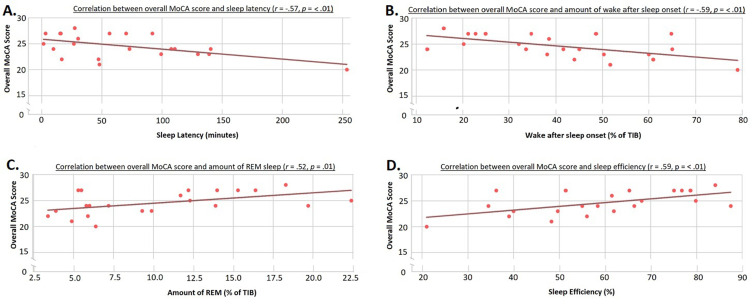
Results: Compared to good-sleepers, patients had lower overall cognitive performance (average: 24.6 versus 26.3 points, Mann-Whitney U = 136.5, p = <0.006), with deficits in clock drawing and verbal abstraction. In patients, poorer overall cognitive performance correlated with reduced subjective sleep quality (PSQI: r(42) = -0.47, p = 0.001; and ISI: r(42) = -0.43, p = 0.004), reduced objective sleep quality (lower sleep efficiency: r(20) = 0.59, p = 0.004 and less REM-sleep: r(20) = 0.52, p = 0.013; and increased sleep latency: r(20) = -0.57, p = 0.005 and time awake: r(20) = -0.59, p = 0.004). Cognitive performance was not related to anxiety/depression scores.
Conclusion: Using a simple neurocognitive screening tool, we found that pID patients showed cognitive deficiencies that related to both subjective/self-reported and objective/polysomnographic measures of sleep quality. Furthermore, these cognitive changes resembled those seen in preclinical non-amnestic AD, and thus could indicate incumbent neurodegenerative processes in pID. Interestingly, increased REM-sleep was correlated with better cognitive performance. However, whether REM-sleep is protective against neurodegeneration requires further investigation.
Keywords: Alzheimer’s disease; cognitive screening; insomnia; neurodegeneration; polysomnography; sleep.
© 2023 Künstler et al.
Conflict of interest statement
The authors report no conflicts of interest in this work.
Figures

References
-
- Iranzo A, Santamaria J. Sleep in neurodegenerative diseases. In: Chokroverty S, Billiard M, editors. Sleep Med. New York, NY: Springer; 2015:271–283.
LinkOut - more resources
Full Text Sources
