Meta-Analysis
. 2023 Jul 6;21(7):e3002166.
doi: 10.1371/journal.pbio.3002166. eCollection 2023 Jul.

Insights into the coexistence of birds and humans in cropland through meta-analyses of bird exclosure studies, crop loss mitigation experiments, and social surveys

Affiliations
Meta-Analysis

Insights into the coexistence of birds and humans in cropland through meta-analyses of bird exclosure studies, crop loss mitigation experiments, and social surveys

Cheng Huang et al. PLoS Biol. .

Abstract

Birds share lands with humans at a substantial scale and affect crops. Yet, at a global scale, systematic evaluations of human-bird coexistence in croplands are scarce. Here, we compiled and used meta-analysis approaches to synthesize multiple global datasets of ecological and social dimensions to understand this complex coexistence system. Our result shows that birds usually increase woody, but not herbaceous, crop production, implying that crop loss mitigation efforts are critical for a better coexistence. We reveal that many nonlethal technical measures are more effective in reducing crop loss, e.g., using scaring devices and changing sow practices, than other available methods. Besides, we find that stakeholders from low-income countries are more likely to perceive the crop losses caused by birds and are less positive toward birds than those from high-income ones. Based on our evidence, we identified potential regional clusters, particularly in tropical areas, for implementing win-win coexistence strategies. Overall, we provide an evidence-based knowledge flow and solutions for stakeholders to integrate the conservation and management of birds in croplands.


Conflict of interest statement

The authors have declared that no competing interests exist.

Figures

Fig 1
Fig 1. A methodological overview for synthesizing evidence of human–bird coexistence in croplands.
(a) Key components of human–bird coexistence system in croplands. (b) To identify crop-consuming species, all diet-related descriptions in the Birds of the World were compiled. (c) To evaluate the net effect of birds on different crop productions, we analyzed data from exclosure experiments, of which the access of birds to crops was intentionally manipulated. (d) To offer potential solutions for reducing crop loss from birds, we analyzed data from mitigation experiments to evaluate the effectiveness of available measures. (e) To explore human perceptions and attitudes toward birds, we evaluated data from different social surveys. Based on the evidence from (b), (c), and (d), we attempted to identify the priority areas to take actions for encouraging the coexistence. Such areas are characterized by a higher proportion of crop that benefits from birds’ service and higher bird conservation value (f).
Fig 2
Fig 2. Number of bird species reported to consume crops and the overlay of their range distributions.
The top barplot (a) shows the number of bird species reported to consume crops of taxonomic families by the IUCN threatened status (the data underlying this figure can be found in S1 Data). Only families with the top 25% number of species were plotted. The bottom map (b) shows the overlay of the range distribution maps of 1,057 crop-consuming bird species. The base map of country boundaries was from https://www.naturalearthdata.com/.
Fig 3
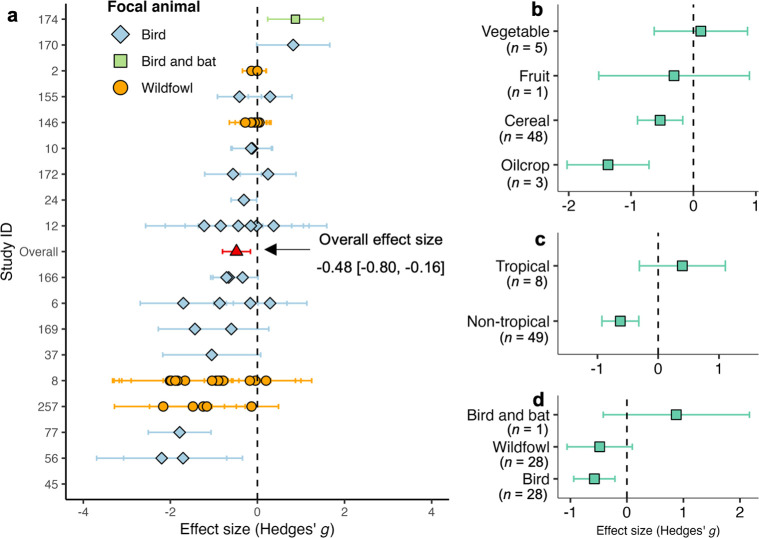
Fig 3. Effect of birds on woody crop production.
(a) The overall effect size (in the red triangle) and the 101 effect sizes from case studies (b) by food types; (c) by climatic regions; (d) by focal animals. The term “bird” mainly refers to Passeriformes or perching birds. In all exclosure experiments, birds were the focal animal of interest, but some experiments necessarily excluded leaf-gleaning bats (d). Plotted are the effect sizes and corresponding 95% confidence interval. A positive value of effect size means that the presence of birds increases crop production and vice versa. The value n is the number of effect sizes per variable of interest. The data underlying this figure can be found in S2 Data.
Fig 4
Fig 4. Effect of birds on herbaceous crop production of.
(a) The overall effect size (in the red triangle) and the 57 effect sizes from case studies (b) by food types; (c) by climatic regions; (d) by focal animals. The term “bird” mainly refers to Passeriformes or perching birds. In all exclosure experiments, birds were the focal animal of interest, but some experiments necessarily excluded leaf-gleaning bats (d). Plotted are the effect sizes and corresponding 95% confidence interval. A positive value of effect size means that the presence of birds increases crop production and vice versa. The value n is the number of effect sizes per variable of interest. The data underlying this figure can be found in S2 Data.
Fig 5
Fig 5. Effectiveness of mitigating measures in reducing crop loss from birds.
(a) By the category of measure applied to all stages; (b) by repellent applied at all stages; (c) the category of measure applied only at sow stage. Examples of field applications are illustrated (d). Plotted are the overall mean value and 95% confidence interval of the effect size. A positive value of effect size means that a measure reduced the crop loss and vice versa. The data underlying this figure can be found in S3 Data.
Fig 6
Fig 6. Coefficients estimated by the averaged generalized linear mixed-effects models of comparable supports for the perception and attitude toward birds.
Respondents from low-income countries are more likely to perceive the disservice from birds (a) and are less positive towards birds (b) than those from the high-income ones. For the comparison among focal bird groups, the base intercept is “bird in general,” which refers to the surveys that only specified the level to “birds”; and the “other” birds include woodpeckers, robins, and hummingbirds. The asterisk indicates the estimation is statistically significant (95%). A blue dot means the coefficient is larger than zero, and a red dot means the coefficient is smaller than zero.
Fig 7
Fig 7. The prioritized areas for efforts to make a better human–bird coexistence in croplands.
The bivariate maps are the overlay of the index of integrative conservation index of birds and crop benefit from birds in tercile increments (33%). The greener color of the bivariate maps (top-right of the legend) represents a higher integrative conservation value and more woody crops that may benefit from birds. The base map of country boundaries was from https://www.naturalearthdata.com/.
Fig 8
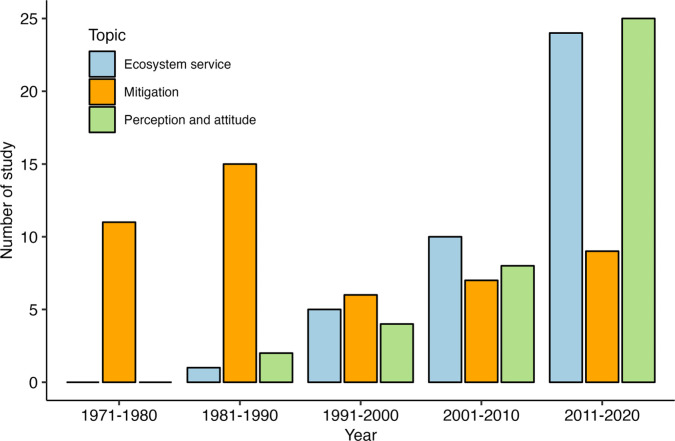
Fig 8. Temporal trend of the number of relevant studies on ecosystem services of birds, mitigation of bird disservice, and perception and attitude towards birds.
The studies about the ecosystem service of birds (p = 0.02) and perception and attitude towards birds (p = 0.02) are generally increasing. The data underlying this figure can be found in S5 Data.

References

    1. Messerli P, Murniningtyas E, Eloundou-Enyegue P, Foli EG, Furman E, Glassman A, et al. Global sustainable development report 2019: The future is now–science for achieving sustainable development. 2019.
    1. Laurance WF, Useche DC, Rendeiro J, Kalka M, Bradshaw CJ, Sloan SP, et al. Averting biodiversity collapse in tropical forest protected areas. Nature. 2012;489(7415):290–294. doi: 10.1038/nature11318 - DOI - PubMed
    1. Geldmann J, Manica A, Burgess ND, Coad L, Balmford A. A global-level assessment of the effectiveness of protected areas at resisting anthropogenic pressures. Proc Natl Acad Sci U S A. 2019;116(46):23209–23215. doi: 10.1073/pnas.1908221116 - DOI - PMC - PubMed
    1. Cazalis V, Princé K, Mihoub JB, Kelly J, Rodrigues A. Effectiveness of protected areas in conserving tropical forest birds. Nat Commun. 2020;11(1):1–8. - PMC - PubMed
    1. Nyhus PJ. Human—wildlife conflict and coexistence. Annu Rev Env Resour. 2016;41:143–171.

Publication types