Results of contact tracing for SARS-CoV-2 Omicron sub-lineages (BA.4, BA.5, BA.2.75) and the household secondary attack risk
- PMID: 37415434
- PMCID: PMC10522828
- DOI: 10.24171/j.phrp.2022.0285
Results of contact tracing for SARS-CoV-2 Omicron sub-lineages (BA.4, BA.5, BA.2.75) and the household secondary attack risk
Abstract
Background: This study aimed to assess the contact tracing outcomes of severe acute respiratory syndrome coronavirus 2 (SARS-CoV-2) Omicron sub-lineages BA.4, BA.5, and BA.2.75 within Republic of Korea, and to generate foundational data for responding to future novel variants.
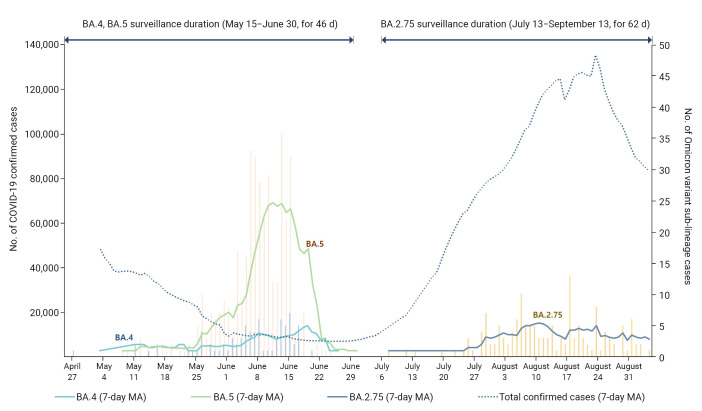
Methods: We conducted investigations and contact tracing for 79 confirmed BA.4 cases, 396 confirmed BA.5 cases, and 152 confirmed BA.2.75 cases. These cases were identified through random sampling of both domestically confirmed and imported cases, with the goal of evaluating the pattern of occurrence and transmissibility.
Results: We detected 79 instances of Omicron sub-lineage BA.4 across a span of 46 days, 396 instances of Omicron sub-lineage BA.5 in 46 days, and 152 instances of Omicron sub-lineage BA.2.75 over 62 days. One patient with severe illness was confirmed among the BA.5 cases; however, there were no reports of severe illness in the confirmed BA.4 and BA.2.75 cases. The secondary attack risk among household contacts were 19.6% for BA.4, 27.8% for BA.5, and 24.3% for BA.2.75. No statistically significant difference was found between the Omicron sub-lineages.
Conclusion: BA.2.75 did not demonstrate a higher tendency for transmissibility, disease severity, or secondary attack risk within households when compared to BA.4 and BA.5. We will continue to monitor major SARS-CoV-2 variants, and we plan to enhance the disease control and response systems.
Keywords: COVID-19; Epidemiology; Risk; Secondary attack rate; Variants.
Conflict of interest statement
The authors have no conflicts of interest to declare.
Figures
References
-
- World Health Organization (WHO). Tracking SARS-CoV-2 variants [Internet]. WHO; 2023 [cited 2023 May 3]. Available from: https://www.who.int/activities/tracking-SARS-CoV-2-variants.
-
- European Centre for Disease Prevention and Control (ECDC). SARS-CoV-2 variants of concern as of 20 April 2023 [Internet]. ECDC; 2023 [cited 2023 May 3]. Available from: https://www.ecdc.europa.eu/en/covid-19/variants-concern.
-
- outbreak.info. BA.2.75 lineage report [Internet]. outbreak.info; 2022 [cited 2023 Sep 20]. Available from: https://outbreak.info/situation-reports?pango=BA.2.75.
-
- Yu M, Lee HY, Park HU, et al. Epidemiologic characteristics of COVID-19 Omicron variant sub-lineages and recombinant variants. Public Health Wkly Rep. 2022;15:1828–34.
-
- Korea Disease Control and Prevention Agency (KDCA). COVID-19-related novel variant monitoring, investigation and evaluation manual. 2nd ed. KDCA; 2022.
LinkOut - more resources
Full Text Sources
Miscellaneous