. 2023 May 31;5(8):100683.
doi: 10.1016/j.xkme.2023.100683. eCollection 2023 Aug.

Atypical Hemolytic Uremic Syndrome Treated With Ravulizumab or Eculizumab: A Claims-Based Evaluation of Health Care Resource Utilization and Clinical Outcomes in the United States

Affiliations

Atypical Hemolytic Uremic Syndrome Treated With Ravulizumab or Eculizumab: A Claims-Based Evaluation of Health Care Resource Utilization and Clinical Outcomes in the United States

Yan Wang et al. Kidney Med. .

Abstract

Rationale and objective: Ravulizumab and eculizumab have shown efficacy for the treatment of atypical hemolytic uremic syndrome (aHUS), but real-world evidence for ravulizumab is limited owing to its more recent approval. This real-world database study examined outcomes for adult patients switching to ravulizumab from eculizumab and patients treated with individual treatments.

Study design: A retrospective, observational study using the Clarivate Real World Database.

Setting and population: US health-insurance billing data (January 2012 to March 2021) of patients aged 18 years or older with ≥1 diagnosis relevant to aHUS, ≥1 claim for treatment with eculizumab or ravulizumab, and no evidence of other indicated conditions.

Exposures: Treatment-switch (to ravulizumab after eculizumab), ravulizumab-only, and eculizumab-only cohorts were examined.

Outcomes: Clinical procedures, facility visits, health care costs, and clinical manifestations.

Analytical approach: Paired-sample statistical testing compared the mean numbers of claims for each group 0-3 months before (preindex period) and 0-3 months and 3-6 months after (postindex period) the index date (point of initiation with a single treatment or treatment switch).

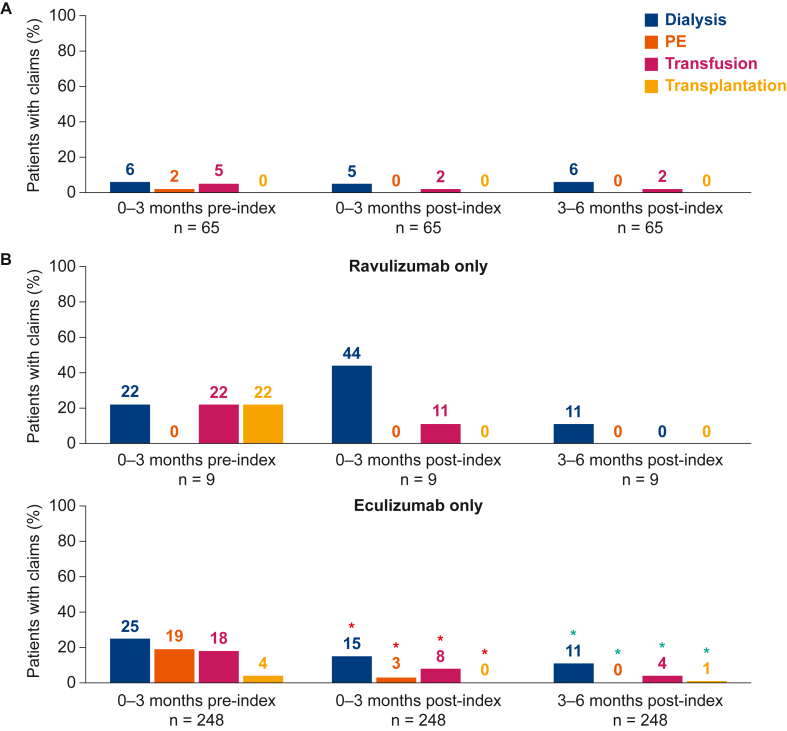
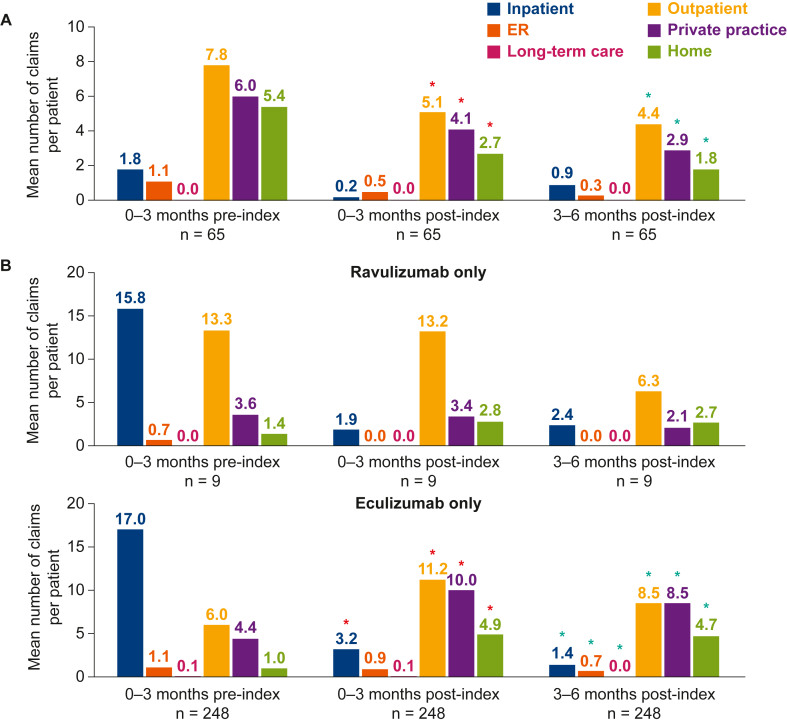
Results: In total, 322 patients met the eligibility criteria at 3-6 months postindex in the treatment-switch (n=65), ravulizumab-only (n=9), and eculizumab-only (n=248) cohorts. The proportions of patients with claims for key clinical procedures continued to be small after treatment switch and were small (0%-11%) across all cohorts at 3-6 months postindex. Inpatient visits were reduced in the postindex period across all cohorts. At 3-6 months after treatment switch, patients reported fewer claims for outpatient, private practice, and home visits and lower median health care costs. The proportions of patients with claims for clinical manifestations of aHUS were generally reduced in the postindex period compared with those of the preindex period.

Limitations: Low patient numbers receiving ravulizumab only.

Conclusions: The health-insurance claims data showed a reduced health care burden for US adult patients after treatment with ravulizumab or eculizumab for treatment of aHUS.

Keywords: Complement C5 inhibitors; atypical hemolytic uremic syndrome; outcomes; real-world evidence; treatment patterns.


Figures

Figure 1
Figure 1
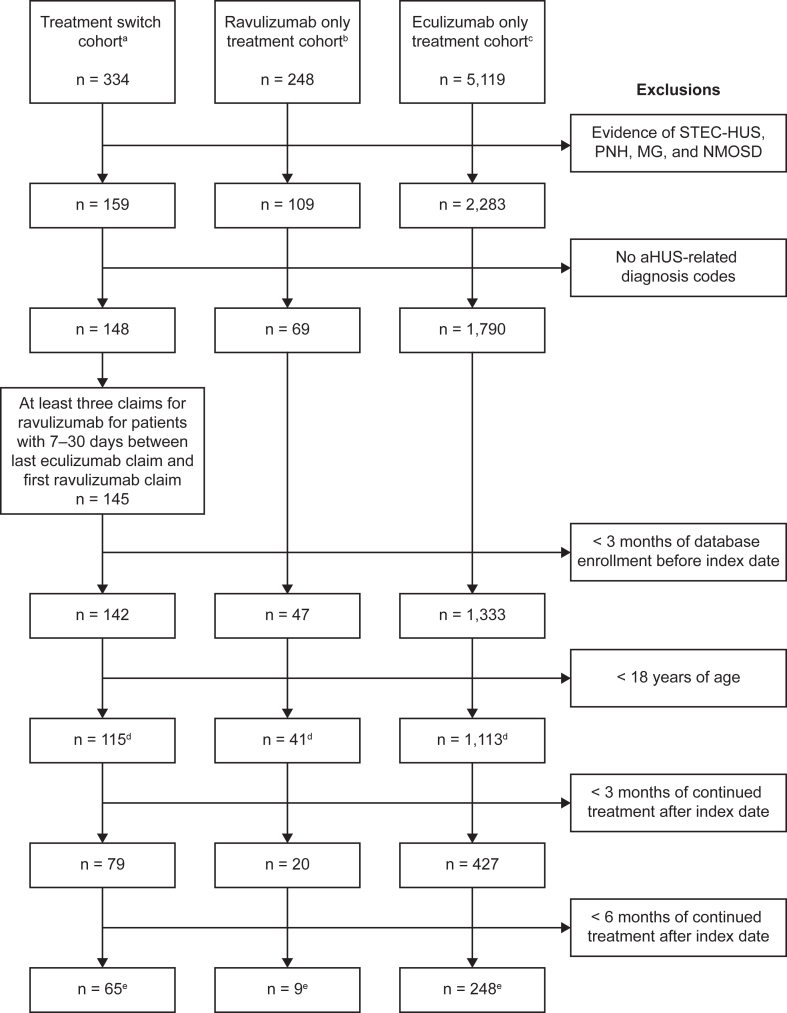
Participant disposition and inclusion/exclusion criteria. aHUS, atypical hemolytic uremic syndrome; MG, myasthenia gravis; NMOSD, neuromyelitis optical spectrum disorder; PNH, paroxysmal nocturnal hemoglobinuria; STEC-HUS, Shiga toxin Escherichia coli-related hemolytic uremic syndrome. aThe switch cohort was required to have ≥ 1 claim for treatment with eculizumab and ≥ 1 claim for treatment with ravulizumab afterward within the study period, 7-30 days between the last eculizumab claim and first ravulizumab claim, and no evidence of eculizumab use after first ravulizumab use. bThe ravulizumab-only cohort was required to have ≥ 1 claim for treatment with ravulizumab and no evidence of eculizumab use in the study period. cThe eculizumab-only cohort was required to have ≥ 1 claim for treatment with eculizumab and no evidence of ravulizumab use in the study period. dDefines the sample used for descriptive analysis of patient demographics and treatment characteristics. eRepresents the sample used for analyses of outcomes for the 3-6 months postindex period.
Figure 2
Figure 2
Percentage of patients with claims for clinical procedures before and after the index date for (A) adult patients who switched from eculizumab to ravulizumab treatment, and (B) adult patients receiving treatment with ravulizumab or eculizumab only. aP < 0.05 [only analyzed for 0-3 months preindex vs 0-3 months postindex (red asterisks) and for 0-3 months preindex vs 3-6 months postindex (green asterisks)]. Owing to the small sample size, no inferential statistical analysis is reported for patients receiving ravulizumab only. Outcomes analyses required at least 6 months of continued eculizumab/ravulizumab use after the index date. Transfusion includes red blood cell and platelet transfusions. PE, plasma exchange.
Figure 3
Figure 3
Mean number of claims for facility visits, before and after the index date, for patients with data available for (A) adult patients who switched from eculizumab to ravulizumab, and (B) adult patients receiving treatment with ravulizumab or eculizumab only. aP < 0.05 [only analyzed for 0-3 months preindex vs 0-3 months postindex (red asterisks), and for 0-3 months preindex vs 3-6 months postindex (green asterisks)]. Owing to the small sample size, no inferential statistical analysis is reported for patients receiving ravulizumab only. Outcomes analyses required at least 6 months of continued eculizumab or ravulizumab use after the index date. The n values vary owing to the number of patients in each time window with data available. Any claim, not just aHUS-related claims, within the 3-month time window with an associated site-of-care variable were included in this analysis. ER, emergency room.

References

    1. Yan K., Desai K., Gullapalli L., Druyts E., Balijepalli C. Epidemiology of atypical hemolytic uremic syndrome: a systematic literature review. Clin Epidemiol. 2020;12:295–305. - PMC - PubMed
    1. Campistol J.M., Arias M., Ariceta G., et al. An update for atypical haemolytic uraemic syndrome: diagnosis and treatment. A consensus document. Nefrologia. 2015;35(5):421–447. - PubMed
    1. Caprioli J., Noris M., Brioschi S., et al. Genetics of HUS: the impact of MCP, CFH, and IF mutations on clinical presentation, response to treatment, and outcome. Blood. 2006;108(4):1267–1279. - PMC - PubMed
    1. Kavanagh D., Goodship T.H., Richards A. Atypical hemolytic uremic syndrome. Semin Nephrol. 2013;33(6):508–530. - PMC - PubMed
    1. Fremeaux-Bacchi V., Fakhouri F., Garnier A., et al. Genetics and outcome of atypical hemolytic uremic syndrome: a nationwide French series comparing children and adults. Clin J Am Soc Nephrol. 2013;8(4):554–562. - PMC - PubMed

LinkOut - more resources