Review
. 2023 Aug;63(2):97.
doi: 10.3892/ijo.2023.5545. Epub 2023 Jul 7.

Immunotherapy for nasopharyngeal carcinoma: Current status and prospects (Review)

Affiliations
Review

Immunotherapy for nasopharyngeal carcinoma: Current status and prospects (Review)

Huageng Huang et al. Int J Oncol. 2023 Aug.

Abstract

Nasopharyngeal carcinoma (NPC) is an epithelial tumor located in the nasopharynx and is highly associated with Epstein‑Barr virus (EBV) infection. Although radiotherapy alone can cure ~90% of patients with early‑stage disease, >70% of patients with NPC have locoregionally advanced or metastatic disease at the first diagnosis due to the insidious and aggressive nature of NPC. After comprehensive radiochemotherapy, 20‑30% of patients with advanced NPC still fail treatment, mainly due to recurrence and/or metastasis (R/M). Conventional salvage treatments, such as radiotherapy, chemotherapy and surgery, are suboptimal and frequently accompanied by severe adverse effects and limited efficacy. In recent years, immunotherapy has emerged as a promising treatment modality for R/M NPC. An increasing number of clinical studies have investigated the safety and efficacy of immunotherapy for advanced NPC and have shown considerable progress. In the present review, the rationale for the use of immunotherapy to treat NPC was summarized and the current status, progress and challenges of NPC clinical research on different immunotherapeutic approaches were highlighted, including immune checkpoint inhibitors, vaccines, immunomodulators, adoptive cell transfer and EBV‑specific monoclonal antibodies. The comprehensive overview of immunotherapy in NPC may provide insight for clinical practice and future investigation.

Keywords: Epstein‑Barr virus; clinical trial; immunotherapy; nasopharyngeal carcinoma; treatment.


Conflict of interest statement

The authors declare that they have no competing interests.

Figures

Figure 1
Figure 1
Pathogenesis of nasopharyngeal carcinoma. Genetically susceptible nasopharyngeal epithelial cells undergo malignant transformation upon acquisition of persistent latent Epstein-Barr virus infection and exposure to environmental carcinogens, which enable cellular transformation and clonal expansion. The figure was created with BioRender. LMP1/2, latent membrane protein 1/2; BARF1, BamH1-A right frame 1; EBNA, Epstein-Barr nuclear antigen 1; MHC, major histocompatibility complex.
Figure 2
Figure 2
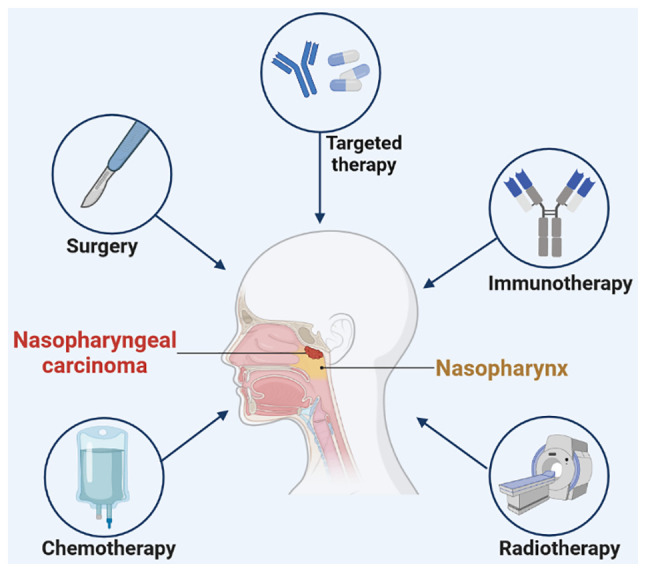
Treatment for NPC. Conventional treatment for nasopharyngeal carcinoma includes radiotherapy, chemotherapy, surgery and targeted therapy. Immunotherapy has emerged as a new strategy for the treatment of advanced NPC in recent years. The figure was created with BioRender. NPC, nasopharyngeal carcinoma.
Figure 3
Figure 3
Classification of immunotherapy for NPC. NPC, nasopharyngeal carcinoma; EBV, Epstein-Barr virus; PD-1, programmed cell death protein-1; PD-L1, programmed death ligand-1; CTLA-4, cytotoxic T-lymphocyte-associated antigen-4; LAG-3, Lymphocyte activation gene-3; TIM-3, T-cell immunoglobulin- and mucin-domain-containing molecule-3; CTL, cytotoxic T lymphocytes; TIL, tumor-infiltrating lymphocytes; CIK, cytokine-induced killer; NK, natural killer; CAR-T, chimeric antigen receptor-modified T; TCR-T, T-cell receptor-engineered T.
Figure 4
Figure 4
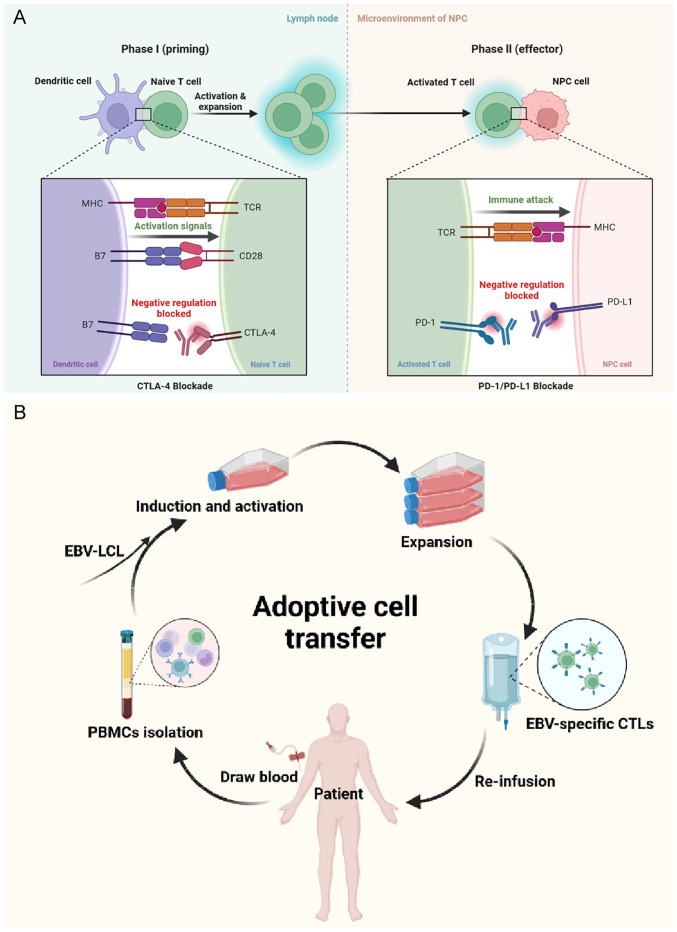
Mechanism of (A) immune checkpoint inhibitors (CTLA-4, PD-1 and PD-L1 inhibitors) and (B) adoptive cell transfer of cytotoxic T lymphocytes. The figure was created with BioRender. MHC, major histocompatibility complex; TCR, T-cell receptor; CTLA-4, cytotoxic T-lymphocyte-associated antigen-4; PD-1, programmed cell death protein-1; PD-L1, programmed death ligand-1; EBV, Epstein-Barr virus; LCL, lymphoblastoid B-cell line; CTLs, cytotoxic T-lymphocytes; PBMCs, peripheral blood mononuclear cells.

References

    1. Wong KCW, Hui EP, Lo KW, Lam WKJ, Johnson D, Li L, Tao Q, Chan KCA, To KF, King AD, et al. Nasopharyngeal carcinoma: An evolving paradigm. Nat Rev Clin Oncol. 2021;18:679–695. doi: 10.1038/s41571-021-00524-x. - DOI - PubMed
    1. Sung H, Ferlay J, Siegel RL, Laversanne M, Soerjomataram I, Jemal A, Bray F. Global cancer statistics 2020: GLOBOCAN estimates of incidence and mortality worldwide for 36 cancers in 185 countries. CA Cancer J Clin. 2021;71:209–249. doi: 10.3322/caac.21660. - DOI - PubMed
    1. Renaud S, Lefebvre A, Mordon S, Moralès O, Delhem N. Novel therapies boosting T cell immunity in epstein barr virus-associated nasopharyngeal carcinoma. Int J Mol Sci. 2020;21:4292. doi: 10.3390/ijms21124292. - DOI - PMC - PubMed
    1. Marks JE, Phillips JL, Menck HR. The National Cancer Data Base report on the relationship of race and national origin to the histology of nasopharyngeal carcinoma. Cancer. 1998;83:582–588. doi: 10.1002/(SICI)1097-0142(19980801)83:3<582::AID-CNCR29>3.0.CO;2-R. - DOI - PubMed
    1. Wang HY, Chang YL, To KF, Hwang JS, Mai HQ, Feng YF, Chang ET, Wang CP, Kam MK, Cheah SL, et al. A new prognostic histopathologic classification of nasopharyngeal carcinoma. Chin J Cancer. 2016;35:41. doi: 10.1186/s40880-016-0103-5. - DOI - PMC - PubMed

MeSH terms