Trends in Opioid Toxicity-Related Deaths in the US Before and After the Start of the COVID-19 Pandemic, 2011-2021
- PMID: 37418260
- PMCID: PMC10329206
- DOI: 10.1001/jamanetworkopen.2023.22303
Trends in Opioid Toxicity-Related Deaths in the US Before and After the Start of the COVID-19 Pandemic, 2011-2021
Abstract
Importance: Opioid-related harms constitute a major public health crisis in the US, and this crisis has worsened during the COVID-19 pandemic.
Objectives: To characterize the societal burden of unintentional opioid-related deaths in the US and describe changing mortality patterns during the COVID-19 pandemic.
Design, setting, and participants: A serial cross-sectional study examined all unintentional opioid-related deaths in the US, evaluated annually from calendar years 2011 to 2021.
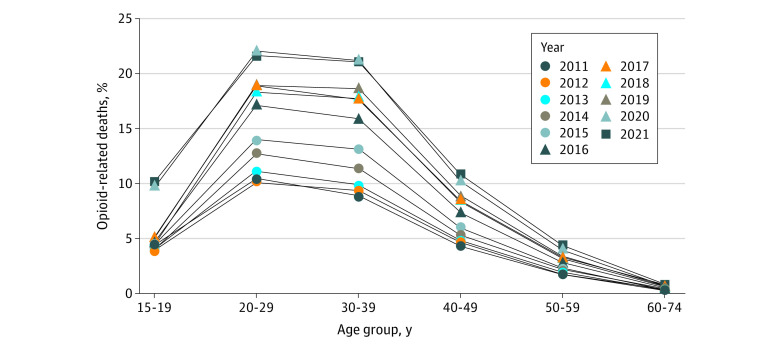
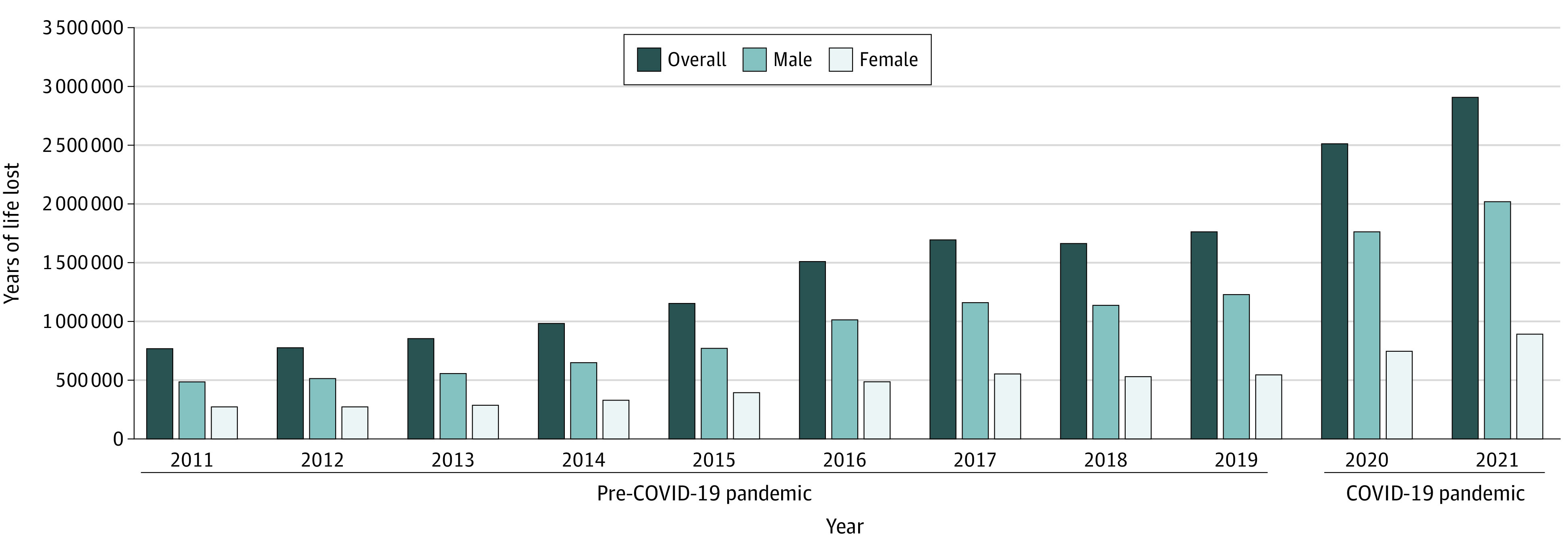
Main outcomes and measures: The public health burden of opioid toxicity-related deaths was estimated in 2 ways. First, the proportion of all deaths that were attributable to unintentional opioid toxicity by year (2011, 2013, 2015, 2017, 2019, and 2021) and age group (15-19, 20-29, 30-39, 40-49, 50-59, and 60-74 years) were calculated, using age-specific estimates of all-cause mortality as the denominator. Second, the total years of life lost (YLL) due to unintentional opioid toxicity was estimated, overall and by sex and age group, for each year studied.
Results: Among the 422 605 unintentional deaths due to opioid toxicity between 2011 and 2021, the median age of the individuals was 39 (IQR, 30-51) years, and 69.7% were male. The number of unintentional deaths due to opioid toxicity increased 289% over the study period, from 19 395 (2011) to 75 477 (2021). Similarly, the percentage of all deaths that were attributed to opioid toxicity increased from 1.8% in 2011 to 4.5% in 2021. By 2021, opioid toxicity was responsible for 10.2% of all deaths among those aged 15 to 19 years, 21.7% of deaths among those aged 20 to 29 years, and 21.0% of deaths among those aged 30 to 39 years. The YLL due to opioid toxicity increased 276% over the study period, from 777 597 in 2011 to 2 922 497 in 2021. While YLL plateaued between 2017 (7.0 YLL per 1000) and 2019 (7.2 YLL per 1000), it increased by 62.9% between 2019 and 2021 coincident with the COVID-19 pandemic, reaching 11.7 YLL per 1000 population. This relative increase was similar across all age groups and sexes with the exception of those aged 15 to 19 years, in whom the YLL nearly tripled, from 1.5 to 3.9 YLL per 1000 population.
Conclusions and relevance: In this cross-sectional study, deaths due to opioid toxicity increased substantially during the COVID-19 pandemic. By 2021, 1 of every 22 deaths in the US was attributable to unintentional opioid toxicity, underscoring the urgent need to support people at risk of substance-related harm, particularly men, younger adults, and adolescents.
Conflict of interest statement
Figures
References
-
- National Institute of Drug Abuse . Drug overdose death rates. 2022. Accessed February 2, 2023. https://nida.nih.gov/research-topics/trends-statistics/overdose-death-ra...
-
- Spencer MR, Minino AM, Warner M. Drug overdose deaths in the United States, 2001–2021. 2022. NCHS Data Brief. 2022;(457):1-8. - PubMed
-
- Canadian Centre on Substance Use and Addiction . Changes related to COVID-19 in the illegal drug supply and access to services, and resulting health harms. 2020. Accessed February 2, 2023. https://www.ccsa.ca/changes-related-covid-19-illegal-drug-supply-and-acc...
Publication types
MeSH terms
Substances
LinkOut - more resources
Full Text Sources
Medical