Impact of Black Race on Peripheral Neuropathy in Patients With Newly Diagnosed Multiple Myeloma Receiving Bortezomib Induction
- PMID: 37418682
- PMCID: PMC10538896
- DOI: 10.1200/OP.22.00781
Impact of Black Race on Peripheral Neuropathy in Patients With Newly Diagnosed Multiple Myeloma Receiving Bortezomib Induction
Abstract
Purpose: The incidence of multiple myeloma (MM) is two to three times higher in Black patients compared with other races, making it the most common hematologic malignancy in this patient population. Current treatment guidelines recommend the combination of a proteasome inhibitor, an immunomodulatory agent, and a corticosteroid as preferred induction therapy. Bortezomib use comes with the risk of peripheral neuropathy (PN) and potential need for dose reduction, therapy interruption, and additional supportive medications. Known risk factors for bortezomib-induced peripheral neuropathy (BIPN) include diabetes mellitus, previous thalidomide, advanced age, and obesity. We aimed to determine the potential association between Black race and incidence of BIPN.
Patients and methods: We identified a cohort of 748 patients with newly diagnosed MM who received induction with bortezomib, lenalidomide, and dexamethasone from 2007 to 2016. One hundred forty Black patients were matched with 140 non-Black patients on age, sex, BMI, and route of bortezomib administration. Incidence of BIPN was a binary event defined as new use of a neuropathy medication, bortezomib dose reduction, dose omission, or discontinuation because of PN.
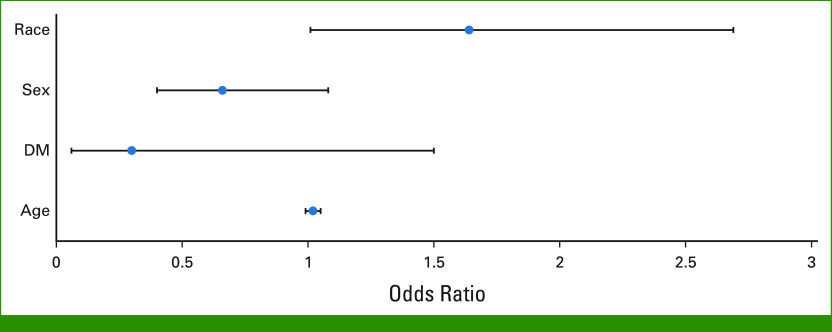
Results: The incidence of BIPN was higher in Black patients (46%) compared with non-Black patients (34%; P = .05) in both univariate (odds ratio [OR], 1.61; 95% CI, 1.00 to 2.61; P = .052) and multivariable analyses (OR, 1.64; 95% CI, 1.01 to 2.67; P = .047). No significant differences in BIPN were seen when stratified by route of administration.
Conclusion: These data indicate that Black race is an independent risk factor for the development of BIPN. Additional prevention strategies, close monitoring, and appropriate supportive care measures are warranted for these patients.
Conflict of interest statement
Disclosures provided by the authors are available with this article at DOI
The following represents disclosure information provided by authors of this manuscript. All relationships are considered compensated unless otherwise noted. Relationships are self-held unless noted. I = Immediate Family Member, Inst = My Institution. Relationships may not relate to the subject matter of this manuscript. For more information about ASCO's conflict of interest policy, please refer to
Open Payments is a public database containing information reported by companies about payments made to US-licensed physicians (
No other potential conflicts of interest were reported.
Figures
References
-
- Röllig C, Knop S, Bornhäuser M: Multiple myeloma. Lancet 385:2197-2208, 2015 - PubMed
-
- National Comprehensive Cancer Network : Multiple myeloma (version 5.2022). https://www.nccn.org/professionals/physician_gls/pdf/myeloma.pdf
-
- Fricker LD: Proteasome inhibitor drugs. Annu Rev Pharmacol Toxicol 60:457-476, 2020 - PubMed
-
- Durie BGM, Hoering A, Abidi MH, et al. : Bortezomib with lenalidomide and dexamethasone versus lenalidomide and dexamethasone alone in patients with newly diagnosed myeloma without intent for immediate autologous stem-cell transplant (SWOG S0777): A randomised, open-label, phase 3 trial. Lancet 389:519-527, 2017 - PMC - PubMed
Publication types
MeSH terms
Substances
Grants and funding
LinkOut - more resources
Full Text Sources
Medical