Review
. 2024 Jan;23(1):e13920.
doi: 10.1111/acel.13920. Epub 2023 Jul 9.

NAD metabolism: Role in senescence regulation and aging

Affiliations
Review

NAD metabolism: Role in senescence regulation and aging

Claudia Christiano Silva Chini et al. Aging Cell. 2024 Jan.

Abstract

The geroscience hypothesis proposes that addressing the biology of aging could directly prevent the onset or mitigate the severity of multiple chronic diseases. Understanding the interplay between key aspects of the biological hallmarks of aging is essential in delivering the promises of the geroscience hypothesis. Notably, the nucleotide nicotinamide adenine dinucleotide (NAD) interfaces with several biological hallmarks of aging, including cellular senescence, and changes in NAD metabolism have been shown to be involved in the aging process. The relationship between NAD metabolism and cellular senescence appears to be complex. On the one hand, the accumulation of DNA damage and mitochondrial dysfunction induced by low NAD+ can promote the development of senescence. On the other hand, the low NAD+ state that occurs during aging may inhibit SASP development as this secretory phenotype and the development of cellular senescence are both highly metabolically demanding. However, to date, the impact of NAD+ metabolism on the progression of the cellular senescence phenotype has not been fully characterized. Therefore, to explore the implications of NAD metabolism and NAD replacement therapies, it is essential to consider their interactions with other hallmarks of aging, including cellular senescence. We propose that a comprehensive understanding of the interplay between NAD boosting strategies and senolytic agents is necessary to advance the field.

Keywords: NAD+ metabolism; SASP; aging; nicotinamide adenine dinucleotide; senescence.


Conflict of interest statement

ENC holds a patent on CD38 inhibitors licensed by Elysium Health. ENC consults for Calico, Mitobridge, and Cytokinetics. Others declare no conflicts.

Figures
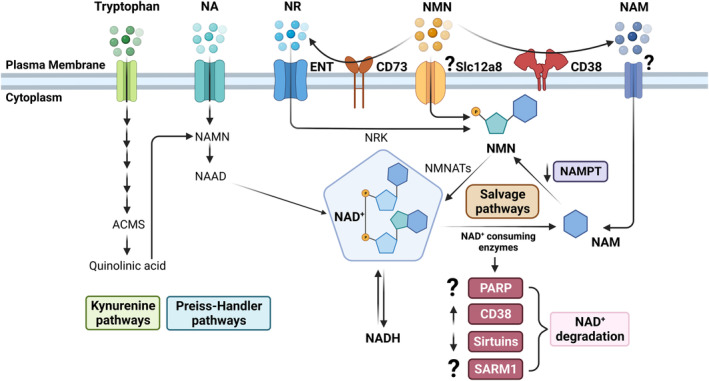
FIGURE 1
FIGURE 1
NAD metabolism pathways: regulation during aging. This figure summarizes the main NAD+ metabolism pathways, highlighting the entrance of NAD precursors in the cell, the synthesizing and degrading enzymes, and some of the changes that happens on these pathways during aging. From left to right: tryptophan enters the cells through neutral amino acids protein carriers, being used in the Kynurenine (de novo) pathway to produce NAD+; NA entrance is also mediated by a membrane carrier system, being used in the Preiss–Handler pathway to produce NAD+. NR enters the cell through ENTs, and NMN may use a specific Slc12a8 transporter. Both NR and NMN can be used in the salvage pathway to make NAD+. Outside of the cell, NMN can be converted to NR by CD73 or to NAM by CD38 before entering the cell. The NAM‐specific mechanism of uptake is still unknown. Decreased NAD+ levels with age appear to be driven by alterations in NAD metabolism enzymes. While levels of NAMPT and sirtuins have been shown to decrease during aging, levels of CD38 increase. PARP levels/activity have been shown to increase or decrease depending on the study, and the role of SARM1 in aging is still unknown. ACMS, 2‐amino‐3‐carboxymuconic acid semialdehyde; ENT, equilibrative nucleoside transporter; NA, nicotinic acid; NAAD, nicotinic acid adenine dinucleotide; NAD+, nicotinamide adenine dinucleotide; NADH, reduced nicotinamide adenosine dinucleotide; NAM, nicotinamide; NAMN, nicotinic acid mononucleotide; NAMPT, nicotinamide phosphoribosyltransferase; NMN, nicotinamide mononucleotide; NMNATs, nicotinamide mononucleotide adenylyl transferase; NR, nicotinamide riboside; NRK, nicotinamide riboside kinase; PARP, poly(ADP‐ribose) polymerase; SARM1, sterile alpha and TIR‐motif‐containing protein 1; Slc12a8, solute carrier family 12 member 8.
FIGURE 2
FIGURE 2
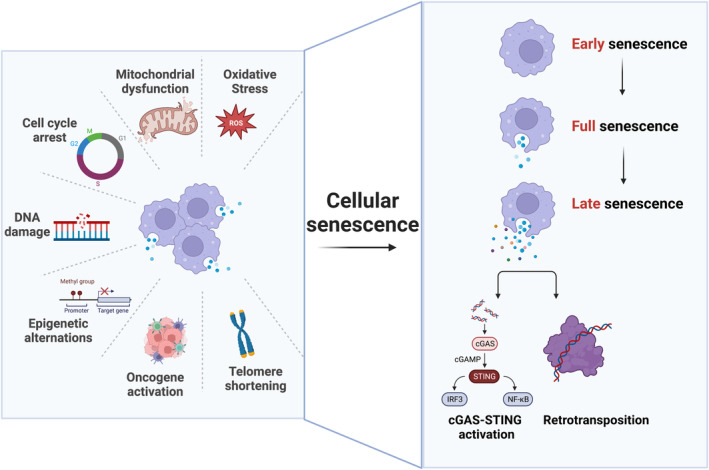
Development of cellular senescence. The left panel shows the main known inducers of cellular senescence. The right panel shows the progression of cellular senescence from early to late senescence. In late senescence, there is activation of the cGAS‐STING pathway alongside the retrotransposition and increased activation of the NF‐kB and interferon pathways. cGAMP, cyclic guanidine monophosphate‐adenosine monophosphate; c‐GAS, Cyclic GMP‐AMP synthase; IRF3, interferon regulator factor 3; NF‐kB, nuclear factor kappa‐light‐chain‐enhancer of activated B cells; ROS, reactive oxygen species; STING, stimulator of interferon genes.
FIGURE 3
FIGURE 3
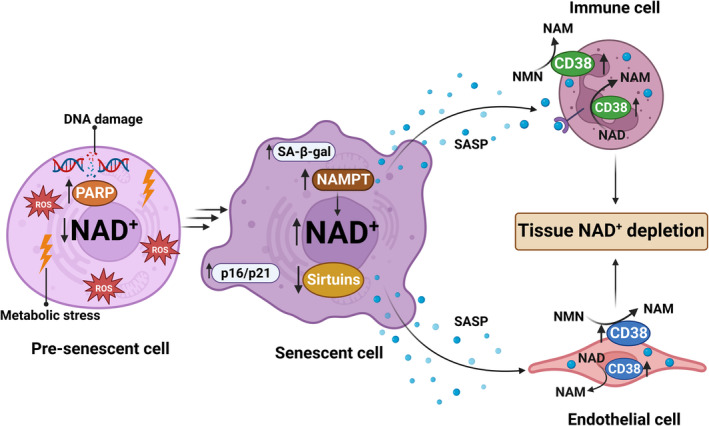
Interaction of cellular senescence and NAD metabolism in aging. Stimulus like metabolic stress and DNA damage induce PARP activation and NAD+ decline in cells, promoting cellular senescence. In senescent cells, NAMPT levels may increase, contributing to an increase in NAD levels that is necessary for SASP production. A decrease in sirtuins is also important for production of SASP‐associated secreted proteins. SASP released from senescent cells activate neighboring cells like immune and endothelial, increasing CD38 expression in these cells. CD38 as a NAD+ and NMN consuming enzyme causes overall tissue NAD+ depletion. NAD+, nicotinamide adenine dinucleotide; NAM, nicotinamide; NAMPT, nicotinamide phosphoribosyltransferase; NMN, nicotinamide mononucleotide; p16, tumor suppressor protein 16; p21, tumor suppressor protein 21; PARP, poly(ADP‐ribose) polymerase; ROS, reactive oxygen species; SASP, senescence‐associated secretory phenotype; SA‐β‐gal, senescence‐associated β‐galactosidase.
FIGURE 4
FIGURE 4
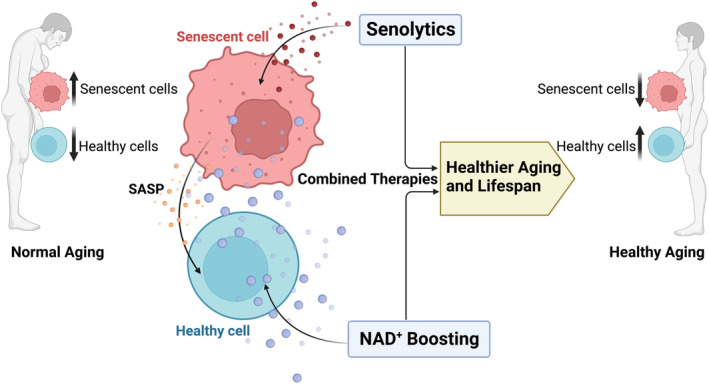
Theoretical framework for combined administration of senolytics and NAD+ boosting (replacement) therapies to promote healthier aging and lifespan. Senolytics selectively kill senescent cells and reduce overall senescence burden while NAD+ boosting globally supplements NAD precursors to different cell populations. Possibly, by combining these two therapies, the relative ratio of senescent cell to healthy cells would be reduced, the overall NAD+ level restored, leading to healthier aging, and increasing lifespan. NAD+, nicotinamide adenine dinucleotide; SASP, senescence‐associated secretory phenotype.

References

    1. Abdellatif, M. , Sedej, S. , & Kroemer, G. (2021). NAD(+) metabolism in cardiac health, aging, and disease. Circulation, 144, 1795–1817. - PubMed
    1. Abdellatif, M. , Trummer‐Herbst, V. , Koser, F. , Durand, S. , Adão, R. , Vasques‐Nóvoa, F. , Freundt, J. K. , Voglhuber, J. , Pricolo, M. R. , Kasa, M. , Türk, C. , Aprahamian, F. , Herrero‐Galán, E. , Hofer, S. J. , Pendl, T. , Rech, L. , Kargl, J. , Anto‐Michel, N. , Ljubojevic‐Holzer, S. , … Sedej, S. (2021). Nicotinamide for the treatment of heart failure with preserved ejection fraction. Sci Transl Med, 13, eabd7064. - PMC - PubMed
    1. Aflatounian, A. , Paris, V. R. , Richani, D. , Edwards, M. C. , Cochran, B. J. , Ledger, W. L. , Gilchrist, R. B. , Bertoldo, M. J. , Wu, L. E. , & Walters, K. A. (2022). Declining muscle NAD(+) in a hyperandrogenism PCOS mouse model: Possible role in metabolic dysregulation. Mol Metab, 65, 101583. - PMC - PubMed
    1. Agorrody, G. , Peclat, T. R. , Peluso, G. , Gonano, L. A. , Santos, L. , van Schooten, W. , Chini, C. C. S. , Escande, C. , Chini, E. N. , & Contreras, P. (2022). Benefits in cardiac function by CD38 suppression: Improvement in NAD+ levels, exercise capacity, heart rate variability and protection against catecholamine‐induced ventricular arrhythmias. J Mol Cell Cardiol, 166, 11–22. - PMC - PubMed
    1. Akanksha, Mishra, S. P. , Kar, A. G. , Karthik, J. S. , Srivastava, A. , Khanna, R. , & Meena, R. N. (2022). Expression of poly(adenosine diphosphate‐ribose) polymerase protein in breast cancer. J Midlife Health, 13, 213–224. - PMC - PubMed

Publication types

LinkOut - more resources