Review
. 2023 Aug 31;21(3):429-446.
doi: 10.9758/cpn.22.1034.

The Role of Glutamate Underlying Treatment-resistant Depression

Affiliations
Review

The Role of Glutamate Underlying Treatment-resistant Depression

Jeongseop Kim et al. Clin Psychopharmacol Neurosci. .

Abstract

The monoamine hypothesis has significantly improved our understanding of mood disorders and their treatment by linking monoaminergic abnormalities to the pathophysiology of mood disorders. Even 50 years after the monoamine hypothesis was established, some patients do not respond to treatments for depression, including selective serotonin reuptake drugs. Accumulating evidence shows that patients with treatment-resistant depression (TRD) have severe abnormalities in the neuroplasticity and neurotrophic factor pathways, indicating that different treatment approaches may be necessary. Therefore, the glutamate hypothesis is gaining attention as a novel hypothesis that can overcome monoamine restrictions. Glutamate has been linked to structural and maladaptive morphological alterations in several brain areas associated with mood disorders. Recently, ketamine, an N-methyl-D-aspartate receptor (NMDAR) antagonist, has shown efficacy in TRD treatment and has received the U.S. Food and Drug Administration approval, revitalizing psychiatry research. However, the mechanism by which ketamine improves TRD remains unclear. In this review, we re-examined the glutamate hypothesis, bringing the glutamate system onboard to join the modulation of the monoamine systems, emphasizing the most prominent ketamine antidepressant mechanisms, such as NMDAR inhibition and NMDAR disinhibition in GABAergic interneurons. Furthermore, we discuss the animal models used in preclinical studies and the sex differences in the effects of ketamine.

Keywords: Chronic stress; Glutamate hypothesis; Ketamine; Models; Sex characteristics; Treatment-resistant depression; animal.


Conflict of interest statement

Conflicts of Interest

No potential conflict of interest relevant to this article was reported.

Figures

Fig. 1
Fig. 1
The main advances in antidepressant drugs since the 1950s. The monoamine oxidase inhibitor iproniazid was initially prescribed to treat tuberculosis. Iproniazid was broadened; however, it is now at the forefront of treating depression after a quick demonstration of its antidepressant effects in 1952. Around the same time, imipramine has also been shown to have antidepressant properties. Imipramine, the first TCA medicine to obtain FDA approval, is thought to help prevent monoamine reuptake, supporting the catecholamine hypothesis, notably the serotonin hypothesis. Evidence supporting the significance of serotonin in depression grew in the early 1970s as concerns about the side effects of MAOIs and TCAs grew. Fluoxetine was the first serotonin reuptake inhibitor, replacing previously used MAOIs and TCAs, and it was refined and FDA-approved as Prozac in 1985. Although these developments have become watersheds for the treatment of depression, monoamine-based medications can only be effective when taken continuously for several weeks, and many patients still do not fully recover. Therefore, new medications that function swiftly, particularly for patients who are resistant to traditional monoamine therapy, are required. As the limitations of the monoamine hypothesis became obvious, researchers began to notice that ketamine, found in 2000, dramatically relieved depressive symptoms within a few hours. Furthermore, when it was shown in 2006 that ketamine had antidepressant benefits in those who did not respond to standard monoamine drugs, the paradigm of depression research was radically altered. Because of this discovery, the FDA authorized the use of (S)-ketamine in 2019 for the treatment of treatment-resistant depression. Although the success of ketamine as an antidepressant has stimulated research into glutamate-based mechanisms of action, new NMDAR antagonists and glutamate-based drugs are yet to display the fast and long-lasting antidepressant effects of ketamine. Research on ketamine is underway to further understand its impact on treatment-resistant depression. MAOIs, monoamine oxidase inhibitors; FDA, Food and Drug Administration; TCAs, tricyclic antidepressants; SSRIs, selective serotonin reuptake inhibitors; MDD, major depressive disorder; TRD, treatment-resistant depression.
Fig. 2
Fig. 2
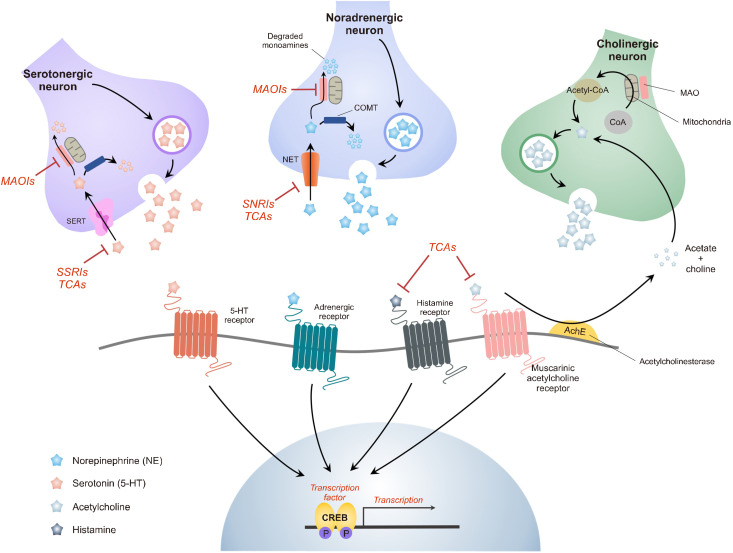
Key mechanisms of action for the antidepressants SSRI, TCA, and ketamine. MAOIs elevate brain amine levels by interfering with nerve-ending metabolism, resulting in increased vesicular storage of NE and 5-HT. Increased levels of amines are generated when nerve activity releases vesicles, boosting the activity of neurotransmitters. Tricyclic antidepressants have an immediate influence on neurotransmitter function at post-synaptic receptors by blocking the reuptake mechanism responsible for the synaptic termination of NE and 5-HT in the brain. The acute activity of SSRIs on the serotonin transporter is highly selective (SERT). SSRIs allosterically block the transporter by binding to sites other than serotonin. They may have little inhibition of the NE transporter or block adrenergic and cholinergic receptors. SNRI enhances the functions of both neurotransmitters by binding to SERT and NE transporters (NET). Unlike TCA, SNRI has no substantial blocking effect on peripheral receptors, such as histamine H1, muscarinic, or adrenergic receptors. This figure is adapted from Aswal et al. (J Formul Sci Bioavailab 2018;2:1000121) [134] and Martín-Hernández et al. (Monoaminergic system and antidepressants. 2021. p.345-355) [135] with original copyright holder’s permission. SSRI, selective serotonin reuptake inhibitor; TCA, tricyclic antidepressant; MAOIs, monoamine oxidase inhibitors; NE, norepinephrine; 5-HT, serotonin; SERT, serotonin transporter; SNRI, serotonin-norepinephrine reuptake inhibitor; COMT, catechol-o-methyltransferase; CoA, coenzyme A; CREB, cyclic adenosine monophosphate response element-binding protein.
Fig. 3
Fig. 3
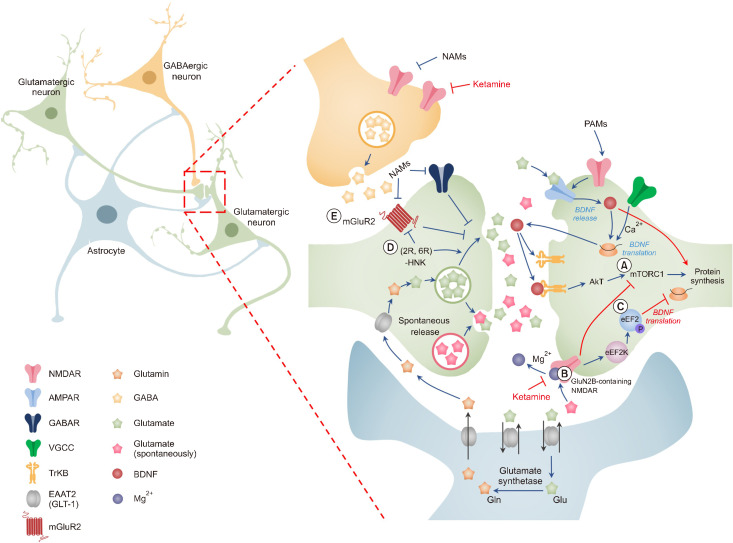
Major hypotheses regarding how ketamine acts as an antidepressant. Ketamine has been utilized as an anesthetic because it is an NMDAR antagonist. Following the discovery that ketamine has rapid antidepressant effects, numerous ideas have been proposed to explain how subanesthetic dosages of ketamine function as antidepressants. (A) According to the disinhibition hypothesis, ketamine selectively inhibits NMDARs expressed in GABAergic inhibitory interneurons, resulting in pyramidal neuron disinhibition and increased glutamatergic firing. Evoked glutamate binds to and activates post-synaptic AMPARs, resulting in enhanced BDNF release, TrkB receptor activation, and subsequent augmentation of protein synthesis via mTORC1. (B) It has been proposed that ketamine specifically inhibits extrasynaptic GluN2B-containing NMDARs, which are intensely stimulated by peripheral Glu levels controlled by EAAT2 in astrocytes, resulting in a decrease in mTORC1 activity. (C) It was predicted that ketamine would increase BDNF translation by decreasing NMDAR-mediated spontaneous neurotransmission, which would reduce eEF2K activity and prevent eEF2 substrate phosphorylation. (D, E) This hypothesis proposes that (2R,6R)-HNK serves as an antidepressant irrespective of NMDAR inhibition. Following treatment, ketamine may be metabolized to HNK, and these HNK metabolites may facilitate AMPAR-mediated synaptic enhancement or increase glutamate release by inhibiting mGluR2. This figure is adapted from Sanacora et al. [7], and Pham et al. [136] with permission. This figure is adapted from Sanacora et al. (Neuropharmacology 2012;62:63-77) [7] and Pham and Gardier (Pharmacol Ther 2019;199:58-90) [136] with original copyright holder’s permission. NMDAR, N-methyl-D-aspartate receptor; AMPAR, α-amino-3-hydroxy-5-methyl-4-isoxazolepropionic acid receptor; BDNF, brain-derived neurotrophic factor; TrkB, tropomyosin receptor kinase B; mTORC1, mammalian target of rapamycin complex 1; GluN2B, glutamate receptor subunit epsilon-2; EAAT2, excitatory amino acid transporter 2; eEF2K, eukaryotic elongation factor 2 kinase; HNK, hydroxynorketamine; NAMs, negative allosteric modulators; PAMs, positive allosteric modulators; VGCC, voltage-gated calcium channel.

References

    1. Selye H. A syndrome produced by diverse nocuous agents. 1936. J Neuropsychiatry Clin Neurosci. 1998;10:230–231. doi: 10.1176/jnp.10.2.230a. - DOI - PubMed
    1. McEwen BS, Gianaros PJ. Stress- and allostasis-induced brain plasticity. Annu Rev Med. 2011;62:431–445. doi: 10.1146/annurev-med-052209-100430. - DOI - PMC - PubMed
    1. Duman RS, Aghajanian GK, Sanacora G, Krystal JH. Synaptic plasticity and depression: New insights from stress and rapid-acting antidepressants. Nat Med. 2016;22:238–249. doi: 10.1038/nm.4050. - DOI - PMC - PubMed
    1. Choi W, Kim JW, Kang HJ, Kim HK, Kang HC, Lee JY, et al. Interactive effects of serum leptin levels and physical comorbidity on the pharmacotherapeutic response of depressive disorders. Clin Psychopharmacol Neurosci. 2022;20:662–674. doi: 10.9758/cpn.2022.20.4.662. - DOI - PMC - PubMed
    1. Bagot RC, Cates HM, Purushothaman I, Vialou V, Heller EA, Yieh L, et al. Ketamine and imipramine reverse transcriptional signatures of susceptibility and induce resilience-specific gene expression profiles. Biol Psychiatry. 2017;81:285–295. doi: 10.1016/j.biopsych.2016.06.012. - DOI - PMC - PubMed