Review
. 2023 Jun 22:17:1199887.
doi: 10.3389/fnbeh.2023.1199887. eCollection 2023.

Diet and obesity effects on cue-driven food-seeking: insights from studies of Pavlovian-instrumental transfer in rodents and humans

Affiliations
Review

Diet and obesity effects on cue-driven food-seeking: insights from studies of Pavlovian-instrumental transfer in rodents and humans

Joanne M Gladding et al. Front Behav Neurosci. .

Abstract

Our modern environment is said to be obesogenic, promoting the consumption of calorically dense foods and reducing energy expenditure. One factor thought to drive excess energy intake is the abundance of cues signaling the availability of highly palatable foods. Indeed, these cues exert powerful influences over food-related decision-making. Although obesity is associated with changes to several cognitive domains, the specific role of cues in producing this shift and on decision-making more generally, remains poorly understood. Here we review the literature examining how obesity and palatable diets affect the ability of Pavlovian cues to influence instrumental food-seeking behaviors by examining rodent and human studies incorporating Pavlovian-instrumental transfer (PIT) protocols. There are two types of PIT: (a) general PIT that tests whether cues can energize actions elicited in the pursuit of food generally, and (b) specific PIT which tests whether cues can elicit an action that earns a specific food outcome when faced with a choice. Both types of PIT have been shown to be vulnerable to alterations as a result of changes to diet and obesity. However, effects appear to be driven less by increases in body fat and more by palatable diet exposure per se. We discuss the limitations and implications of the current findings. The challenges for future research are to uncover the mechanisms underlying these alterations to PIT, which appear unrelated to excess weight itself, and to better model the complex determinants of food choice in humans.

Keywords: Pavlovian-instrumental transfer (PIT); cues; diet; food-seeking; obesity.


Conflict of interest statement

The authors declare that the research was conducted in the absence of any commercial or financial relationships that could be construed as a potential conflict of interest.

Figures
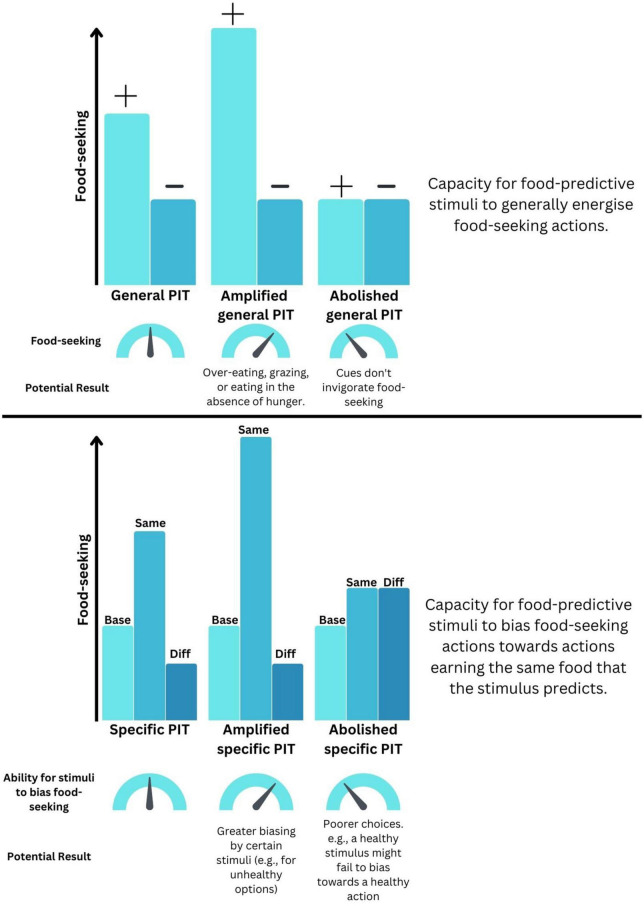
FIGURE 1
FIGURE 1
How distortions to Pavlovian-instrumental transfer (PIT) could drive maladaptive food-seeking. (Top) Schematic representation of how changes to the ability for predictive cues to invigorate general food-seeking could be distorted. (+) indicates a food-predictive cue whereas (–) indicates a neutral cue. (Bottom) Schematic representation of how changes to the ability for predictive cue to bias the selection of foods could become maladaptive. “Base” indicates baseline food-seeking in the absence of predictive cues. “Same” indicates food-seeking for an outcome that is also predicted by that cue. “Diff” indicates food-seeking for an outcome that is different to that predicted by that cue.
FIGURE 2
FIGURE 2
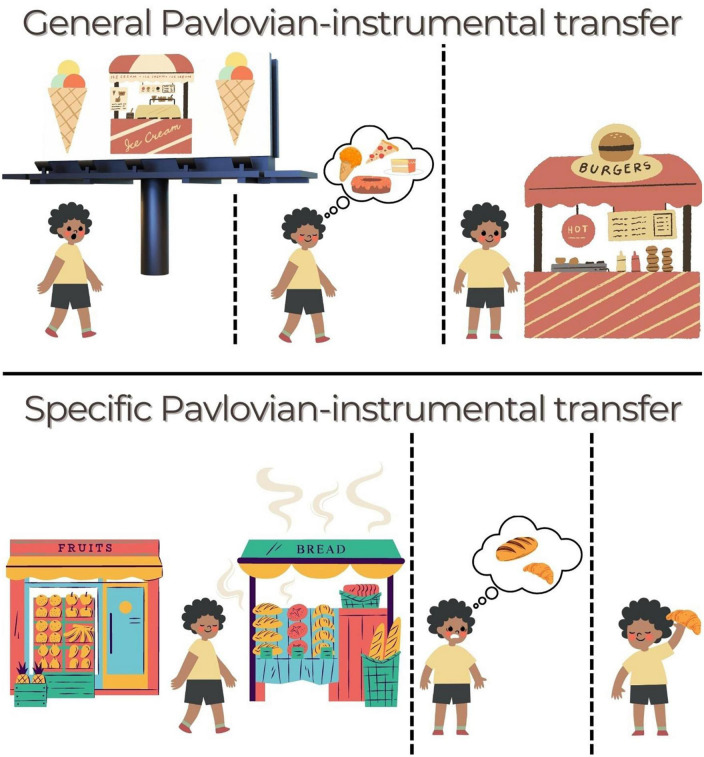
Ways that PIT might operate in daily life to drive food-seeking. (Top) General PIT. Someone is walking when they see a billboard for their favorite ice-cream. They continue walking, feeling a little hungry now, before deciding to stop at a burger shop that they see. The billboard acted as a cue that aroused general motivation to seek out food (action), even though the burger (outcome) was not specifically linked to that cue. An amplification of this effect could lead to overeating or indiscriminate grazing. (Bottom) Specific PIT. The next morning, they want to get something for breakfast on their way to work but they haven’t decided what. At the end of the street is a bakery and a fruit grocer. As the person approaches, they smell the aromas of freshly baked bread wafting toward them (cue). This guides them to select (action) a fresh croissant (“Same” outcome) rather than a fruit salad. A distortion of this effect could lead to greater biasing by certain cues (e.g., unhealthy foods) or failure to use a healthy cue to select a healthy option.

References

    1. Akter S., Uddin K. R., Sasaki H., Shibata S. (2020). Gamma oryzanol alleviates high-fat diet-induced anxiety-like behaviors through downregulation of dopamine and inflammation in the amygdala of mice. Front. Pharmacol. 11:330. 10.3389/fphar.2020.00330 - DOI - PMC - PubMed
    1. Altherr E., Rainwater A., Kaviani D., Tang Q., Güler A. D. (2021). Long-term high fat diet consumption reversibly alters feeding behavior via a dopamine-associated mechanism in mice. Behav. Brain Res. 414:113470. 10.1016/j.bbr.2021.113470 - DOI - PMC - PubMed
    1. Balleine B. (1994). Asymmetrical interactions between thirst and hunger in Pavlovian-instrumental transfer. Q. J. Exp. Psychol. B 47 211–231. - PubMed
    1. Boitard C., Parkes S. L., Cavaroc A., Tantot F., Castanon N., Layé S., et al. (2016). Switching adolescent high-fat diet to adult control diet restores neurocognitive alterations. Front. Behav. Neurosci. 10:225. 10.3389/fnbeh.2016.00225 - DOI - PMC - PubMed
    1. Boswell R. G., Kober H. (2016). Food cue reactivity and craving predict eating and weight gain: A meta-analytic review. Obes. Rev. 17 159–177. 10.1111/obr.12354 - DOI - PMC - PubMed

LinkOut - more resources