


Changes in glucose metabolism among recipients with diabetes 1 year after kidney transplant: a multicenter 1-year prospective study
- PMID: 37424863
- PMCID: PMC10325682
- DOI: 10.3389/fendo.2023.1197475
Changes in glucose metabolism among recipients with diabetes 1 year after kidney transplant: a multicenter 1-year prospective study
Abstract
Background: Diabetes mellitus is a common and crucial metabolic complication in kidney transplantation. It is necessary to analyze the course of glucose metabolism in patients who already have diabetes after receiving a transplant. In this study, we investigated the changes in glucose metabolism after transplantation, and a detailed analysis was performed on some patients whose glycemic status improved.
Methods: The multicenter prospective cohort study was conducted between 1 April 2016 and 31 September 2018. Adult patients (aged 20 to 65 years) who received kidney allografts from living or deceased donors were included. Seventy-four subjects with pre-transplant diabetes were followed up for 1 year after kidney transplantation. Diabetes remission was defined as the results of the oral glucose tolerance test performed one year after transplantation and the presence or absence of diabetes medications. After 1-year post-transplant, 74 recipients were divided into the persistent diabetes group (n = 58) and the remission group (n = 16). Multivariable logistic regression was performed to identify clinical factors associated with diabetes remission.
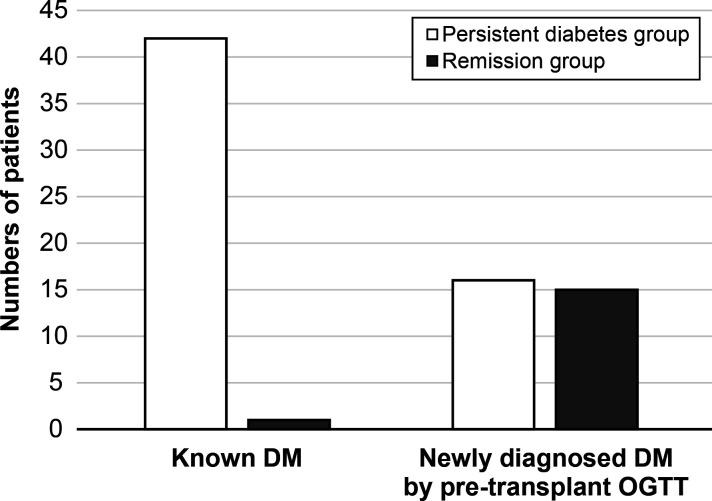
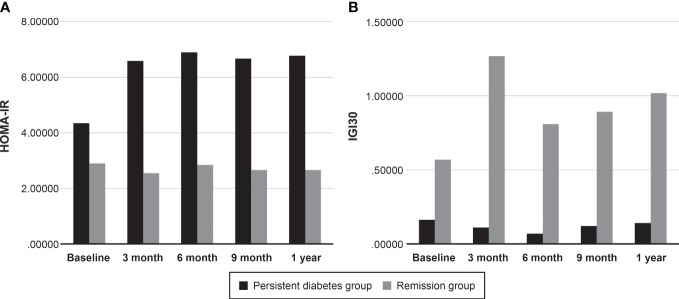
Results: Of 74 recipients, 16 (21.6%) showed diabetes remission after 1-year post-transplant. The homeostatic model assessment for insulin resistance numerically increased in both groups throughout the first year after transplantation and significantly increased in the persistent diabetes group. The insulinogenic index (IGI30) value significantly increased only in the remission group, and the IGI30 value remained low in the persistent diabetes group. In univariate analysis, younger age, newly diagnosed diabetes before transplantation, low baseline hemoglobin A1c, and high baseline IGI30 were significantly associated with remission of diabetes. After multivariate analysis, only newly diagnosed diabetes before transplantation and IGI30 at baseline were associated with remission of diabetes (34.00 [1.192-969.84], P = 0.039, and 17.625 [1.412-220.001], P = 0.026, respectively).
Conclusion: In conclusion, some kidney recipients with pre-transplant diabetes have diabetes remission 1 year after transplantation. Our prospective study revealed that preserved insulin secretory function and newly diagnosed diabetes at the time of kidney transplantation were favorable factors for which glucose metabolism did not worsen or improve 1 year after kidney transplantation.
Keywords: glucose tolerance test; immunosuppression therapy; insulin resistance; insulin secretion; kidney transplantation; type 2 diabetes mellitus.
Copyright © 2023 Bang, Oh, Kim, Kim, Yu, Kim, Ju, So, Lee, Han, Jung, Kim, Ahn, Lee and Jeon.
Conflict of interest statement
The authors declare that the research was conducted in the absence of any commercial or financial relationships that could be construed as a potential conflict of interest.
Figures

Similar articles
-
Insulin Secretion and Insulin Resistance Trajectories over 1 Year after Kidney Transplantation: A Multicenter Prospective Cohort Study.Endocrinol Metab (Seoul). 2020 Dec;35(4):820-829. doi: 10.3803/EnM.2020.743. Epub 2020 Nov 18. Endocrinol Metab (Seoul). 2020. PMID: 33202516 Free PMC article.
-
Effect of Prediabetes on Allograft Survival and Evolution of New-Onset Diabetes After Transplant in Deceased-Donor Kidney Transplant Recipients During Long-Term Follow-Up.Exp Clin Transplant. 2017 Dec;15(6):620-626. doi: 10.6002/ect.2016.0196. Epub 2017 Mar 22. Exp Clin Transplant. 2017. PMID: 28332958
-
Insulin resistance and insulin secretion in renal transplant recipients with hepatitis C.Transplant Proc. 2013 May;45(4):1540-3. doi: 10.1016/j.transproceed.2013.01.053. Transplant Proc. 2013. PMID: 23726615
-
The impact of impaired insulin release and insulin resistance on glucose intolerance after renal transplantation.Clin Transplant. 2002 Dec;16(6):389-96. doi: 10.1034/j.1399-0012.2002.02059.x. Clin Transplant. 2002. PMID: 12437616 Review.
-
Evaluating mechanisms of post-transplant diabetes mellitus.Nephrol Dial Transplant. 2004 Dec;19 Suppl 6:vi8-vi12. doi: 10.1093/ndt/gfh1063. Nephrol Dial Transplant. 2004. PMID: 15575024 Review.
Cited by
-
Risk prediction of kidney function in long-term kidney transplant recipients.Front Med (Lausanne). 2025 Mar 20;12:1469363. doi: 10.3389/fmed.2025.1469363. eCollection 2025. Front Med (Lausanne). 2025. PMID: 40182840 Free PMC article.
References
-
- Sharif A, Hecking M, de Vries AP, Porrini E, Hornum M, Rasoul-Rockenschaub S, et al. . Proceedings from an international consensus meeting on posttransplantation diabetes mellitus: recommendations and future directions. Am J Transplant (2014) 14:1992–2000. doi: 10.1111/ajt.12850 - DOI - PMC - PubMed
Publication types
MeSH terms
Substances
LinkOut - more resources
Full Text Sources
Medical
Miscellaneous
