


Assessing the impact of the COVID‑19 pandemic health protocols on the hygiene status of swimming pools of hotel units
- PMID: 37425352
- PMCID: PMC10326652
- DOI: 10.3892/mi.2023.92
Assessing the impact of the COVID‑19 pandemic health protocols on the hygiene status of swimming pools of hotel units
Abstract
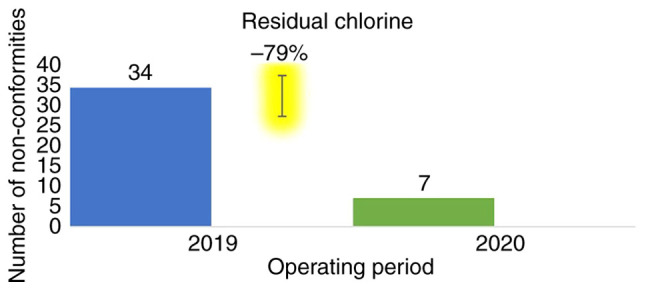
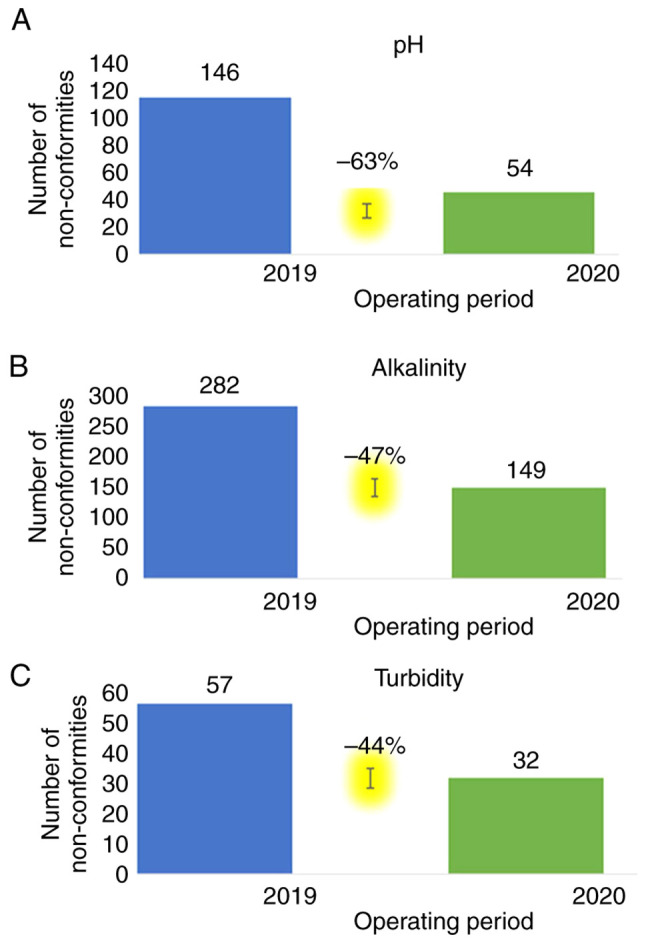
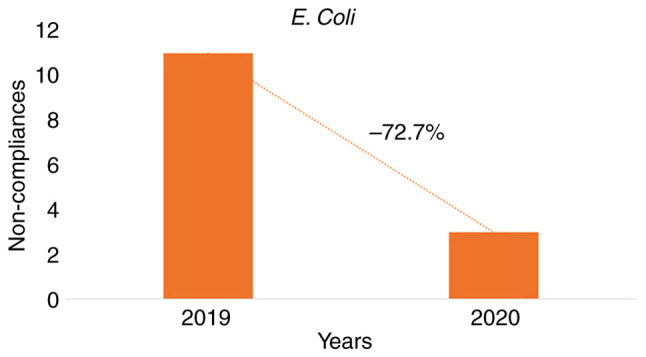
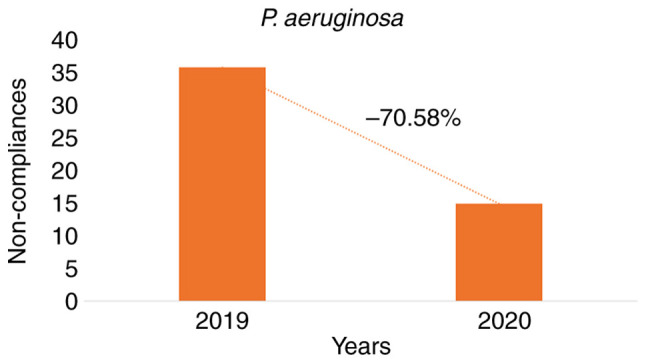
With the onset of the coronavirus disease 2019 (COVID-19) pandemic, numerous countries imposed strict lockdown measures and travel bans, resulting in the closure of hotels. Over time, the opening of hotel units was gradually allowed, and new strict regulations and protocols were issued to ensure the hygiene and safety of swimming pools in the era of COVID-19. The present study aimed to evaluate the implementation of strict health COVID-19-related protocols in hotel units during the 2020 summer tourist season concerning microbiological hygiene and physicochemical parameters of water, and to compare the data with those from the 2019 tourist season. For this reason, 591 water samples from 62 swimming pools were analyzed, of which 381 samples were for the 2019 tourist season and 210 samples were for the 2020 tourist season. To examine the presence of Legionella spp, 132 additional samples were taken from 14 pools, of which 49 in 2019 and 83 in 2020. In 2019, 2.89% (11/381) of the samples were out of legislative limits (0/250 mg/l) regarding the presence of Escherichia coli (E. coli), 9.45% (36/381) were out of acceptable limits (0/250 mg/l) regarding the presence of Pseudomonas aeruginosa (P. aeruginosa) and 8.92% (34/381) had residual chlorine levels <0.4 mg/l. In 2020, 1.43% (3/210) of the samples were out of the legislative limits as regards the presence of E. coli, 7.14% (15/210) were out of acceptable limits regarding the presence of P. aeruginosa and 3.33% (7/210) of the samples measured residual chlorine levels <0.4 mg/l. The risk ratio (RR) in relation to the presence of E. coli due to incorrect compliance with the requirements for residual chlorine was calculated for 2019 at 8.50, while in 2020 it was calculated at 14.50 (P=0.008). The RR of the presence of P. aeruginosa due to inappropriate residual chlorine requirements was calculated in 2019 at 2.04 (P=0.0814), while in 2020 it was calculated at 2.07 (P=0.44). According to the microbiological hygiene and physicochemical parameters of the water samples studied, there was a significant improvement due to the strict protocols for the swimming pools in the summer season of 2020 compared to the tourist season of 2019, namely 72.72% (E. coli), 58.33% (P. aeruginosa), 79.41% (of residual chlorine <0.4 mg/l) in the three main parameters studied. Finally, an increased colonization by Legionella spp. detected in the internal networks of the hotels due to the non-operation of the hotels during the lockdown, the improper disinfection and stagnant water in the internal water supply networks. Specifically, in 2019, 95.92% (47/49) of the samples tested negative and 4.08% (2/49) tested positive (≥50 CFU/l) for Legionella spp., compared to 2020 where 91.57% (76/83) of the samples tested negative and 8.43% (7/83) tested positive.
Keywords: COVID-19; Legionella spp.; Pseudomonas aeruginosa; coliforms; colonization; hygiene; recreational waters; severe acute respiratory syndrome coronavirus 2; swimming pools.
Copyright: © 2023 Papadakis et al.
Conflict of interest statement
The authors declare that they have no competing interests.
Figures
References
-
- Centers for Disease Control and Prevention (CDC): COVID-19 and Public Pools and Beaches, CDC, Atlanta, GA, 2023. https://www.cdc.gov/healthywater/swimming/aquatics-professionals/covid-1....
-
- Centers for Disease Control and Prevention (CDC): Community, Work, and School. CDC, Atlanta, GA, 2020. https://www.cdc.gov/coronavirus/2019-ncov/community/index.html.
-
- Mellou K, Mplougoura A, Mandilara G, Papadakis A, Chochlakis D, Psaroulaki A, Mavridou A. Swimming pool regulations in the COVID-19 Era: Assessing acceptability and compliance in greek hotels in two consecutive summer touristic periods. Water. 2022;14(796)
LinkOut - more resources
Full Text Sources
Miscellaneous