[Preprint]. 2023 Jun 26:2023.06.23.546267.
doi: 10.1101/2023.06.23.546267.

Liquid-like condensates mediate competition between actin branching and bundling

Affiliations

Liquid-like condensates mediate competition between actin branching and bundling

Kristin Graham et al. bioRxiv. .

Update in

Abstract

Cellular remodeling of actin networks underlies cell motility during key morphological events, from embryogenesis to metastasis. In these transformations there is an inherent competition between actin branching and bundling, because steric clashes among branches create a mechanical barrier to bundling. Recently, liquid-like condensates consisting purely of proteins involved in either branching or bundling of the cytoskeleton have been found to catalyze their respective functions. Yet in the cell, proteins that drive branching and bundling are present simultaneously. In this complex environment, which factors determine whether a condensate drives filaments to branch versus becoming bundled? To answer this question, we added the branched actin nucleator, Arp2/3, to condensates composed of VASP, an actin bundling protein. At low actin to VASP ratios, branching activity, mediated by Arp2/3, robustly inhibited VASP-mediated bundling of filaments, in agreement with agent-based simulations. In contrast, as the actin to VASP ratio increased, addition of Arp2/3 led to formation of aster-shaped structures, in which bundled filaments emerged from a branched actin core, analogous to filopodia emerging from a branched lamellipodial network. These results demonstrate that multi-component, liquid-like condensates can modulate the inherent competition between bundled and branched actin morphologies, leading to organized, higher-order structures, similar to those found in motile cells.

Keywords: Biological sciences; Biophysics & computational biology; actin; condensates; cytoskeleton; liquid-liquid phase separation.


Conflict of interest statement

Competing interests statement The authors declare no competing interests.

Figures
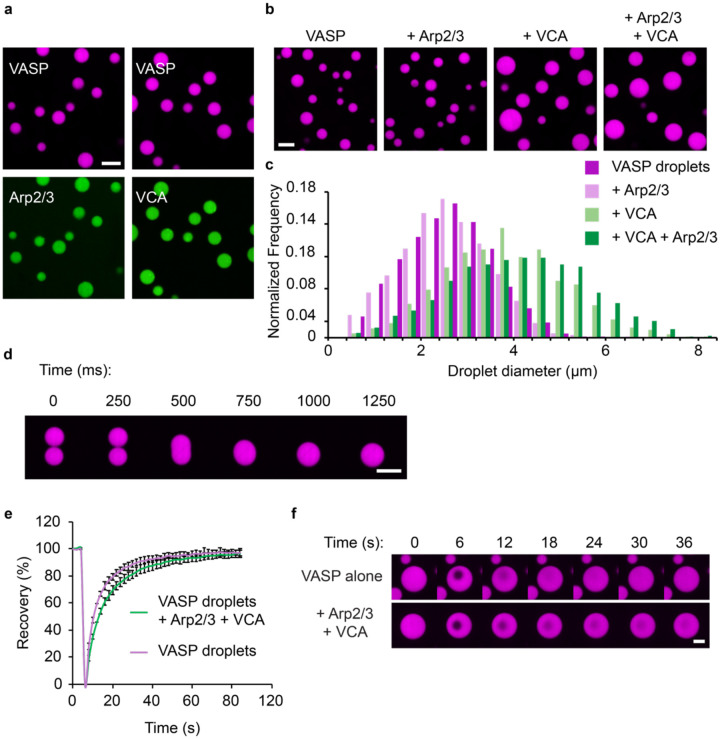
Figure 1.
Figure 1.. Arp2/3 and VCA participate in phase separation of liquid-like VASP droplets.
(a) Enrichment of 1 μM Arp2/3 (labeled with Atto-594, shown in green) or 1 μM VCA (labeled with Atto-488, shown in green) to 20 μM VASP droplets. Droplets are formed in “droplet buffer”: 50 mM Tris pH 7.4, 150 mM NaCl, 3% (w/v) PEG8000. Scale bar 5 μm. (b) Representative images of droplets formed from a 15 μM solution of VASP with either 150 nM Arp2/3, 6 μM VCA, or both 150 nM Arp2/3 and 6 μM VCA. Scale bar 5 μm. (c) Histogram of droplet sizes quantified from (b). Data from n=3 replicates. (d) Composite droplets formed of 15 μM VASP, 150 nM Arp2/3, and 6 μM VCA still remain liquid-like, as exhibited by rapid fusion events. Scale bar 5 μm. (e) Composite droplets formed of 15 μM VASP, 150 nM Arp2/3, and 6 μM VCA display rapid recovery after photobleaching, and the fraction of mobile VASP is nearly equivalent to droplets lacking Arp2/3 and VCA. Curves show the average VASP recovery profile with error bars representing SD for n=11 droplets for each condition. (f) Representative time series of FRAP of either VASP only droplets, or composite droplets as quantified in (e). Scale bar 2 μm.
Figure 2.
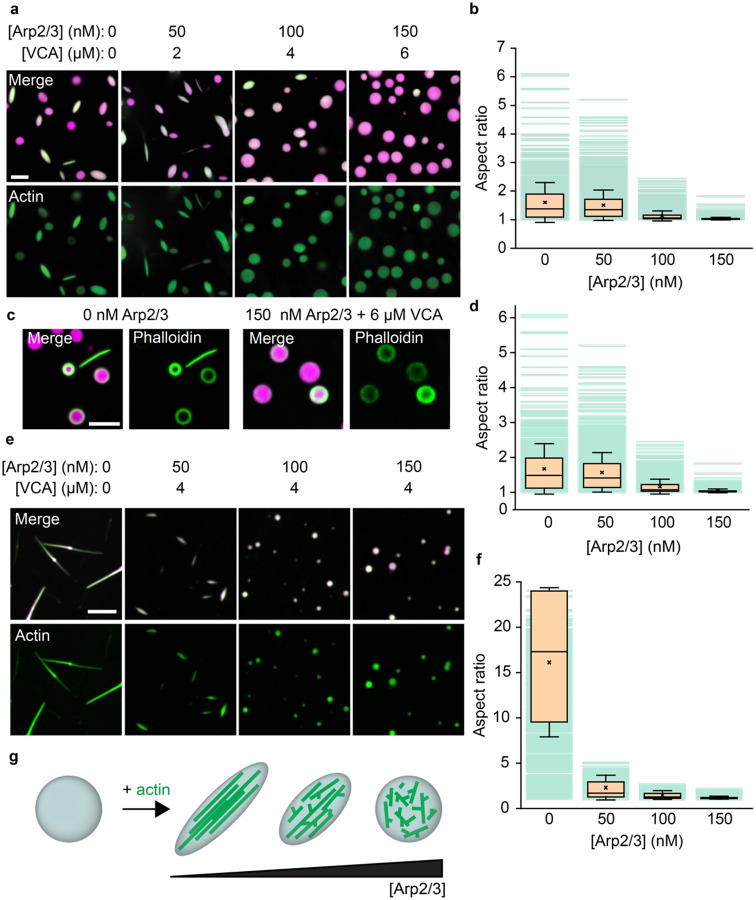
Figure 2.. Addition of Arp2/3 to VASP droplets inhibits droplet deformation and actin bundling.
(a) Representative images of droplets formed from 15 μM VASP and 2 μM actin, with increasing concentrations of Arp2/3 and VCA. Scale bar 5 μm. (b) Quantification of aspect ratios of droplets in (a). Box represents interquartile range (IQR) with median as a bisecting line, mean as an ‘x’, and whiskers, which represent SD. Each background line represents one data point. Data are from 3 replicates. For 0 nM Arp2/3, n=755 droplets; for 50 nM Arp2/3, n=1391; for 100 nM Arp2/3, n= 2123; for 150 nM Arp2/3, n=2286. (c) Representative images of phalloidin staining of 2 μM actin polymerized by either 15 μM VASP-only droplets, or 15 μM VASP droplets with 150 nM Arp2/3 and 6 μM VCA. Scale bar 5 μm. (d) Quantification of aspect ratios of droplets in (b), filtered for droplets with a minor axis < 3 μm. (e) Representative images of droplets formed from 5 μM VASP, exposed to 0.67 μM actin, with 4 μM VCA and increasing concentrations of Arp2/3. Scale bar 5 μm. (f) Quantification of droplet aspect ratio as a function of Arp2/3 concentration as seen in (e). Box represents IQR with median as a bisecting line, mean as an ‘x’, and whiskers, which represent SD. Data from 3 replicates. For 0 nM Arp2/3, n=656; for 50 nM Arp2/3, n=1116; for 100 nM Arp2/3, n=1239; for 150 nM Arp2/3, n=1006. (g) Cartoon depicting sphere to rod transition driven by the ability of VASP droplets to bundle actin filaments, a process which is inhibited by the addition of Arp2/3 and VCA.
Figure 3.
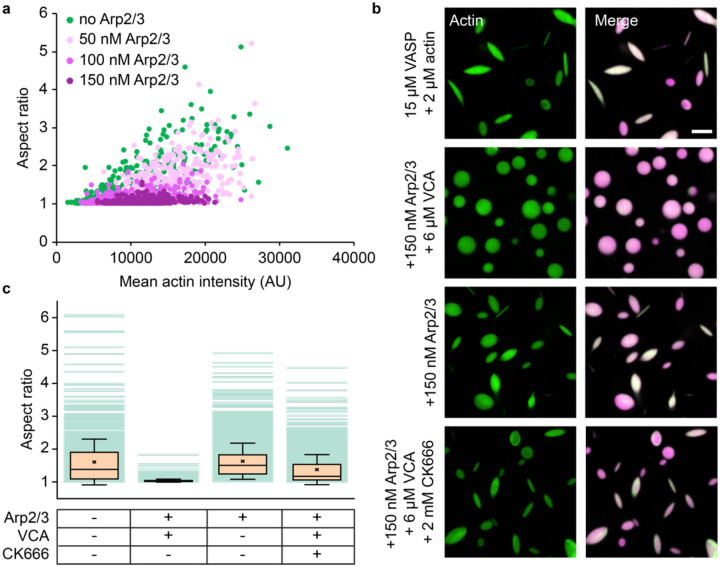
Figure 3.. Decreased droplet deformation is due to Arp2/3 activity.
(a) Relationship between droplet aspect ratio and actin intensity within the droplet for droplets formed from 15 μM VASP and exposed to 2 μM actin with increasing concentrations of Arp2/3 and VCA, as visualized in Figure 2a. Replicates can be found in Supplemental Figure S1. n=2885 droplets counted over at least 3 images per condition. (b) Representative images of droplets composed of 15 μM VASP and 2 μM actin, with either (i) Arp2/3 and VCA added, (ii) only Arp2/3, or (iii) Arp2/3, VCA, and the Arp2/3 inhibitor, CK666. Scale bar 5 μm. (c) Quantification of droplet aspect ratio measured from (b). Box represents IQR with median as a bisecting line, mean as an ‘x’, and whiskers represent SD. Data from 3 replicates. At least 700 droplets were analyzed per condition.
Figure 4.
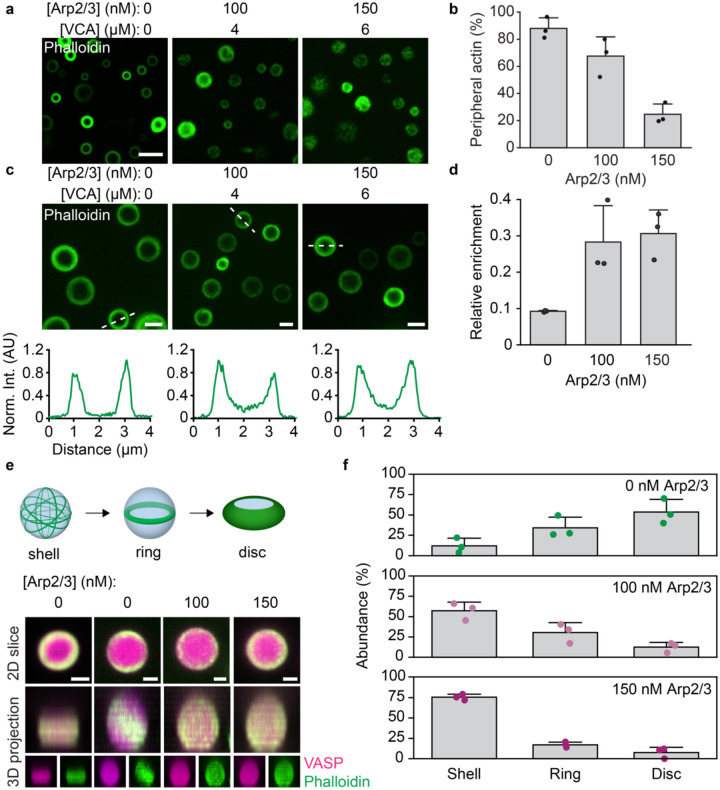
Figure 4.. Arp2/3 activity reduces droplet deformation by inhibiting assembly of actin rings.
(a) Representative images of droplets formed from 15 μM VASP with 2 μM actin and increasing concentration of Arp2/3 and VCA, stained with phalloidin. Scale bar 5 μm. (b) Quantification of the abundance of droplets with peripheral actin accumulation as a function of Arp2/3 concentration. Bars represent mean±SD of n=3 experiments, with 3 images analyzed per condition. (c) Top: Representative images of droplets formed as in (a), exhibiting peripheral accumulation of actin filaments. Scale bar 2 μm. Bottom: Representative line profiles of actin intensity in designated droplets. Actin intensities are normalized to the max intensity of each profile. (d) Quantification of the relative enrichment of actin to the interior of the droplet compared to the periphery. Data are mean±SD from n= 3 experiments, with 12 droplets analyzed per condition. (e) Top: Cartoon of the different 3D spatial arrangements of droplets with peripheral actin. Bottom: Representative 3D projections of droplets as in (c), revealing examples of disc, ring, and shell distributions of actin. Scale bar 1 μm. (f) Distribution of the abundance of actin shells, rings, and discs in droplets formed from 15 μM VASP with 2 μM actin and increasing Arp2/3 and VCA concentrations as shown in (a–d). Bars are mean±SD across n=3 experiments, with 3 images analyzed per condition.
Figure 5.
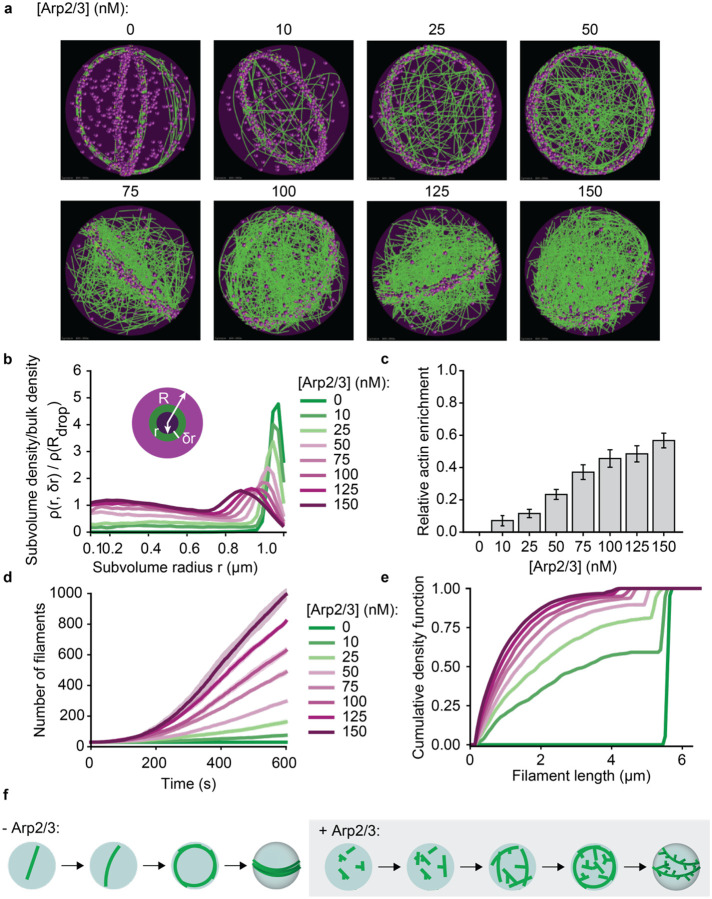
Figure 5.. Simulations predict that Arp2/3-driven changes to filament length distribution inhibits the formation of actin-rich rings at the droplet periphery.
(a) Representative final snapshots (t=600s) from rigid droplets (radius = 1 μm) [VASP-tet] = 0.2 μM and various Arp2/3 concentrations are shown. Actin filaments are shown in green while VASP tetramers are shown as magenta spheres. Supplemental Movie M3 shows the time evolution of the trajectories. (b) Plot shows the mean ratio of actin density within subvolume shells of radius r and thickness δr = 25 nm (shown in inset) to the overall density of actin within the droplet of radius R. Plot lines are colored based on Arp2/3 concentration (c) Actin enrichment close to droplet core is calculated at various [Arp2/3] as the ratio of actin density within shells of radius rc = 0.25 μm and rπ = 0.9 μm. Data from 5 replicates, the last 10 snapshots per replicate were used here. (d) Mean (solid line) and standard deviation (shaded area) in the number of actin filaments are plotted as time traces and colored based on the concentration of Arp2/3. (e) The final distribution of filament lengths (last 10 snapshots per replicate) is plotted as a cumulative density function and colored by Arp2/3 concentration. Data from 5 replicates. (f) Proposed model describing ring formation in the absence and presence of Arp2/3 activity.
Figure 6.
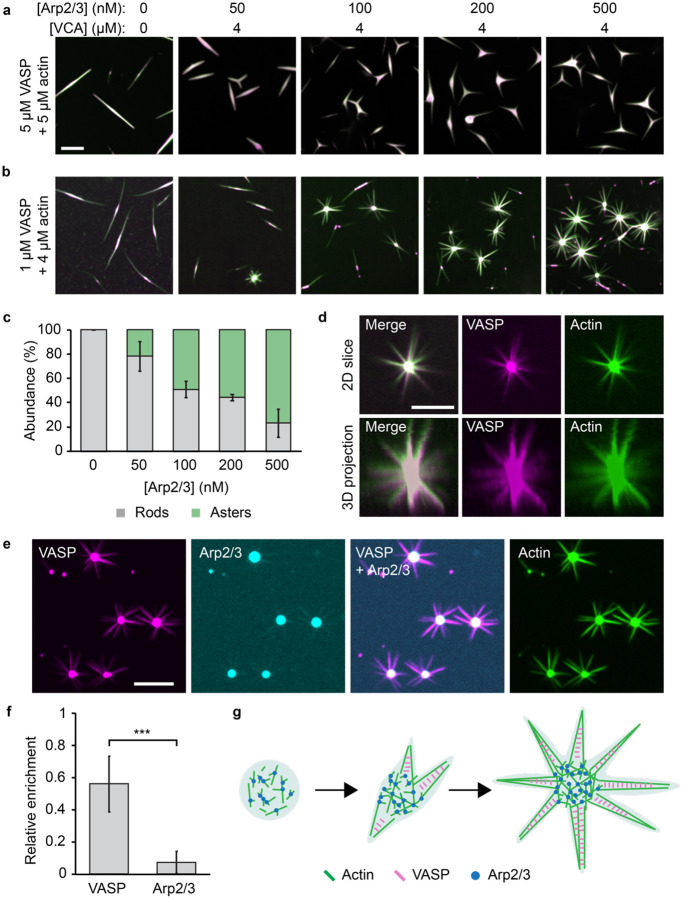
Figure 6.. At high actin-to-VASP ratios, Arp2/3 activity drives aster-like morphologies.
(a) Titration of Arp2/3 and 4 μM VCA in droplets formed from 5 μM VASP and exposed to 5 μM actin. Scale bar 5 μm. (b) Titration of Arp2/3 and 4 μM VCA as in (a) into droplets formed from 1 μM VASP and exposed to 4 μM actin. Scale bar 5 μm. (c) Quantification of the percent of droplets that deformed into rods and asters in (b). Bars are mean±SD across n=3 experiments, with at least 4 images analyzed per condition. (d) 3D projection of a representative aster-shaped droplet. Scale bar 5 μm. (e) Representative images of VASP, Arp2/3, and actin intensity distributions throughout aster-shaped droplets. Condition: 1 μM VASP, 500 μM Arp2/3, 4 μM VCA, 4 μM actin. Scale bar 5 μm. (f) Quantification of the relative enrichment of VASP and Arp2/3 to the spokes of aster-shaped droplets. Enrichment is normalized to actin intensity. Droplets formed as in (e). Bars are mean±SD across n=3 experiments, with 10 droplets analyzed per experiment. Asterisks indicates data tested for significance via an unpaired two tailed t-test, with p < 0.001. (g) Proposed model for Arp2/3- and VASP- mediated aster formation.

References

    1. Blanchoin L, Boujemaa-Paterski R, Sykes C, Plastino J. Actin Dynamics, Architecture, and Mechanics in Cell Motility. Physiological Reviews. 2014. Jan;94(1):235–63. - PubMed
    1. Stricker J, Falzone T, Gardel ML. Mechanics of the F-actin cytoskeleton. Journal of Biomechanics. 2010. Jan 5;43(1):9–14. - PMC - PubMed
    1. Fletcher DA, Mullins RD. Cell mechanics and the cytoskeleton. Nature. 2010. Jan;463(7280):485–92. - PMC - PubMed
    1. Mattila PK, Lappalainen P. Filopodia: molecular architecture and cellular functions. Nat Rev Mol Cell Biol. 2008. Jun;9(6):446–54. - PubMed
    1. Padrick SB, Doolittle LK, Brautigam CA, King DS, Rosen MK. Arp2/3 complex is bound and activated by two WASP proteins. Proceedings of the National Academy of Sciences. 2011. Aug 16;108(33):E472–9. - PMC - PubMed

Publication types