


Association between childhood trauma and mental health disorders in adolescents during the second pandemic wave of COVID-19, Chiclayo-Peru
- PMID: 37426089
- PMCID: PMC10323439
- DOI: 10.3389/fpsyt.2023.1169247
Association between childhood trauma and mental health disorders in adolescents during the second pandemic wave of COVID-19, Chiclayo-Peru
Abstract
Introduction: The COVID-19 pandemic has significantly affected mental health, with children and adolescents being particularly vulnerable. Evidence on the association between childhood trauma and mental health outcomes in schoolchildren during the pandemic is limited. This study aimed to evaluate this relationship in Chiclayo city, northern Peru, during the second wave of COVID-19.
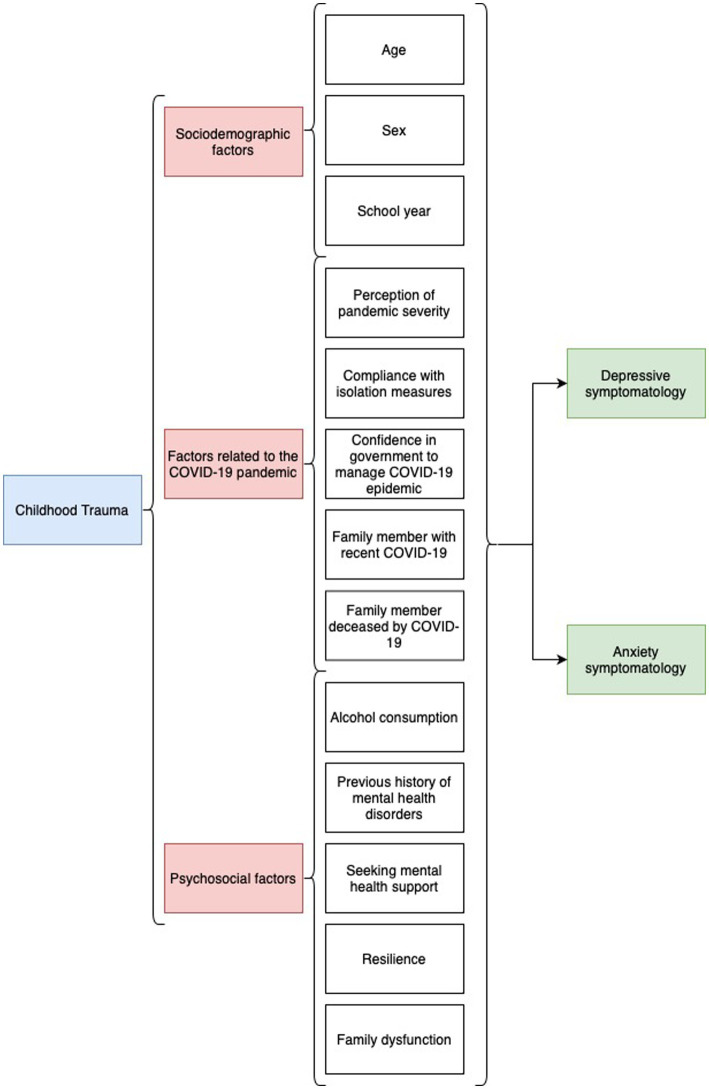
Methods: A cross-sectional secondary data study was conducted, measuring childhood trauma using the Marshall's Trauma Scale, depressive symptomatology (PHQ-9), and anxiety symptomatology (GAD-7). Additional variables assessed were alcohol use (AUDIT), resilience (abbreviated CD-RISC), and socio-educational data. Prevalence ratios were estimated using generalized linear models.
Results: Among 456 participants, 88.2% were female, with a mean age of 14.5 years (SD: 1.33). Depressive symptomatology prevalence was 76.3% (95%CI: 72.14-80.15) and increased by 23% in schoolchildren with childhood trauma (PR: 1.23; 95%CI: 1.10-1.37). Factors positively associated with depressive symptomatology included increasing age, seeking mental health help during the pandemic, and severe family dysfunction. Anxiety symptomatology prevalence was 62.3% (95%CI: 57.65-66.75) and increased by 55% in schoolchildren with childhood trauma (PR: 1.55; 95%CI: 1.31-1.85). Anxiety symptomatology was positively associated with mild, moderate, and severe family dysfunction.
Conclusion: Schoolchildren exposed to childhood trauma are at increased risk for depressive and anxiety symptoms. Monitoring the impact of the COVID-19 pandemic on adolescent mental health is vital. These findings can assist schools in establishing effective measures to prevent mental health outcomes.
Keywords: COVID-19; Peru; adolescents; anxiety; childhood trauma; depression; mental health; pandemic.
Copyright © 2023 Valladares-Garrido, León-Figueroa, Dawson, Burga-Cachay, Fernandez-Canani, Failoc-Rojas, Pereira-Victorio, Valladares-Garrido and Inga-Berrospi.
Conflict of interest statement
The authors declare that the research was conducted in the absence of any commercial or financial relationships that could be construed as a potential conflict of interest.
Figures
References
-
- UNICEF . Por lo menos 1 de cada 7 niños y jóvenes ha vivido confinado en el hogar durante gran parte del año, lo que supone un riesgo para su salud mental y su bienestar, según UNICEF (2021). Available at: https://www.unicef.org/chile/comunicados-prensa/por-lo-menos-1-de-cada-7...
-
- Valladares-Garrido MJ, Picón-Reátegui CK, Zila-Velasque JP, Grados-Espinoza P, Hinostroza-Zarate CM, Failoc-Rojas VE, et al. Suicide risk in military personnel during the COVID-19 health emergency in a Peruvian region: a cross-sectional study. Environ Res Public Health. (2022) 19:13502. doi: 10.3390/ijerph192013502, PMID: - DOI - PMC - PubMed
-
- Aveiro-Róbalo TR, Garlisi-Torales LD, Chumán-Sánchez M, Pereira-Victorio CJ, Huaman-Garcia M, Failoc-Rojas VE, et al. Prevalence and associated factors of depression, anxiety, and stress in university students in Paraguay during the COVID-19 pandemic. Int J Environ Res Public Health. (2022) 19:12930. doi: 10.3390/ijerph191912930, PMID: - DOI - PMC - PubMed
-
- Hernández-Yépez PJ, Muñoz-Pino CO, Ayala-Laurel V, Contreras-Carmona PJ, Inga-Berrospi F, Vera-Ponce VJ, et al. Factors associated with anxiety, depression, and stress in Peruvian university students during the COVID-19 pandemic. Int J Environ Res Public Health. (2022) 19:14591. doi: 10.3390/ijerph192114591, PMID: - DOI - PMC - PubMed
Grants and funding
LinkOut - more resources
Full Text Sources
Research Materials
