


The effect of telephone health coaching and remote exercise monitoring for peripheral artery disease (TeGeCoach) on health care cost and utilization: results of a randomized controlled trial
- PMID: 37428355
- PMCID: PMC11136827
- DOI: 10.1007/s10198-023-01616-4
The effect of telephone health coaching and remote exercise monitoring for peripheral artery disease (TeGeCoach) on health care cost and utilization: results of a randomized controlled trial
Abstract
Background: Peripheral artery disease (PAD) is the third most prevalent atherosclerotic cardiovascular disease. In 2016, costs per patient associated with PAD exceeded even the health-economic burden of coronary heart disease. Although affecting over 200 million people worldwide, a clear consensus on the most beneficial components to be included in home-based exercise programs for patients with peripheral artery disease is lacking. The aim of the study was to examine the health care use and costs caused by the 12-month patient-centered 'Telephone Health Coaching and Remote Exercise Monitoring for Peripheral Artery Disease' (TeGeCoach) program in a randomized controlled trial.
Methods: This is a two-arm, parallel-group, open-label, pragmatic, randomized, controlled clinical trial (TeGeCoach) at three German statutory health insurance funds with follow-up assessments after 12 and 24-months. Study outcomes were medication use (daily defined doses), days in hospital, sick pay days and health care costs, from the health insurers' perspective. Claims data from the participating health insurers were used for analyses. The main analytic approach was an intention-to-treat (ITT) analysis. Other approaches (modified ITT, per protocol, and as treated) were executed additionally as sensitivity analysis. Random-effects regression models were calculated to determine difference-in-difference (DD) estimators for the first- and the second year of follow-up. Additionally, existing differences at baseline between both groups were treated with entropy balancing to check for the stability of the calculated estimators.
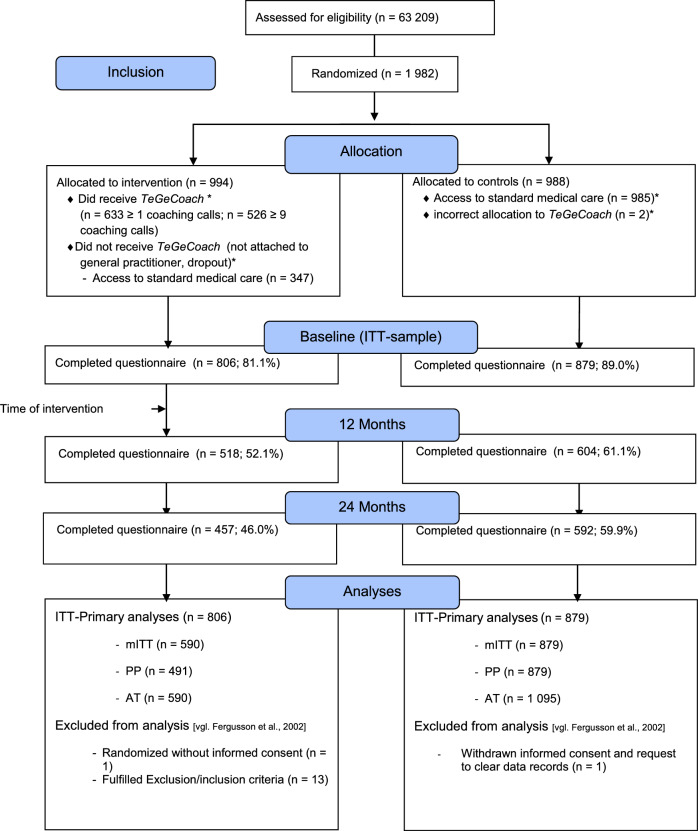
Results: One thousand six hundred eighty-five patients (Intervention group (IG) = 806; Control group (CG) = 879) were finally included in ITT analyses. The analyses showed non-significant effects of the intervention on savings (first year: - 352€; second year: - 215€). Sensitivity analyses confirmed primary results and showed even larger savings.
Conclusion: Based on health insurance claims data, a significant reduction due to the home-based TeGeCoach program could not be found for health care use and costs in patients with PAD. Nevertheless, in all sensitivity analysis a tendency became apparent for a non-significant cost reducing effect.
Trial registration: NCT03496948 (www.
Clinicaltrials: gov), initial release on 23 March 2018.
Keywords: Health care use and costs; Home-based exercise program; Intention-to-treat; Peripheral artery disease; Randomised controlled trial.
© 2023. The Author(s).
Conflict of interest statement
The authors have no relevant financial or non-financial interests to disclose.
References
-
- Fowkes FGR, Rudan D, Rudan I, Aboyans V, Denenberg JO, McDermott MM, Norman PE, Sampson UKA, Williams LJ, Mensah GA, Criqui MH. Comparison of global estimates of prevalence and risk factors for peripheral artery disease in 2000 and 2010: a systematic review and analysis. Lancet. 2013;382(9901):1329–40. doi: 10.1016/S0140-6736(13)61249-0. - DOI - PubMed
-
- Malyar N, Fürstenberg T, Wellmann J, Meyborg M, Lüders F, Gebauer K, Bunzemeier H, Roeder N, Reinecke H. Recent trends in morbidity and in-hospital outcomes of in-patients with peripheral arterial disease: a nationwide population-based analysis. Eur. Heart. J. 2013;34(34):2706–2714. doi: 10.1093/eurheartj/eht288. - DOI - PubMed
Publication types
MeSH terms
Associated data
Grants and funding
LinkOut - more resources
Full Text Sources
Medical
