


Factors Affecting Digital Tool Use in Client Interaction According to Mental Health Professionals: Interview Study
- PMID: 37428520
- PMCID: PMC10366964
- DOI: 10.2196/44681
Factors Affecting Digital Tool Use in Client Interaction According to Mental Health Professionals: Interview Study
Abstract
Background: Digital tools and interventions are being increasingly developed in response to the growing mental health crisis, and mental health professionals (MHPs) considerably influence their adoption in client practice. However, how MHPs use digital tools in client interaction is yet to be sufficiently understood, which poses challenges to their design, development, and implementation.
Objective: This study aimed to create a contextual understanding of how MHPs use different digital tools in clinical client practice and what characterizes the use across tools.
Methods: A total of 19 Finnish MHPs participated in semistructured interviews, and the data were transcribed, coded, and inductively analyzed.
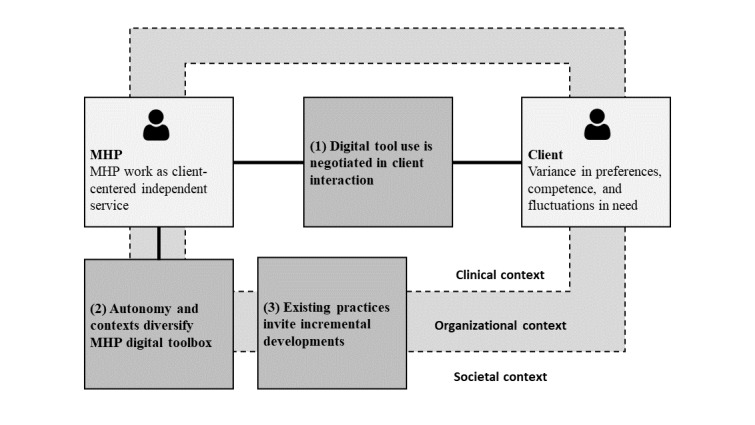
Results: We found that MHP digital tool use was characterized by 3 distinct functions: communication, diagnosis and evaluation, and facilitating therapeutic change. The functions were addressed using analog tools, digitized tools that mimic their analog counterparts, and digital tools that use the possibilities native to digital. The MHP-client communication included various media alongside face-to-face meetings, the MHPs increasingly used digitized tools in client evaluation, and the MHPs actively used digitized materials to facilitate therapeutic change. MHP tool use was generally characterized by adaptability-it was negotiated in client interactions. However, there was considerable variance in the breadth of MHPs' digital toolbox. The existing clinical practices emphasized MHP-client interaction and invited incremental rather than radical developments, which challenged the achievement of the scalability benefits expected from digital tools.
Conclusions: MHPs use digitized and digital tools in client practice. Our results contribute to the user-centered research, development, and implementation of new digital solutions in mental health care by classifying them according to their function and medium and describing how MHPs use and do not use them.
Keywords: clinical practice; digital mental health interventions; intervention design; mental health applications; mental health professionals; mobile phone; teletherapy.
©Lauri Lukka, Veli-Matti Karhulahti, J Matias Palva. Originally published in JMIR Human Factors (https://humanfactors.jmir.org), 10.07.2023.
Conflict of interest statement
Conflicts of Interest: None declared.
Figures
References
-
- GBD 2019 Mental Disorders Collaborators Global, regional, and national burden of 12 mental disorders in 204 countries and territories, 1990-2019: a systematic analysis for the global burden of disease study 2019. Lancet Psychiatry. 2022 Mar;9(2):137–50. doi: 10.1016/S2215-0366(21)00395-3. https://linkinghub.elsevier.com/retrieve/pii/S2215-0366(21)00395-3 S2215-0366(21)00395-3 - DOI - PMC - PubMed
-
- Kohn R, Saxena S, Levav I, Saraceno B. The treatment gap in mental health care. Bull World Health Organ. 2004 Nov;82(11):858–66. https://europepmc.org/abstract/MED/15640922 S0042-96862004001100011 - PMC - PubMed
-
- Hollis C, Morriss R, Martin J, Amani S, Cotton R, Denis M, Lewis S. Technological innovations in mental healthcare: harnessing the digital revolution. Br J Psychiatry. 2015 Apr;206(4):263–5. doi: 10.1192/bjp.bp.113.142612. https://core.ac.uk/reader/162657017?utm_source=linkout S0007125000278677 - DOI - PubMed
-
- Murray E, Hekler EB, Andersson G, Collins LM, Doherty A, Hollis C, Rivera DE, West R, Wyatt JC. Evaluating digital health interventions: key questions and approaches. Am J Prev Med. 2016 Nov;51(5):843–51. doi: 10.1016/j.amepre.2016.06.008. https://europepmc.org/abstract/MED/27745684 S0749-3797(16)30229-X - DOI - PMC - PubMed
LinkOut - more resources
Full Text Sources
