Review
. 2023 Sep 15;63(3):530-547.
doi: 10.1093/icb/icad097.

Sleep: An Essential and Understudied Process in the Biology of Blood-Feeding Arthropods

Affiliations
Review

Sleep: An Essential and Understudied Process in the Biology of Blood-Feeding Arthropods

Oluwaseun M Ajayi et al. Integr Comp Biol. .

Abstract

Understanding the biology of blood-feeding arthropods is critical to managing them as vectors of etiological agents. Circadian rhythms act in the regulation of behavioral and physiological aspects such as blood feeding, immunity, and reproduction. However, the impact of sleep on these processes has been largely ignored in blood-feeding arthropods, but recent studies in mosquitoes show that sleep-like states directly impact host landing and blood feeding. Our focus in this review is on discussing the relationship between sleep and circadian rhythms in blood-feeding arthropods along with how unique aspects such as blood gluttony and dormancy can impact sleep-like states. We highlight that sleep-like states are likely to have profound impacts on vector-host interactions but will vary between lineages even though few direct studies have been conducted. A myriad of factors, such as artificial light, could directly impact the time and levels of sleep in blood-feeding arthropods and their roles as vectors. Lastly, we discuss underlying factors that make sleep studies in blood-feeding arthropods difficult and how these can be bypassed. As sleep is a critical factor in the fitness of animal systems, a lack of focus on sleep in blood-feeding arthropods represents a significant oversight in understanding their behavior and its role in pathogen transmission.


Conflict of interest statement

There are no conflicts of interest.

Figures
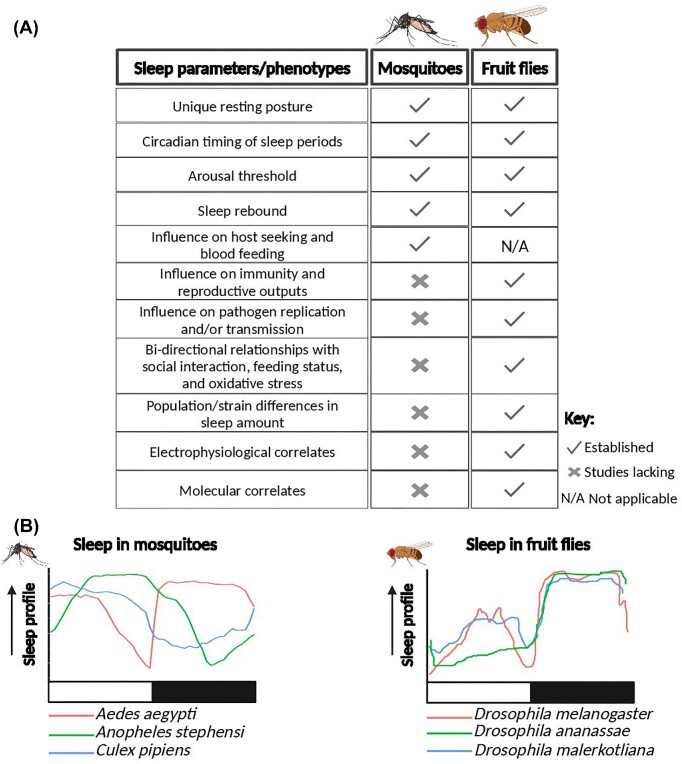
Fig. 1
Fig. 1
Comparison of sleep in mosquitoes and fruit flies. (A) Sleep phenotypes and parameters established in mosquitoes and fruit flies. Literature sources of established parameters can be found in Supplementary Table S1. (B) Differences in sleep profiles among three female mosquito and Drosophila species. Sleep profiles of the mosquito and Drosophila species were modified from Ajayi et al. (2022) and Mishra et al. (2023), respectively. White and dark horizontal bars represent photophase and scotophase, respectively. Created with BioRender.com, check online for colored version.
Fig. 2
Fig. 2
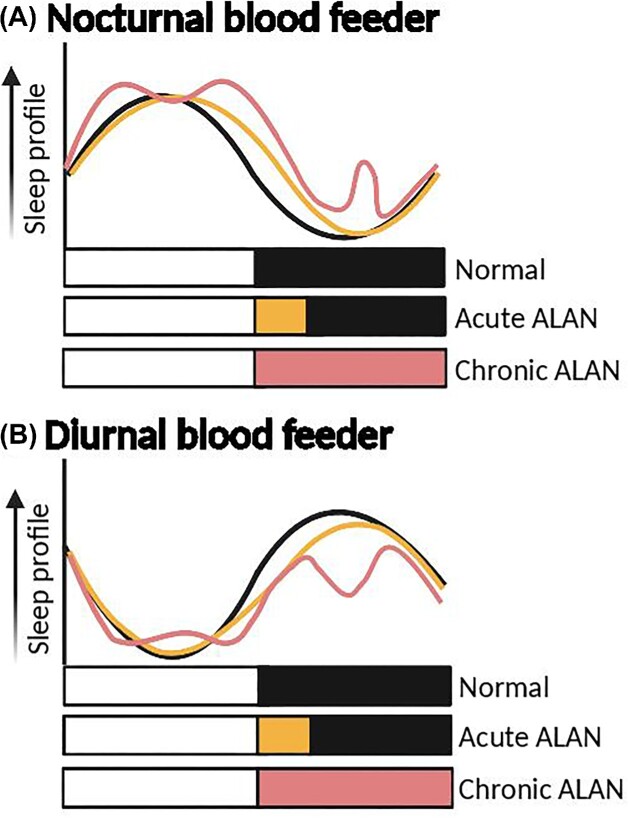
Potential influence of light pollution on the sleep of blood-feeding arthropods. Predicted sleep profiles of a typical (A) nocturnal and (B) diurnal blood feeder under different light exposures during a circadian day. Sleep profiles are based on general trends of increased sleep in the light cycle for nocturnal insects and reduced sleep in the light cycle for diurnal insects. Black, orange, and red solid lines show the normalized profiles under normal light–dark conditions, acute ALAN, and chronic ALAN, respectively. Extension of the day by the ALAN is expected to prolong or reduce the sleep period in the scotophase or photophase period. Chronic ALAN will likely yield more unpredictable and sporadic periods of sleep across the day. Other parameters, such as random periods of light during the night, are not shown but will likely impact the sleep profiles. White, dark, orange, and red horizontal bars represent photophase, scotophase, acute ALAN, and chronic ALAN, respectively. Created with BioRender.com, check online for colored version.
Fig. 3
Fig. 3
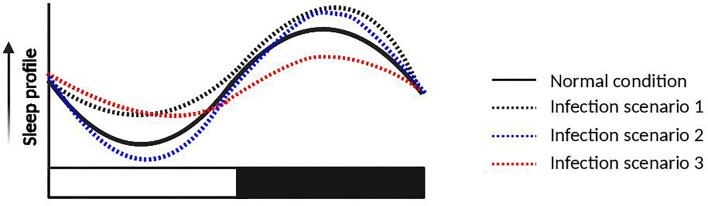
Impact of microbial infection on the sleep cycle of blood-feeding arthropods. Predicted sleep profiles of a typical diurnal blood feeder under different conditions of infection. Sleep and activity patterns could be shifted to increase interaction with potential hosts to improve transmission or promote the survival of the vector. Predictions are based on previous studies in mosquitoes and fruit flies reported in the main text. Other potential shifts, such as a general reduction or increase in sleep overall, depend on the specific interaction between host and microbe. Furthermore, other factors that could be altered due to infection, such as increased metabolism, could impact sleep patterns in unexpected ways. White and dark horizontal bars represent photophase and scotophase, respectively. Created with BioRender.com, check online for colored version.

References

    1. Aak A, Rukke BA, Soleng A, Rosnes MK. 2014. Questing activity in bed bug populations: male and female responses to host signals. Physiol Entomol. 39:199–207. - PMC - PubMed
    1. Abdelkarim EI, Brady J. 1984. Changing visual responsiveness in pregnant and larvipositing tsetse flies, Glossina morsitans. Physiol Entomol. 9:125–31.
    1. Adewoye AB, Kyriacou CP, Tauber E. 2015. Identification and functional analysis of early gene expression induced by circadian light-resetting in Drosophila. BMC Genomics. 16:570. - PMC - PubMed
    1. Ajayi OM, Eilerts DF, Bailey ST, Vinauger C, Benoit JB. 2020. Do mosquitoes sleep?. Trends Parasitol. 36:888–97. - PMC - PubMed
    1. Ajayi OM, Marlman JM, Gleitz LA, Smith ES, Piller BD, Krupa JA, Vinauger C, Benoit JB. 2022. Behavioral and postural analyses establish sleep-like states for mosquitoes that can impact host landing and blood feeding. J Exp Biol. 225:jeb244032. - PMC - PubMed

Publication types

LinkOut - more resources