


Determinants and treatments of heart failure after transcatheter aortic valve implantation: moving up a notch
- PMID: 37430483
- PMCID: PMC10375170
- DOI: 10.1002/ehf2.14435
Determinants and treatments of heart failure after transcatheter aortic valve implantation: moving up a notch
Abstract
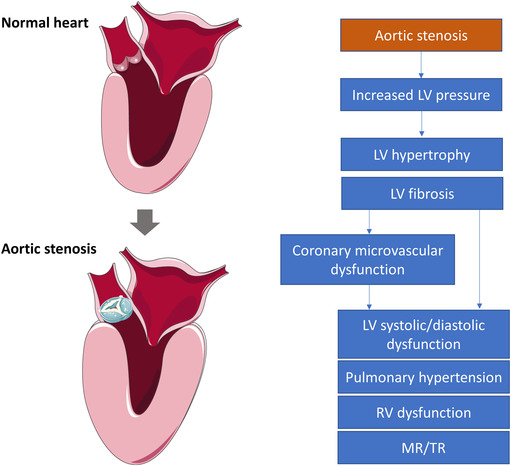
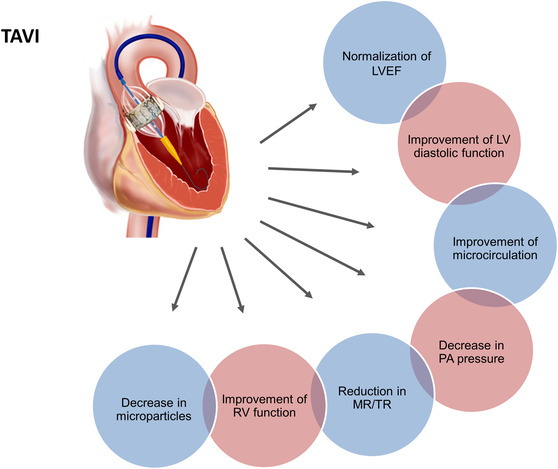
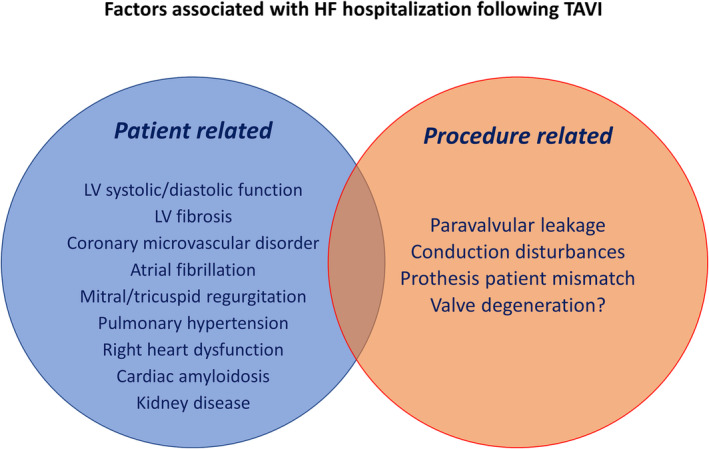
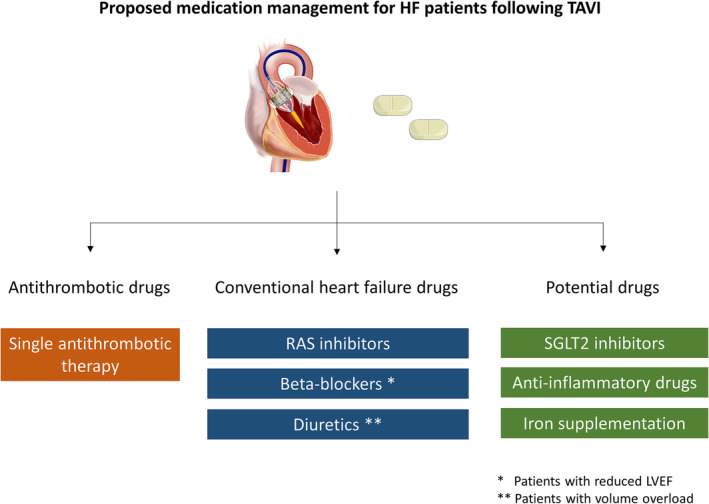
Transcatheter aortic valve implantation (TAVI) has become an alternative to surgical aortic valve replacement for patients with symptomatic severe aortic stenosis in elderly and comorbid population. Significant improvement in heart function has been observed in patients undergoing TAVI, but numerous patients are readmitted to hospital for heart failure (HF). Moreover, repeat HF hospitalization is strongly associated with an adverse prognosis and increases the financial burden of health care. Although studies have identified pre-existing and post-procedural factors that contribute to HF hospitalization after TAVI, there is a paucity of data regarding optimal post-procedural pharmacological treatments. This review aims to provide an overview of the current understanding of mechanisms, determinants, and potential treatments of HF following TAVI. We first review the pathophysiology of left ventricular (LV) remodelling, coronary microcirculation disorder, and endothelial dysfunction in patients with aortic stenosis and then examine the impact of TAVI on these conditions. We then present evidence of various factors and complications that may interplay with LV remodelling and contribute to HF events after TAVI. Next, we describe the triggers and predictors of early and late HF rehospitalizations following TAVI. Lastly, we discuss the potential of conventional pharmacological treatments, including renin-angiotensin blockers, beta-blockers, and diuretics in TAVI patients. The paper explores the potential of newer drugs, including sodium-glucose co-transporter 2 inhibitors, anti-inflammatory drugs, and ion supplementation. Comprehensive knowledge in this field may aid in recognizing successful existing therapies, developing effective new treatments, and establishing dedicated patient care strategies during follow-up after TAVI.
Keywords: Cardiac remodelling; Heart failure; Transcatheter aortic valve implantation.
© 2023 The Authors. ESC Heart Failure published by John Wiley & Sons Ltd on behalf of European Society of Cardiology.
Conflict of interest statement
K.M. received a grant from Edwards Lifesciences (THV‐F20‐142). The other authors have reported that they have no relationship to disclose.
Figures
Similar articles
-
Prognostic value of pre-procedural left ventricular strain for clinical events after transcatheter aortic valve implantation.PLoS One. 2018 Oct 11;13(10):e0205190. doi: 10.1371/journal.pone.0205190. eCollection 2018. PLoS One. 2018. PMID: 30308001 Free PMC article.
-
Update on the clinical impact of mild aortic regurgitation after transcatheter aortic valve implantation: Insights from the Japanese multicenter OCEAN-TAVI registry.Catheter Cardiovasc Interv. 2020 Jan;95(1):35-44. doi: 10.1002/ccd.28279. Epub 2019 Apr 11. Catheter Cardiovasc Interv. 2020. PMID: 30977256
-
Impact of N-terminal pro-B-type natriuretic peptide response on long-term prognosis after transcatheter aortic valve implantation for severe aortic stenosis and heart failure.Heart Vessels. 2019 May;34(5):777-783. doi: 10.1007/s00380-018-1297-z. Epub 2018 Nov 15. Heart Vessels. 2019. PMID: 30443765
-
Updated clinical indications for transcatheter aortic valve implantation in patients with severe aortic stenosis: expert opinion of the Italian Society of Cardiology and GISE.J Cardiovasc Med (Hagerstown). 2018 May;19(5):197-210. doi: 10.2459/JCM.0000000000000636. J Cardiovasc Med (Hagerstown). 2018. PMID: 29578921 Review.
-
Antithrombotic therapy after transcatheter aortic valve implantation.Expert Rev Med Devices. 2022 Jun;19(6):499-513. doi: 10.1080/17434440.2022.2106853. Epub 2022 Aug 7. Expert Rev Med Devices. 2022. PMID: 35881777 Review.
Cited by
-
Readmissions after next-day discharge following transcatheter aortic valve implantation.EuroIntervention. 2024 Dec 16;20(24):e1505-e1519. doi: 10.4244/EIJ-D-24-00514. EuroIntervention. 2024. PMID: 39676548
-
Transcatheter aortic valve replacement beneficial in patients with severely reduced left ventricle ejection fraction: does the type of valve also matter?ESC Heart Fail. 2024 Aug;11(4):1813-1815. doi: 10.1002/ehf2.14902. Epub 2024 Jun 5. ESC Heart Fail. 2024. PMID: 38840426 Free PMC article. No abstract available.
-
The value of the dynamic changes in cardiac power output in aortic stenosis patients following transcatheter aortic valve implantation: an exercise stress echocardiography study.J Echocardiogr. 2025 Jun;23(2):99-108. doi: 10.1007/s12574-024-00664-w. Epub 2024 Oct 21. J Echocardiogr. 2025. PMID: 39433649
-
Cardiac power output is associated with adverse outcomes in patients with preserved ejection fraction after transcatheter aortic valve implantation.Eur Heart J Imaging Methods Pract. 2024 May 21;2(2):qyae048. doi: 10.1093/ehjimp/qyae048. eCollection 2024 Apr. Eur Heart J Imaging Methods Pract. 2024. PMID: 39045467 Free PMC article.
-
Prognostic value of computed tomography-derived myocardial extracellular volume in aortic stenosis: a meta-analysis of all-cause mortality and heart failure hospitalization.Eur Heart J Open. 2025 Jan 25;5(1):oeaf007. doi: 10.1093/ehjopen/oeaf007. eCollection 2025 Jan. Eur Heart J Open. 2025. PMID: 39912102 Free PMC article.
References
-
- Makkar RR, Fontana GP, Jilaihawi H, Kapadia S, Pichard AD, Douglas PS, Thourani VH, Babaliaros VC, Webb JG, Herrmann HC, Bavaria JE, Kodali S, Brown DL, Bowers B, Dewey TM, Svensson LG, Tuzcu M, Moses JW, Williams MR, Siegel RJ, Akin JJ, Anderson WN, Pocock S, Smith CR, Leon MB. Transcatheter aortic‐valve replacement for inoperable severe aortic stenosis. N Engl J Med. 2012; 366: 1696–1704. - PubMed
-
- Leon MB, Smith CR, Mack MJ, Makkar RR, Svensson LG, Kodali SK, Thourani VH, Tuzcu EM, Miller DC, Herrmann HC, Doshi D, Cohen DJ, Pichard AD, Kapadia S, Dewey T, Babaliaros V, Szeto WY, Williams MR, Kereiakes D, Zajarias A, Greason KL, Whisenant BK, Hodson RW, Moses JW, Trento A, Brown DL, Fearon WF, Pibarot P, Hahn RT, Jaber WA, Anderson WN, Alu MC, Webb JG. Transcatheter or surgical aortic‐valve replacement in intermediate‐risk patients. N Engl J Med. 2016; 374: 1609–1620. - PubMed
-
- Mack MJ, Leon MB, Thourani VH, Makkar R, Kodali SK, Russo M, Kapadia SR, Malaisrie SC, Cohen DJ, Pibarot P, Leipsic J, Hahn RT, Blanke P, Williams MR, McCabe JM, Brown DL, Babaliaros V, Goldman S, Szeto WY, Genereux P, Pershad A, Pocock SJ, Alu MC, Webb JG, Smith CR. Transcatheter aortic‐valve replacement with a balloon‐expandable valve in low‐risk patients. N Engl J Med. 2019; 380: 1695–1705. - PubMed
-
- Auffret V, Bakhti A, Leurent G, Bedossa M, Tomasi J, Belhaj Soulami R, Verhoye JP, Donal E, Galli E, Loirat A, Sharobeem S, Sost G, Le Guellec M, Boulmier D, Le Breton H. Determinants and impact of heart failure readmission following transcatheter aortic valve replacement. Circ Cardiovasc Interv. 2020; 13: e008959. - PubMed
Publication types
MeSH terms
LinkOut - more resources
Full Text Sources
Medical
Research Materials
Miscellaneous
