


Post-traumatic stress disorder among LGBTQ people: a systematic review and meta-analysis
- PMID: 37431310
- PMCID: PMC10387489
- DOI: 10.1017/S2045796023000586
Post-traumatic stress disorder among LGBTQ people: a systematic review and meta-analysis
Abstract
Aims: Lesbian, gay, bisexual, transgender and queer people (LGBTQ) are at increased risk of traumatization. This systematic review aimed to summarize data regarding the risk of post-traumatic stress disorder (PTSD) for LGBTQ people and their subgroups.
Methods: Medline, Scopus, PsycINFO and EMBASE were searched until September 2022. Studies reporting a comparative estimation of PTSD among LGBTQ population and the general population (i.e., heterosexual/cisgender), without restrictions on participants' age and setting for the enrolment, were identified. Meta-analyses were based on odds ratio (OR and 95% confidence intervals [CI]), estimated through inverse variance models with random effects.
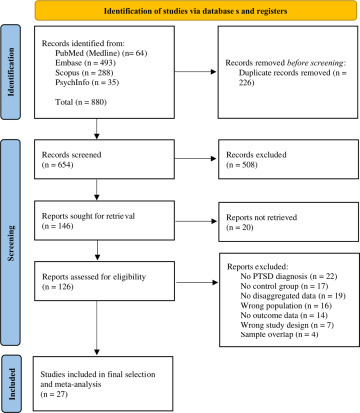
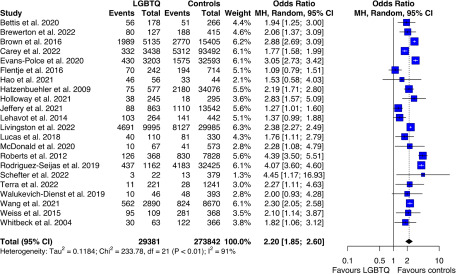
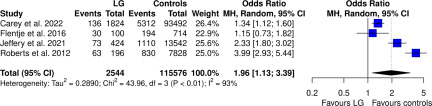
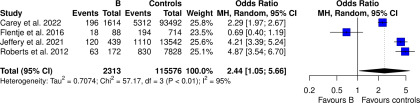
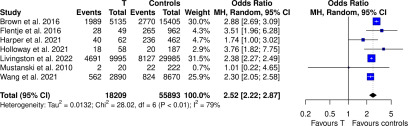
Results: The review process led to the selection of 27 studies, involving a total of 31,903 LGBTQ people and 273,842 controls, which were included in the quantitative synthesis. Overall, LGBTQ people showed an increased risk of PTSD (OR: 2.20 [95% CI: 1.85; 2.60]), although there was evidence of marked heterogeneity in the estimate (I2 = 91%). Among LGBTQ subgroups, transgender people showed the highest risk of PTSD (OR: 2.52 [95% CI: 2.22; 2.87]) followed by bisexual people (OR: 2.44 [95% CI: 1.05; 5.66]), although these comparisons are limited by the lack of data for other sexual and gender minorities, such as intersex people. Interestingly, the risk of PTSD for bisexual people was confirmed also considering lesbian and gay as control group (OR: 1.44 [95% CI: 1.07; 1.93]). The quality of the evidence was low.
Conclusions: LGBTQ people are at higher risk of PTSD compared with their cisgender/heterosexual peers. This evidence may contribute to the public awareness on LGBTQ mental health needs and suggest supportive strategies as well as preventive interventions (e.g., supportive programs, counselling, and destigmatizing efforts) as parts of a tailored health-care planning aimed to reduce psychiatric morbidity in this at-risk population.
Keywords: LGBTQ; mental health; post-traumatic stress disorder; trauma.
Conflict of interest statement
None
Figures
References
-
- Alba B, Lyons A, Waling A, Minichiello V, Hughes M, Barrett C, Fredriksen-Goldsen K, Edmonds S, Savage T, Pepping CA and Blanchard M (2022) Factors associated with self-reported PTSD diagnosis among older lesbian women and gay men. Journal of Gerontological Social Work 65, 129–142. - PubMed
-
- American Psychiatric Association (2013) Diagnostic and Statistical Manual of Mental Disorders: DSM-5, 5th edn. Arlington, VA: American Psychiatric Association.
-
- Auxéméry Y (2018) Post-traumatic psychiatric disorders: PTSD is not the only diagnosis. La Presse Médicale Paris 1983 47, 423–430. - PubMed
Publication types
MeSH terms
LinkOut - more resources
Full Text Sources
Medical
