


Acetaminophen use during pregnancy and offspring attention deficit hyperactivity disorder - a longitudinal sibling control study
- PMID: 37431475
- PMCID: PMC10242945
- DOI: 10.1002/jcv2.12020
Acetaminophen use during pregnancy and offspring attention deficit hyperactivity disorder - a longitudinal sibling control study
Abstract
Background: Maternal acetaminophen use during pregnancy is associated with increased risk of ADHD in the child. This could reflect causal influence of acetaminophen on fetal neurodevelopment or could be due to confounding factors. The aim of the current study was to examine unmeasured familial confounding factors of this association.
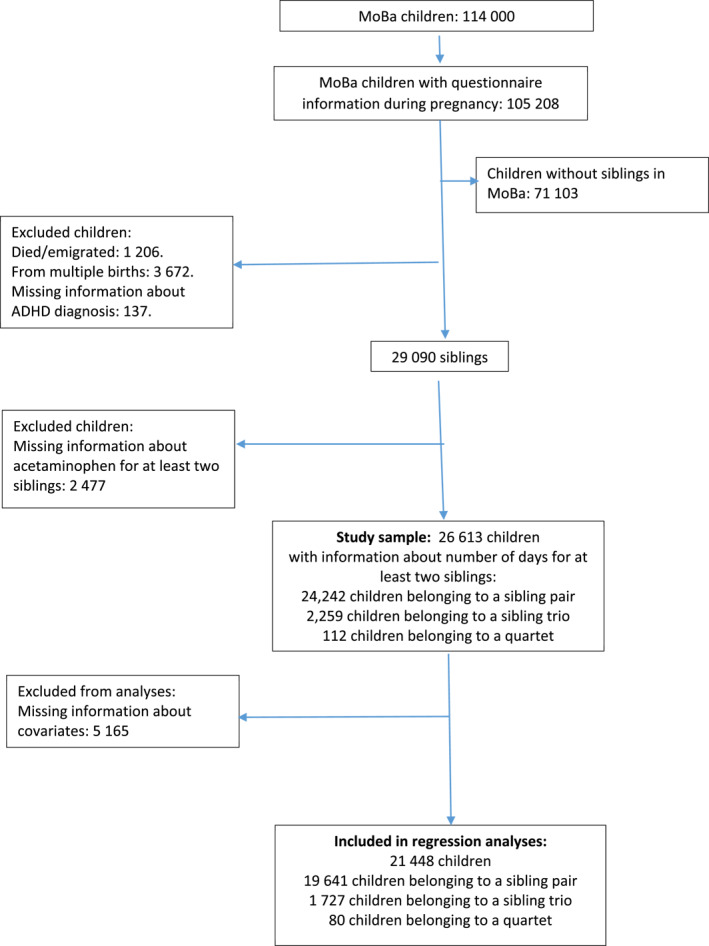
Methods: We used data from 26,613 children from 12,902 families participating in the prospective Norwegian Mother, Father, and Child Cohort Study (MoBa). The MoBa was linked to the Norwegian Medical Birth Register and the Norwegian Patient Registry. Siblings discordant for prenatal acetaminophen exposure were compared regarding risk of having an ADHD diagnosis.
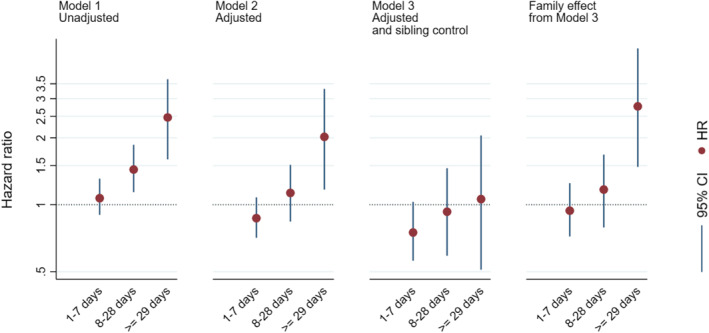
Results: Children exposed to acetaminophen up to 28 days during pregnancy did not have increased risk of receiving an ADHD diagnosis compared to unexposed children. The adjusted Hazard ratio (aHR) was 0.87 (95% C.I. = 0.70-1.08) for exposure 1 to 7 days, and 1.13 (95% C.I. = 0.82-1.49) for 8-28 days. Long-term exposure (29 days or more) was associated with a two-fold increase in risk of ADHD diagnosis (aHR = 2.02, 95% C.I = 1.17-3.25). In the sibling control model, the association between long-term acetaminophen use and ADHD in the child was aHR = 2.77 (95% C.I. = 1.48-5.05) at the between-family level, and aHR = 1.06 (95% C.I. = 0.51-2.05) at the within-family level.
Conclusions: Both the exposed and the unexposed children of mothers with long-term use of acetaminophen in one of the pregnancies had increased risk of receiving an ADHD diagnosis. This indicates that the observed association between long-term acetaminophen use during pregnancy and ADHD in the child may at least partly be confounded by unobserved family factors.
Keywords: ADHD; MoBa; acetaminophen; pregnancy; sibling control.
© 2021 The Authors. JCPP Advances published by John Wiley & Sons Ltd on behalf of Association for Child and Adolescent Mental Health.
Conflict of interest statement
Eivind Ystrom is Joint Editor for JCPP Advances. The remaining authors have declared that they have no competing or potential conflicts of interest. [Corrections made on 22 June 2022, after first online publication: This Conflict of Interest Statement has been updated in this version.]
Figures
References
-
- Avella‐Garcia, C. B. , Julvez, J. , Fortuny, J. , Rebordosa, C. , Garcia‐Esteban, R. , Galán, I. R. , Tardón, A. , Rodríguez‐Bernal, C. L. , Iñiguez, C. , Andiarena, A. , Santa‐Marina, L. , & Sunyer, J. (2016). Acetaminophen use in pregnancy and neurodevelopment: Attention function and autism spectrum symptoms. International Journal of Epidemiology, 45(6), 1987–1996. 10.1093/ije/dyw115 - DOI - PubMed
-
- Baker, B. H. , Lugo‐Candelas, C. , Wu, H. , Laue, H. E. , Boivin, A. , Gillet, V. , Aw, N. , Rahman, T. , Lepage, J.‐F. , Whittingstall, K. , Bellenger, J.‐P. , Posner, J. , Takser, L. , & Baccarelli, A. A. (2020). Association of prenatal acetaminophen exposure measured in meconium with risk of attention‐deficit/hyperactivity disorder mediated by frontoparietal network brain connectivity. JAMA Pediatrics, 174(11), 1073–1081. 10.1001/jamapediatrics.2020.3080 - DOI - PMC - PubMed
-
- Biele, G. , Gustavson, K. , Czajkowski, N. O. , Nilsen, R. M. , Reichborn‐Kjennerud, T. , Magnus, P. M. , et al. (2019). Bias from self selection and loss to follow‐up in prospective cohort studies. European Journal of Epidemiology, 34(10), 927–938. - PubMed
Grants and funding
LinkOut - more resources
Full Text Sources