. 2023 Jul 11;14(1):4123.
doi: 10.1038/s41467-023-39723-8.

On the mechanisms of lysis triggered by perturbations of bacterial cell wall biosynthesis

Affiliations

On the mechanisms of lysis triggered by perturbations of bacterial cell wall biosynthesis

Yoshikazu Kawai et al. Nat Commun. .

Abstract

Inhibition of bacterial cell wall synthesis by antibiotics such as β-lactams is thought to cause explosive lysis through loss of cell wall integrity. However, recent studies on a wide range of bacteria have suggested that these antibiotics also perturb central carbon metabolism, contributing to death via oxidative damage. Here, we genetically dissect this connection in Bacillus subtilis perturbed for cell wall synthesis, and identify key enzymatic steps in upstream and downstream pathways that stimulate the generation of reactive oxygen species through cellular respiration. Our results also reveal the critical role of iron homeostasis for the oxidative damage-mediated lethal effects. We show that protection of cells from oxygen radicals via a recently discovered siderophore-like compound uncouples changes in cell morphology normally associated with cell death, from lysis as usually judged by a phase pale microscopic appearance. Phase paling appears to be closely associated with lipid peroxidation.


Conflict of interest statement

The authors declare no competing interests.

Figures
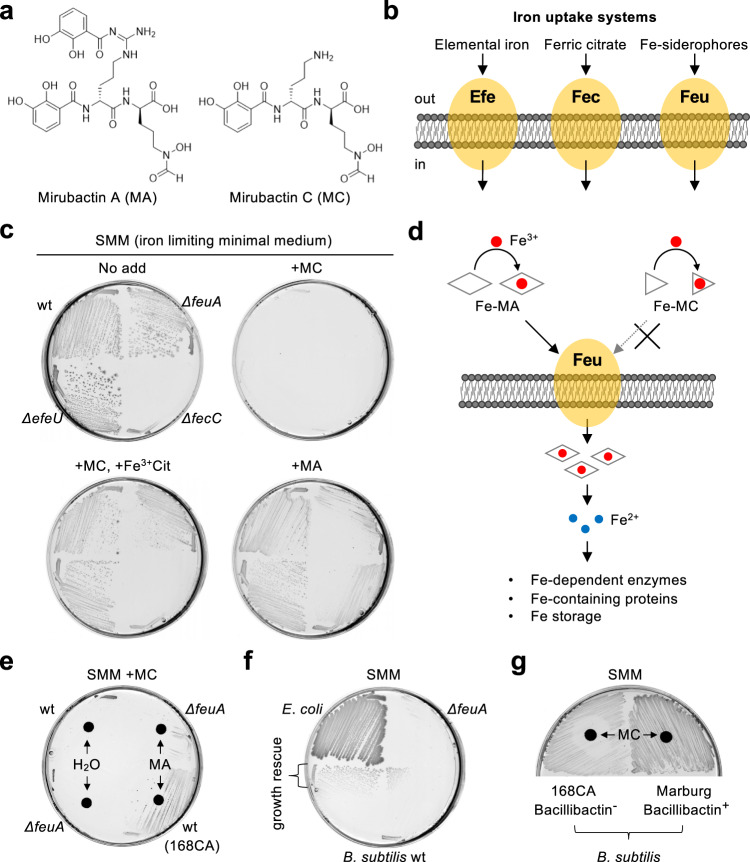
Fig. 1
Fig. 1. Mirubactin C inhibits iron uptake and its utilization.
a Schematic representation of structures of Mirubactin A (MA) and C (MC). b Schematic representation of iron uptake systems in B. subtilis. c Growth inhibition by MC in iron-limiting minimal medium (SMM). B. subtilis strains 168CA (wild-type), YK2739 (ΔefeU), YK2740 (ΔfecC) and YK2741 (ΔfeuA) were streaked on SMM plates with or without 20 μg/ml MA, 10 μg/ml MC and/or 100 μM ferric-citrate (Fe3+Cit), and incubated for 30–42 h at 37 °C. d Schematic representation of effects of Mirubactins on iron uptake and utilization. e Uptake and utilization of iron in B. subtilis mediated by MA. 168CA (wild-type) and YK2741 (ΔfeuA) were streaked on a SMM plate in the presence of 10 μg/ml MC, with paper disc containing 6 μl of H2O or 20 mg/ml MA, and incubated for 30–42 h at 37 °C. f Uptake and utilization of iron in B. subtilis mediated by E. coli. E. coli strain BW25113 and B. subtilis strains (wild-type 168CA and ΔfeuA) were streaked on a SMM plate containing 10 μg/ml MC, and incubated for 30–42 h at 37 °C. g Growth of B. subtilis Marburg strain in the presence of MC. 168CA (bacillibactin-) and Marburg (bacillibactin+) strains were streaked on a SMM plate with paper disc containing 6 μl of 5 mg/ml MC, and incubated for 30–42 h at 37 °C. The figures are representative of at least three independent experiments.
Fig. 2
Fig. 2. Growth rescue of elongation mutants by restricting iron availability.
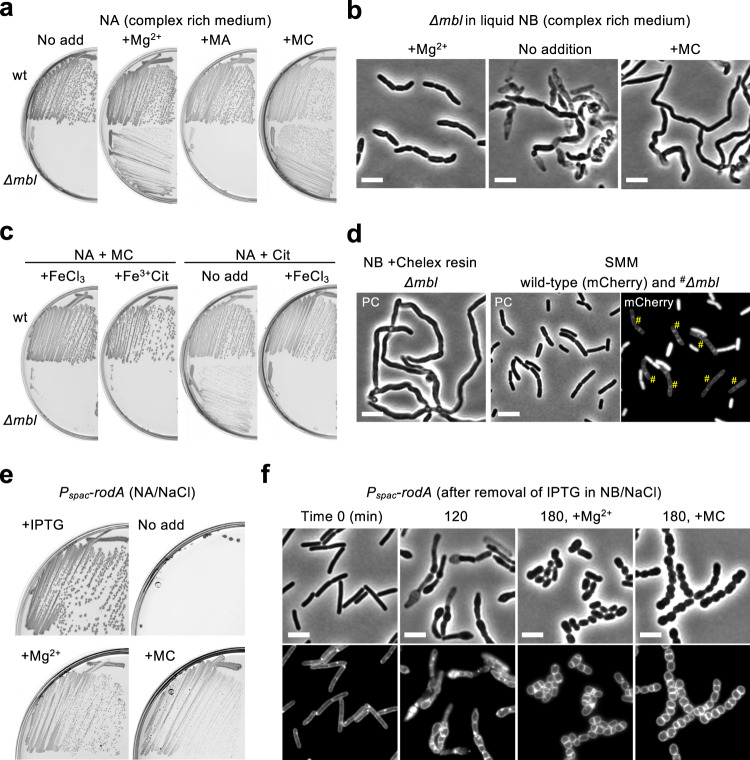
a Growth rescue of an mbl mutant by MC. B. subtilis strains 168CA (wild-type) and YK2638 (Δmbl) were streaked on NA plates with or without 10 mM MgSO4 (Mg2+), 10 μg/ml MA or MC, and incubated for 18 h at 37 °C. b Suppression of phase pale effect in an mbl mutant by MC. Phase contrast micrographs of exponentially growing mbl mutant cells in liquid NB containing 10 mM Mg2+. The cells were diluted into fresh NB with or without 10 μg/ml MC and incubated for 2–3 h. c Effects of iron availability on mbl mutant growth in complex rich medium. Wild-type and Δmbl strains were streaked on NA plates containing 10 μg/ml MC or 5 mM citrate (Cit), with or without 50 μM ferric chloride (FeCl3) or ferric citrate (Fe3+Cit) and incubated for 18 h at 37 °C. d Effects of iron availability on cell morphology in an mbl mutant. YK2265 (wild-type expressing mCherry) and YK2638 (Δmbl) strains were cultured in NB with added 10 mM Mg2+ at 37 °C. Δmbl cells were diluted into fresh NB pre-treated in the presence of 1% Chelex resin (no added Mg2+), and phase contrast (PC) micrographs were captured after 90 min incubation (left panel). Mixture of Δmbl and wild-type cells (expressing mCherry) were diluted into SMM, and phase contrast and the corresponding fluorescent micrographs were captured after 180 min incubation. e Growth rescue of a rodA mutant by MC. YK2245 (Pspac-rodA) was streaked on NA plates containing 100 mM NaCl (for osmoprotection), with or without 0.1 mM IPTG, 10 mM Mg2+ or 40 μg/ml MC, and incubated for 24 h at 37 °C. f Suppression of phase pale effect in a rodA mutant by MC. Phase contrast and the corresponding membrane staining images of exponentially growing Pspac-rodA strain (YK2245) in liquid NB containing 0.1 mM IPTG (Time 0). The cells were diluted into fresh NB with or without 10 mM Mg2+ or 10 μg/ml MC. Phase contrast and the corresponding membrane staining images of the cells were captured after 2–3 h incubation as indicated. Scale bars represent 5 μm. The figures are representative of at least three independent experiments.
Fig. 3
Fig. 3. Dysfunction of lipid II synthesis associates with an mbl mutant lethality.
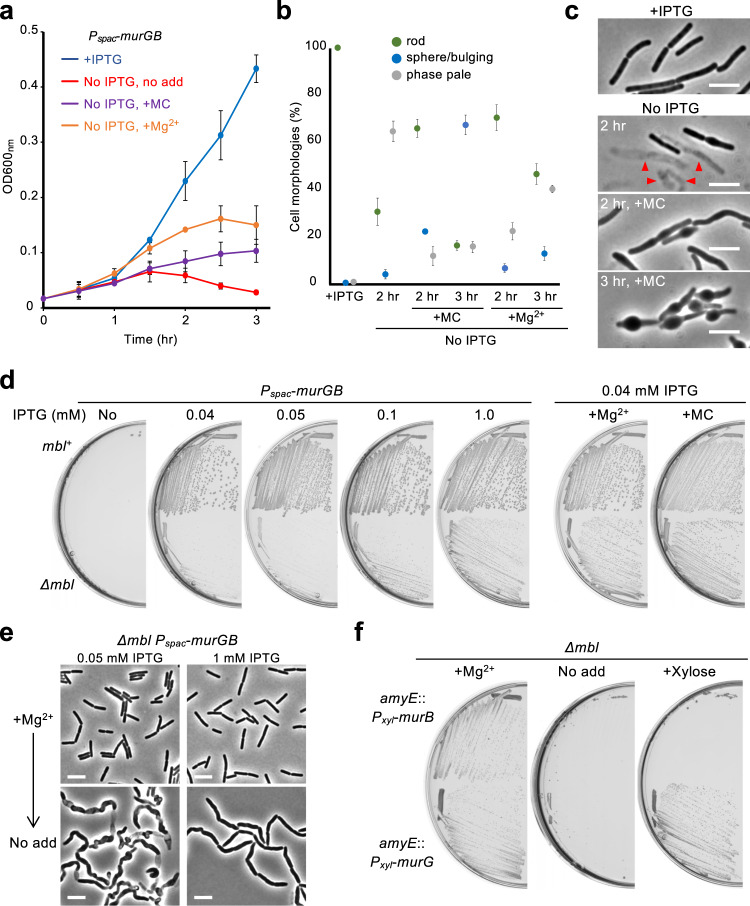
a Growth curves during murGB repression. B. subtilis strain YK1540 (Pspac-murG-murB) was cultured in NB containing 0.1 mM IPTG (blue line) at 37 °C. The exponentially growing cells were diluted into fresh NB (without IPTG, red line) with 10 μg/ml MC (purple line) or 10 mM Mg2+ (orange line) and cultured at 37 °C for OD600 measurements. The means were obtained from three independent experiments. Error bars indicate standard deviation (SD). Source data are provided as a Source Data file. b Effects of MC on lethal effect and cell morphology during murGB repression. Cell morphologies of about 200 cells under each condition shown in panel a were classified into three types (rod, sphere/bulging or phase pale) based on the phase contrast images as shown in panel c and Suppremenratly a. The results were obtained from three independent experiments. Error bars indicate SD. Source data are provided as a Source Data file. c Phase contrast micrographs of Pspac-murG-murB (YK1540) cells were captured in the course of carrying out the growth curves shown in panel a. Scale bars represent 5 μm. d Effects of murGB expression levels on mbl mutant growth. YK1540 (Pspac-murG-murB) and YK2665 (Δmbl Pspac-murG-murB) strains were streaked on NA plates containing various concentrations of IPTG, with or without 10 μg/ml MC or 10 mM Mg2+. The plates were incubated for 18 h at 37 °C. e Effects of murGB expression levels on cell morphology of an mbl mutant. Phase contrast micrographs of strain YK2665 (Δmbl Pspac-murG-murB) in liquid NB containing 10 mM Mg2+, with 0.05 mM or 1 mM IPTG (+Mg2+). The exponentially growing cells were diluted into fresh NB (no added Mg2+) with 0.05 or 1 mM IPTG and incubated for 2–3 h (No add). Scale bars represent 5 μm. f Growth rescue of an mbl mutant by murG overexpression. YK2700 (Δmbl amyE::Pxyl- murB) and YK2701 (Δmbl amyE::Pxyl- murG) were streaked on NA plates with or without 10 mM Mg2+ or 0.5% xylose, and incubated for 18 h at 37 °C. The figures are representative of at least three independent experiments.
Fig. 4
Fig. 4. UDP-GlcNAc synthesis associates with mbl mutant lethality.
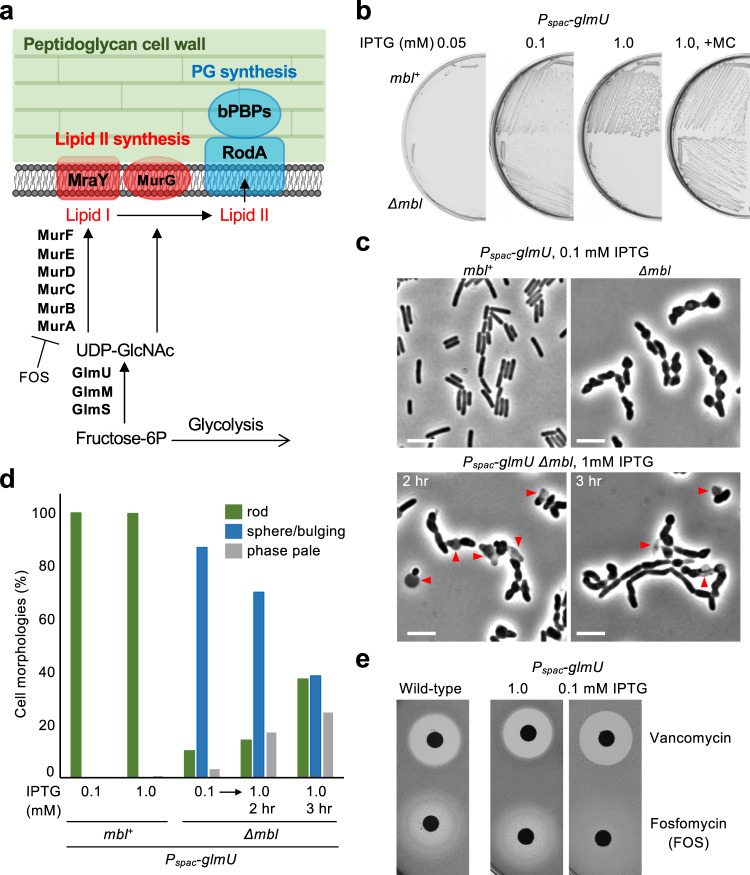
a Schematic representation of PG precursor synthesis in B. subtilis. b Growth rescue of an mbl mutant by reducing UDP-GlcNAc synthesis. B. subtilis strains YK1538 (Pspac-glmU) and YK2687 (Δmbl Pspac-glmU) were streaked on NA plates containing 0.1 or 1 mM IPTG, with or without 10 μg/ml MC, and incubated for 18 h at 37 °C. c Effects of glmU expression levels on cell morphology of an mbl mutant. Phase contrast micrographs of strains YK1538 (Pspac-glmU) and YK2687 (Δmbl Pspac-glmU) in liquid NB containing 0.1 mM IPTG (upper panels). In the culture of YK2687, IPTG was added to 1 mM, and phase contrast micrographs were captured after 2 and 3 h incubation (bottom panels). Scale bars represent 5 μm. d Cell morphologies shown in panel c were classified into three types (rod, sphere/bulging or phase pale). About 300 cells were examined for each condition. e Effects of glmU expression levels on fosfomycin sensitivity. Disc diffusion assay of B. subtilis strains (wild-type and Pspac-glmU) on NA plates with or without IPTG using paper discs with 6 μl of 1 mg/ml vancomycin or 50 mg/ml fosfomycin. The plates were incubated for 24 h at 37 °C. The figures are representative of at least three independent experiments.
Fig. 5
Fig. 5. Cellular respiration associates with mbl mutant lethality.
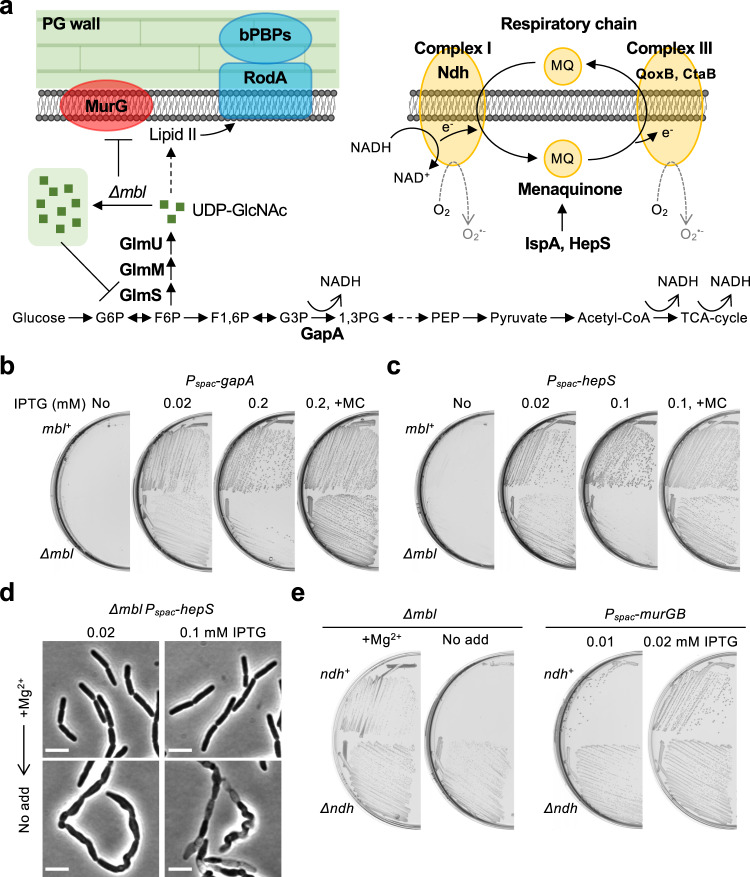
a Schematic representation of a link between PG precursor synthesis and central carbon metabolism in B. subtilis. b Effects of gapA expression levels on mbl mutant growth. YK1567 (Pspac-gapA) and YK2711 (Δmbl Pspac-gapA) were streaked on NA plates containing 0.02 or 0.2 mM IPTG, with or without 10 μg/ml MC, and incubated for 18 h at 37 °C. c Effects of menaquinone synthesis on mbl mutant growth. YK1450 (Pspac-hepS-menH-hepT) and YK2625 (Δmbl Pspac-hepS-menH-hepT) were streaked on NA plates containing 0.02 or 0.1 mM IPTG, with or without 10 μg/ml MC, and incubated for 18 h at 37 °C. d Effects of menaquenone synthesis on cell morphology of an mbl mutant. Phase contrast micrographs of a strain YK2625 (Δmbl Pspac-hepS-menH-hepT) in NB containing 10 mM Mg2+, with 0.02 mM or 0.1 mM IPTG (+Mg2+). The exponentially growing cells were diluted into fresh NB (no added Mg2+) with IPTG and incubated for 2–3 h (No add). Scale bars represent 5 μm. e Growth rescue of an mbl mutant and murGB repression by disrupting NADH dehydrogenase. YK2638 (Δmbl) and YK2646 (Δmbl Δndh) were streaked on NA plates with or without 10 mM Mg2+ and incubated for 18 h at 37 °C (left panels). YK1540 (Pspac-murG-murB) and YK2689 (Δndh Pspac-murG-murB) were streaked on NA plates with 0.01 or 0.02 mM IPTG and incubated for 18 h at 37 °C (right panels). The figures are representative of at least three independent experiments.
Fig. 6
Fig. 6. MC treatment counteracts ROS-mediated cell death.
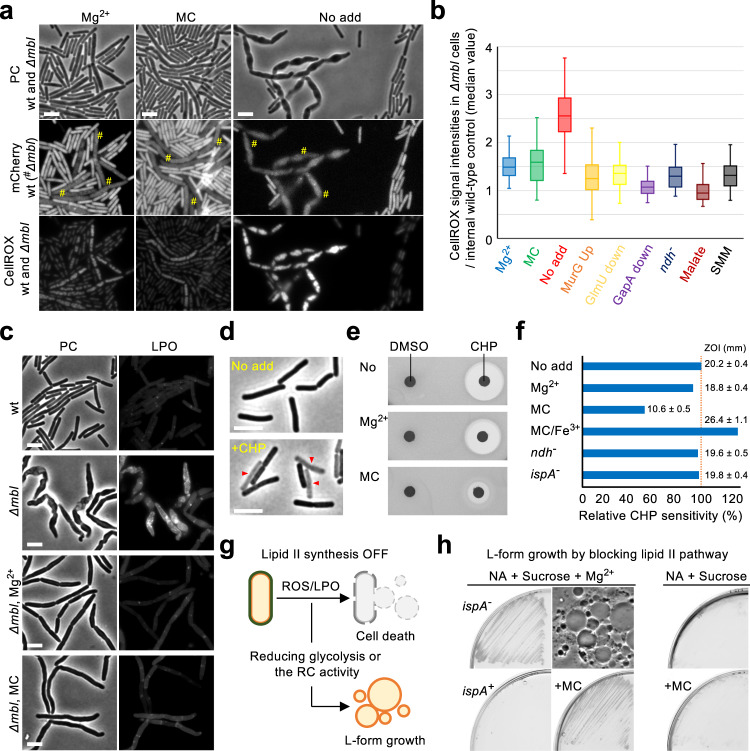
a ROS production in mbl mutant cells. YK2265 (wild-type expressing mCherry) and YK2638 (Δmbl) were cultured in NB with added 10 mM Mg2+ at 37 °C, followed by CellROX Green treatment. Phase contrast (PC) and the corresponding fluorescent images (mCherry and CellROX) of mixtures of the wild-type and Δmbl cells were captured (left panels). The cultures before CellROX treatment were diluted into fresh NB (no added Mg2+) with or without 10 μg/ml MC and incubated for 60 min, followed by CellROX reatment, before taking images. b YK2265 and mbl mutant strains (YK2638; Δmbl, YK2701; Δmbl amyE::Pxyl- murG, YK2687; Δmbl Pspac-glmU, YK2711; Δmbl Pspac-gapA, YK2646; Δmbl Δndh) were cultured in NB containing 10 mM Mg2+ with appropriate supplements. The cultures were diluted in fresh SMM, or NB (no added Mg2+) with or without 10 μg/ml MC, 0.5% xylose (for YK2701), 0.1 mM IPTG (for YK2687), 0.05 mM IPTG (for YK2711) or 0.2% malate, and incubated for 60–90 min, followed by CellROX treatment, before taking images. The relative signal intensity of green fluorescence in mbl mutant cells (n=100) over internal wild-type control (mean value, n=100) were represented by boxplots. Boxplots represent the upper and lower quartile values (boxes), median (horizontal lines in the boxes) and most extreme data points within 1.5 times interquartile ranges (whiskers). Source data are provided as a Source Data file. c Lipid peroxidation (LPO) in mbl mutant cells. Cultures of wild-type and mbl mutant cells in NB with 10 mM Mg2+ were diluted in fresh NB (no added Mg2+) with or without MC and incubated for 60 min, followed by C11-BODIPY581/591 treatment, before taking images. d Effects of CHP treatment on cell morphology. Phase contrast micrographs of wild-type (168CA) cells in liquid NB before or after treatment with 10 mM CHP. e Disc diffusion assay on NA plates with or without 10 mM Mg2+ or 10 μg/ml MC using paper discs with 6 μl of DMSO or 250 mM CHP. The plates were incubated for 24 h at 37 °C. f Zones of growth inhibition (ZOI) were measured from four independent disc diffusion assays. The means and SD were shown. Wild-type (168CA), YK1714 (Δndh) and YK1395 (ispA-) was cultured on NA plates with or without added Mg2+, 10 MC and 50 μM ferric chloride (Fe3+). g Schematic representation of L-form generation and ROS-mediated killing during inhibition of lipid II synthesis. h Effects of MC and Mg2+ on L-form growth. LR2 (ispA- Pxyl-murE) and BS115 (Pxyl-murE) strains were streaked on NA plates containing 0.5 M sucrose, with or without 20 mM MgSO4 (Mg2+) and/or 10 μg/ml MC, and incubated for 2–3 days at 30 °C. The phase contrast micrograph of L-form cells was obtained from the left plate adjacent to the micrograph. Scale bars represent 5 μm. The figures are representative of at least three independent experiments.
Fig. 7
Fig. 7. Critical role for metabolic perturbations and ion homeostasis in the mbl lethality.
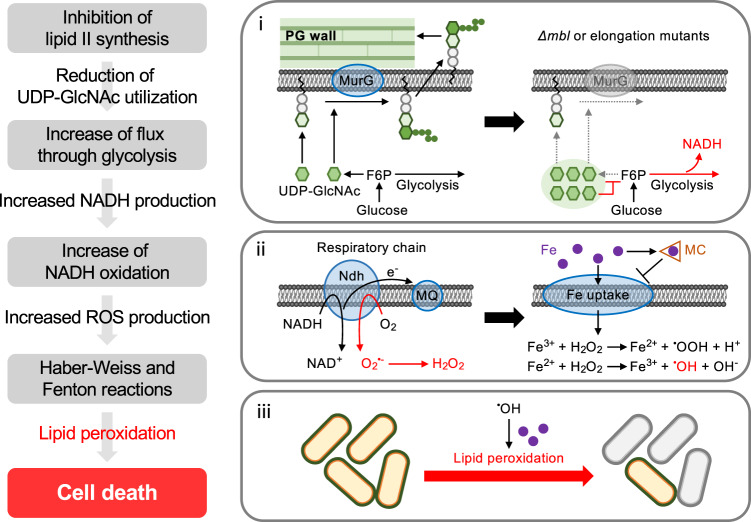
Schematic representation of key cellular functions that link metabolic perturbations in mbl mutants to bacterial cell death, and the critical connections between iron homeostasis and the killing activity. Disruption of an mbl gene or other elongation mutants infuences lipid II synthesis, plausibly by affecting the membrane localization or synthesis of MurG. This could cause the accumulation of UDP-GlcNAc, by preventing its utilization for lipid II synthesis (i). The increased intracellular concentration of UDP-GlcNAc is of critical importance in the downstream metabolic shifts. When the intracellular concentration of UDP-GlcNAc is high, GlmS activity is reduced, resulting in the rerouting of glucose metabolism towards glycolysis and increased NADH production (i). Oxidation of the excess NADH in the RC pathway increases ROS generation (ii), which drives the toxic effect of the mbl mutation in the presence of iron (iii). The sequestration of extracellular iron in the presence of MC could reduce the labile iron pool in the cytosol acts to catalyse the production of deleterious hydroxyl radical via the Fenton/Haber-Weiss reaction cycle under oxidative stress conditions, and thereby formation of hydroxyl radical through interaction with iron is prevented (ii). This, in turn, protects the mbl mutant cells from toxic oxidative damage.

References

    1. Höltje JV. Growth of the stress-bearing and shape-maintaining murein sacculus of Escherichia coli. Microbiol Mol. Biol. Rev. 1998;62:181–203. doi: 10.1128/MMBR.62.1.181-203.1998. - DOI - PMC - PubMed
    1. Egan AJF, Errington J, Vollmer W. Regulation of peptidoglycan synthesis and remodelling. Nat. Rev. Microbiol. 2020;18:446–460. doi: 10.1038/s41579-020-0366-3. - DOI - PubMed
    1. Meeske AJ, et al. SEDS proteins are a widespread family of bacterial cell wall polymerases. Nature. 2016;537:634–638. doi: 10.1038/nature19331. - DOI - PMC - PubMed
    1. Emami K, et al. RodA as the missing glycosyltransferase in Bacillus subtilis and antibiotic discovery for the peptidoglycan polymerase pathway. Nat. Microbiol. 2017;2:16253. doi: 10.1038/nmicrobiol.2016.253. - DOI - PMC - PubMed
    1. Sjodt M, et al. Structural coordination of polymerization and crosslinking by a SEDS-bPBP peptidoglycan synthase complex. Nat. Microbiol. 2020;5:813–820. doi: 10.1038/s41564-020-0687-z. - DOI - PMC - PubMed

Publication types