


Potential relevance between soybean nitrogen uptake and rhizosphere prokaryotic communities under waterlogging stress
- PMID: 37433864
- PMCID: PMC10336055
- DOI: 10.1038/s43705-023-00282-0
Potential relevance between soybean nitrogen uptake and rhizosphere prokaryotic communities under waterlogging stress
Abstract
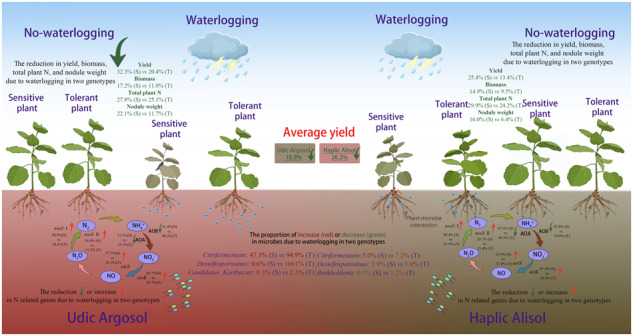
Waterlogging in soil can limit the availability of nitrogen to plants by promoting denitrification and reducing nitrogen fixation and nitrification. The root-associated microorganisms that determine nitrogen availability at the root-soil interface can be influenced by plant genotype and soil type, which potentially alters the nitrogen uptake capacity of plants in waterlogged soils. In a greenhouse experiment, two soybean genotypes with contrasting capacities to resist waterlogging stress were grown in Udic Argosol and Haplic Alisol soils with and without waterlogging, respectively. Using isotope labeling, high-throughput amplicon sequencing and qPCR, we show that waterlogging negatively affects soybean yield and nitrogen absorption from fertilizer, atmosphere, and soil. These effects were soil-dependent and more pronounced in the waterlogging-sensitive than tolerant genotype. The tolerant genotype harbored more ammonia oxidizers and less nitrous oxide reducers. Anaerobic, nitrogen-fixing, denitrifying and iron-reducing bacteria such as Geobacter/Geomonas, Sphingomonas, Candidatus Koribacter, and Desulfosporosinus were proportionally enriched in association with the tolerant genotype under waterlogging. These changes in the rhizosphere microbiome might ultimately help the plant to improve nitrogen uptake under waterlogged, anoxic conditions. This research contributes to a better understanding of the adaptability of soybean genotypes under waterlogging stress and might help to formulate fertilization strategies that improve nitrogen use efficiency of soybean. Schematic representation of the effects of waterlogging on nitrogen uptake and rhizosphere microbiota in dependence of soil type and soybean genotype.
© 2023. The Author(s).
Conflict of interest statement
The authors declare no competing interests.
Figures




References
-
- Kaur G, Singh G, Motavalli PP, Nelson KA, Orlowski JM, Golden BR. Impacts and management strategies for crop production in waterlogged or flooded soils: a review. Agron J. 2020;112:1475–501. doi: 10.1002/agj2.20093. - DOI
-
- Minchin FR, Summerfield RJ, Eaglesham ARJ, Stewart KA. Effects of short-term waterlogging on growth and yield of cowpea (Vigna unguiculata) J Agric Sci. 1978;90:355–66. doi: 10.1017/S0021859600055465. - DOI
-
- Christophe S, Jean-Christophe A, Annabelle L, Alain O, Marion P, Anne-Sophie V. Plant N fluxes and modulation by nitrogen, heat and water stresses: a review based on comparison of legumes and non legume plants. In: Shanker A, Venkateswarlu B, editors. Abiotic stress in plants–mechanisms and adaptations. Rijeka: Intech Open Access Publisher; 2011. p. 79–118.
-
- Oram NJ, Sun Y, Abalos D, van Groenigen JW, Hartley S, De Deyn GB. Plant traits of grass and legume species for flood resilience and N2O mitigation. Funct Ecol. 2021;35:2205–18. doi: 10.1111/1365-2435.13873. - DOI
